
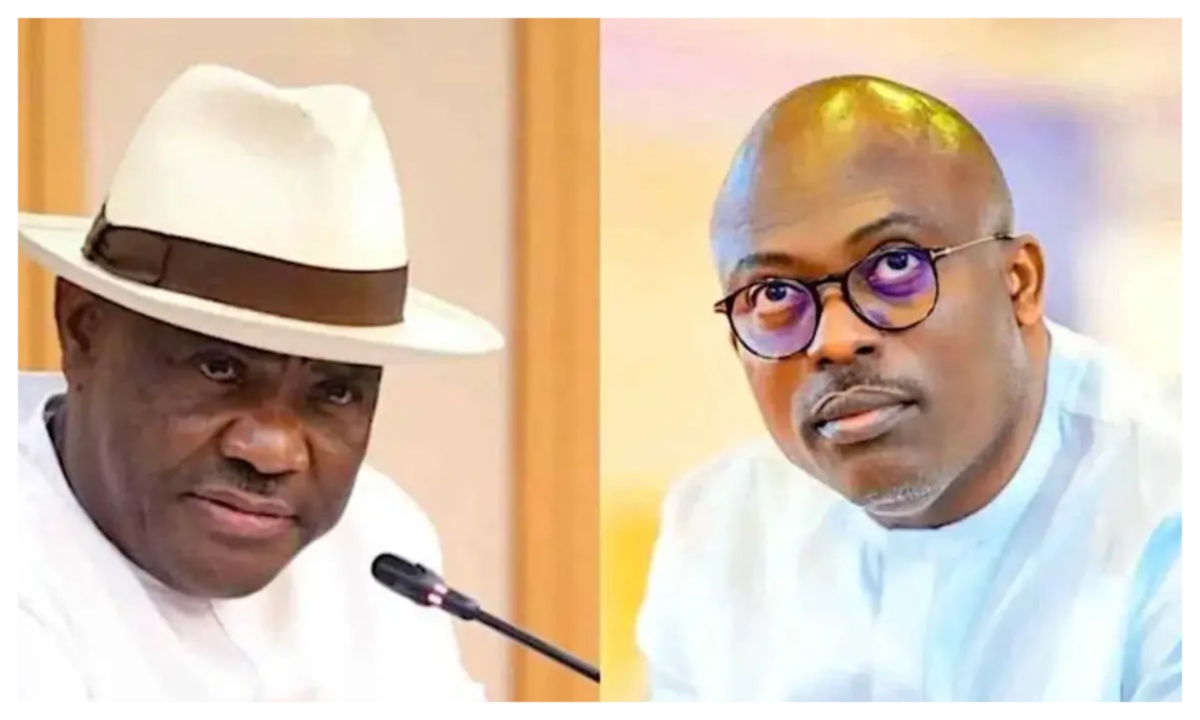
CONCERN GROWS IN RIVERS OVER GOVERNANCE AMID WIKE AND FUBARA DISPUTE
Read Time:2 Minute, 44 Second

By: Fasasi Hammad
Political watchers in Rivers State are raising alarms as the ongoing feud between Minister of the Federal Capital Territory (FCT), Chief Nyesom Wike, and his political protégé, Governor Siminalayi Fubara, continues to hamper governance in the state.
The tensions between the two escalated shortly after the 2023 governorship election and Fubara’s inauguration, with the governor falling out with his benefactor and immediate past governor, Wike.
While some observers describe Wike as domineering, others argue that Fubara’s refusal to remain loyal to the political structure that facilitated his rise constitutes a betrayal of trust, noting that loyalty is a key test of character in Nigerian politics.
“Politics is not charity. Power is not a gift from heaven without human instruments. In Nigerian politics, loyalty is political capital,” said Chief Chukwuma Ugbah, an APC chieftain in Delta State. “Every serious aspirant knows that the open backing of a sitting governor or dominant political leader is an enormous advantage.”
Although disagreements between predecessors and successors are not unusual, analysts say such conflicts should not escalate into public confrontations that disrupt governance.
Despite attempts at reconciliation, including intervention by President Bola Tinubu, the crisis has taken a new turn. Governor Fubara, who narrowly escaped impeachment after the president declared a state of emergency, was recently served another notice of impeachment by the Rivers State Assembly, with fingers pointed at Wike.
The initial impeachment attempt accused Fubara of bombarding the assembly complex, conducting local government elections in defiance of court orders, and presenting a budget to a three-member assembly while sidelining 27 elected members.
Observers warn that the ongoing battle between Wike and Fubara is creating instability in Rivers State, threatening public trust and governance ahead of the 2027 elections. Some analysts suggest that the struggle is tied to control over the state’s resources and political influence with the federal government.
Former presidential candidate Chief Peter Ameh criticized the feud as an “orchestrated tragedy,” arguing that ordinary citizens are the primary victims. “The genuine sufferers remain the people of Rivers State, whose peace, prosperity, and democratic rights are being exchanged for the personal survival of their leaders,” he said.
Local stakeholders also confirm that development in the state has stalled due to the power struggle. Barr. Chizi Enyi said that infrastructure projects have been significantly affected.
“No doubt about it. Development has been stagnated by Wike’s fight with the governor,” Enyi said. “He wields power and uses every strategy to win. Since the emergency rule ended, the assembly has refused to approve the budget, stalling projects and development.”
APC chieftain Eze Chukwuemeka Eze added that the crisis has negatively impacted governance and the state’s economy. He noted that major projects, such as the Ring-Road, were abandoned during the emergency period, investors were scared away, jobs were lost, and internally generated revenue suffered.
“Wike’s actions have disrupted governance, eroded democratic institutions, and diverted resources from critical development needs,” Eze said. “The state will grapple with the impact of this crisis for a long time. We pray the governor is empowered to navigate these challenges and restore stability.”
Meanwhile, reports indicate that President Bola Tinubu may have intervened to halt the assembly’s impeachment move, and some lawmakers have withdrawn from the process.


Happy
0 %

Sad
0 %

Excited
0 %

Sleepy
0 %

Angry
0 %

Surprise
0 %
 0
0
 0
0