
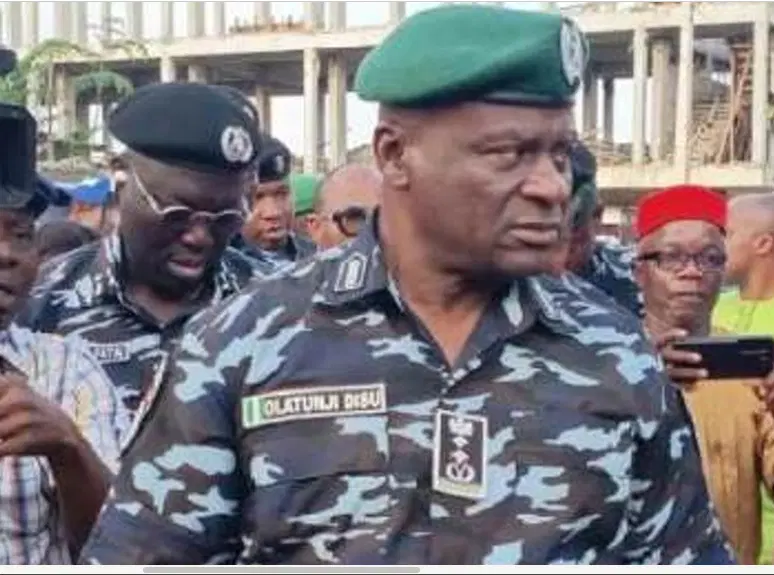
DISU INSPECTS 21 POLICE HOUSING PROJECTS, VOWS TO ADDRESS BARRACKS CRISIS
Read Time:4 Minute, 6 Second

By: Fasasi Hammad
For years, the deteriorating condition of police barracks across Nigeria has remained a symbol of the difficult living conditions faced by many police officers and their families.
Leaking roofs, cracked walls, overcrowding, poor sanitation and inadequate water supply have raised persistent concerns about police welfare and the ability of the Nigeria Police Force to maintain the morale of its personnel.
In Lagos, where several old barracks have been demolished or earmarked for reconstruction, affected officers have faced prolonged uncertainty over their accommodation.
Against this backdrop, the Inspector-General of Police, Olatunji Disu, recently inspected about 21 police housing projects across the state at various stages of development.
The inspection provided an opportunity for the police leadership to engage contractors and stakeholders while assessing the factors responsible for delays. At some sites, Disu expressed dissatisfaction with the pace of construction, stressing the importance of officer welfare to effective policing.
The inspection came months after several police barracks in Lagos were cleared to pave the way for reconstruction.
For affected officers, however, the demolition meant more than the loss of old buildings. Many families were forced to relocate, secure temporary accommodation and, in some cases, move farther away from their places of work.
Disu acknowledged the frustration surrounding the situation, noting that although he had spent about six months in office at the time, the accommodation challenge had existed for much longer.
He expressed optimism that some of the ongoing projects could become habitable by December or January, depending on the pace of construction.
Under a directive dated May 15, 2024, the first phase of the Lagos barracks redevelopment programme covered Falomo; Police Mounted Troops/Ribadu in Ikoyi; Alausa Police Barracks; Obafemi Awolowo Way, Ikeja; Federal Highway Patrol Barracks, Yaba; and Iponri Police Barracks in Surulere.
The Nigeria Police Force Property Development and Construction Company was directed to commence the reconstruction programme.
The directive also provided for compensation to verified occupants before demolition and required personnel who had received approved payments to vacate the affected premises.
However, the compensation process generated complaints from some officers. While the approved amount was reportedly N2 million in some cases, some personnel alleged that they received less than the stated figure, with one officer claiming to have been shortchanged by as much as N1 million.
Such allegations require proper verification, but they reflect the concerns surrounding a process that has already disrupted the lives of several police families.
For some officers, the current reconstruction programme has also revived memories of previous redevelopment schemes that failed to deliver the expected transformation.
Police properties and barracks in areas including Mobolaji Bank Anthony Way, Ikeja GRA, Zone 2, Onikan, Obalende and Ijeh have, at different times, been linked to relocation, redevelopment and property disputes.
There have also been claims concerning the proposed demolition of Alausa Police Barracks and resistance from individuals asserting ownership interests in the land.
Such claims, particularly those involving ownership or legal proceedings, require documentary and judicial verification before they can be regarded as established facts.
What remains evident, however, is that repeated changes in police leadership and redevelopment plans have left some personnel cautious about promises attached to new reconstruction programmes.
The accommodation crisis is not limited to Lagos. Police personnel in cities including Onitsha, Maiduguri, Ibadan, Calabar, Lokoja and Umuahia have also faced varying housing challenges.
Many police barracks date back to the colonial era or the early years after independence. Decades of inadequate maintenance, limited funding and administrative challenges have contributed to their deterioration.
The situation has resulted in three major housing concerns: dilapidated accommodation, insufficient housing and disputes involving police land and properties.
For officers unable to secure barracks accommodation, renting privately can create an additional financial burden, particularly for junior personnel whose salaries must also support their families.
Disu’s decision to personally inspect the reconstruction sites has brought renewed attention to a housing problem that has persisted for decades.
However, the success of the exercise will ultimately depend on whether contractors meet agreed deadlines, funds are transparently utilised and displaced officers are able to return to decent accommodation.
The IGP has also spoken about improving the use of the police mortgage scheme and partnering with relevant stakeholders to provide affordable housing, particularly for rank-and-file personnel.
The current reconstruction programme has therefore created a major expectation among affected officers: that the demolition of old barracks will result in better homes rather than another cycle of displacement and uncertainty.
While the inspection has signalled a more hands-on approach to police housing, the real test remains delivery.
If the December-January target is achieved at the relevant sites, displaced officers and their families will have tangible evidence that the reconstruction programme is moving beyond promises.
For officers who have watched their barracks demolished, secured temporary accommodation and waited months for new homes, the ultimate measure of progress will not be another inspection, but the delivery of a decent house.


Happy
0 %

Sad
0 %

Excited
0 %

Sleepy
0 %

Angry
0 %

Surprise
0 %
 0
0
 0
0