
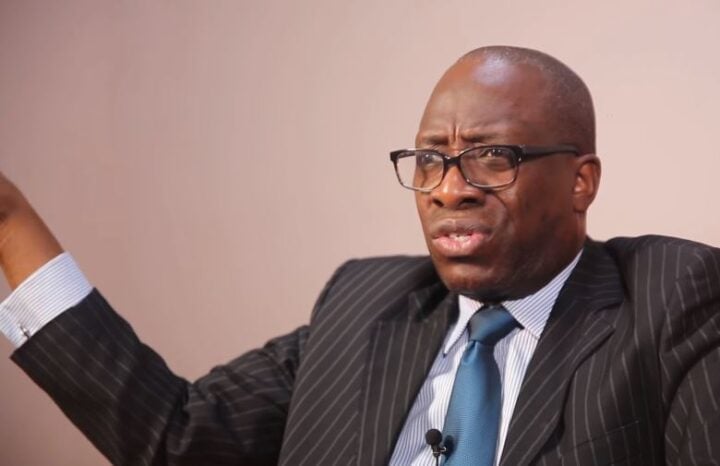
2027: SHOWUNMI SEEKS SANCTIONS FOR POLITICIANS THREATENING NATIONAL SECURITY
Read Time:3 Minute, 59 Second
By ‘Balogun Ibrahim
A chieftain of the Peoples Democratic Party in Ogun State and convener of The Alternative Movement, Segun Showunmi, has called on the National Security Adviser, Nuhu Ribadu, to take action against politicians whose actions threaten national security and unity.
Showunmi made the call in an open letter addressed to Ribadu in Abuja and made available to journalists on Monday, expressing concern over what he described as the growing toxicity of political conduct, irresponsible communication and increasingly dangerous behaviour among politicians, their supporters and influential individuals.
In the letter, titled “An Open Letter to the National Security Adviser: On the Urgent Need to Establish Firm Boundaries for Political Conduct and Hold Those Who Threaten National Security Accountable,” he urged the Office of the National Security Adviser to collaborate with relevant security and law enforcement agencies to tackle political actions capable of undermining public peace and national stability.
READ MORE…
EFCC CHALLENGES MEDICAL REPORT IN DEFENDANT’S FRESH BAIL APPLICATION
The letter was also copied to President Bola Tinubu; the Minister of Defence, General Christopher Gwabin Musa (retd.); the Special Adviser to the President on Homeland Security, Major General Adeyinka A. Famadewa (retd.); the Inspector-General of Police, Olatunji Rilwan Disu; the Director-General of the Department of State Services, Oluwatosin Ajayi; and the Minister of State for Defence, Bello Muhammad Matawalle.
Showunmi argued that Nigeria’s existing security challenges should not be worsened by political rivalry, personal ambition and partisan disagreements.
“The country is navigating a delicate security environment requiring vigilance, institutional coordination, intelligence gathering and responsible leadership.
“At such a time, it is difficult to understand why we should allow political competition, personal ambition and partisan disagreements to become additional threats to our national stability.
“There is a difference between robust political engagement and conduct that deliberately or recklessly threatens public peace. There is a difference between criticising government and deliberately inciting citizens against one another,” he said.
He also cautioned against what he described as the growing acceptance of provocative statements, ethnic and religious insinuations, threats, inflammatory public displays and the exploitation of sensitive national issues for political gains.
According to him, some politicians, their loyalists and influential supporters appeared to believe that their positions or connections shielded them from the consequences of their public statements and actions.
“That assumption must be firmly challenged,” he declared, adding that “National security cannot be held hostage to political ambition.”
As part of his recommendations, Showunmi urged Ribadu to establish and publicly communicate clear guidelines for political communication, particularly as the country approaches an increasingly competitive political period.
He maintained that politicians, political parties, spokespersons, campaign organisations and their supporters must understand that freedom of expression comes with corresponding responsibilities.
The PDP chieftain, who was recently appointed to the Communication and Strategy Committee of the All Progressives Congress Presidential Campaign Council, specifically urged political actors to avoid using public communication to promote violence, ethnic hostility, religious antagonism, intimidation or threats to national peace.
Showunmi also called on political parties and their leadership structures to take greater responsibility for the conduct of individuals operating under their platforms or acting on their behalf.
He argued that parties should not enjoy the benefits of democratic participation while distancing themselves from the irresponsible actions of their supporters, spokespersons and other affiliated individuals.
He further insisted that credible evidence of criminal offences should lead to decisive lawful action, regardless of the status of those involved.
“Going forward, decisive lawful action must follow credible evidence of offences, irrespective of how highly placed the individual involved may be.
“No political position, personal relationship, financial influence or proximity to government should provide protection against legitimate investigation and prosecution,” he said.
According to Showunmi, safeguarding national security should not be regarded as the sole responsibility of soldiers, police officers, intelligence operatives and other security personnel.
He argued that political actors also had a duty to protect the conditions necessary for democratic governance and national stability.
“We cannot continue to behave as though national security is the exclusive responsibility of soldiers, policemen, intelligence officers and other security operatives. Political actors also have a responsibility to preserve the environment in which democracy can function. Their words matter. Their conduct matters. Their influence carries consequences,” he wrote.
However, Showunmi clarified that his demand for responsibility and accountability was not an attempt to silence opposition, restrict legitimate criticism or criminalise political disagreements.
He acknowledged that dissent, protests, criticism and competing political positions remained essential components of democratic governance.
The Egba-born politician therefore urged the government and security agencies to distinguish legitimate political expression from actions that amount to criminal offences.
He also warned public institutions against amplifying unverified allegations, while calling for deliberately fabricated information intended to incite violence to be investigated in accordance with the law.


Happy
0 %

Sad
0 %

Excited
0 %

Sleepy
0 %

Angry
0 %

Surprise
0 %
 0
 0