
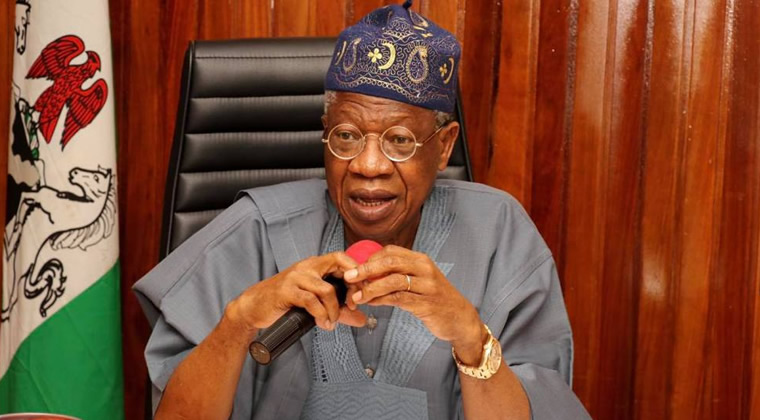
LAI MOHAMMEED CALLS #ENDSARS HIS TOUGHEST MOMENT AS MINISTER
Read Time:3 Minute, 38 Second
The #EndSARS protests in 2020, as shared by former Minister of Information and Culture, Lai Mohammed, were the hardest time he faced while working in public office.
In his new book, Headlines and Sound Bites: Media Moments That Defined an Administration, Mohammed talked about the protests and called the time a period filled with false news and misleading information, which he believed was a serious threat to Nigeria.
“While the suspension of Twitter was one of the toughest decisions I took while in office, the #EndSARS saga was undoubtedly the most difficult moment of my tenure as minister.
“It confirmed my worst fears about fake news and disinformation as a clear and present danger to our country. It posed a direct threat to the administration of President Muhammadu Buhari and, sadly, it dragged my family into an unwarranted crisis for no fault of theirs,” he said.
Mohammed remembered the big protests that happened across the country after a video went viral showing what people claimed was police violence in Delta State. He said, “The way the #EndSARS protest started showed how dangerous fake news, hate speech, and false information can be. When these bad things spread quickly, they can really hurt democracy.“
The protests started on October 3, 2020, and grew really fast. The Federal Government acted quickly in response.
On October 11, the top police officer said the Special Anti-Robbery Squad was being broken up.
Former President Muhammadu Buhari also told the public that there would be big changes in the police force to make sure their main job is to protect people‘s lives and their way of living.
Despite these actions, violence erupted in several states.
According to Mohammed, security forces faced unprecedented attacks.
“The security agencies were specifically targeted. Police personnel were hacked down in the most gruesome manner that called into question the sanity of their killers. The toll was devastating: six soldiers and 37 policemen were killed all over the country during the crisis.
“Also, 196 policemen were injured; 164 police vehicles were destroyed, and 134 police stations were burnt down. In addition, the violence left 57 civilians dead across the country, 269 private and corporate facilities burnt, looted or vandalised, 243 government facilities burnt or vandalised, and 81 government warehouses looted,” he wrote.
The situation escalated in Lagos State, leading Governor Babajide Sanwo-Olu to impose a 24-hour curfew on October 20, 2020.
Soldiers deployed to the Lekki Toll Gate reportedly fired blank bullets to disperse protesters, Mohammed said.
However, the following day, media reports began to spread claims that a massacre had occurred.
“The Federal Government almost fell for the disinformation. I had gone to see the Chief of Staff on the need for Council to observe a minute’s silence for those who were reportedly killed at the Lekki Toll Gate.
“It was when Mr President called the Governor of Lagos to commiserate with him that he learnt from the governor that no such massacre had taken place,” he added.
Mohammed described the subsequent media coverage as reckless and damaging.
He said, “Undoubtedly, the most disgraceful and irresponsible reporting of the events of October 20, 2020, was carried out by CNN.
“Its one-sided reporting breached the most basic principles of journalism — balance and fairness. How could CNN claim to do an ‘investigative report’ without speaking to any Nigerian government official?”
He also detailed the personal toll of the disinformation campaign.
“My family came under fire, almost literally. They bore the brunt. They were vilified online, their businesses boycotted and my son labelled ‘the child of a murderer.’
“My home address was circulated online, forcing me to seek security protection for my family and their businesses,” the former minister stated.
Mohammed emphasised that history should be grounded in evidence, not hysteria.
“A massacre leaves behind corpses, grieving families and undeniable evidence. None of these exist in the case of the so-called Lekki massacre.
“What we witnessed was the triumph of disinformation over truth. And as long as no families have stepped forward and no bodies have been produced, the truth remains unshaken: there can be no massacre without bodies,” he wrote.
Mohammed served as Minister of Information and Culture for the entirety of late President Major General Muhammadu Buhari’s (retd.) two terms, giving him a perspective on the administration’s decisions, challenges and legacy.


Happy
0 %

Sad
0 %

Excited
0 %

Sleepy
0 %

Angry
0 %

Surprise
0 %
 0
0
 0
0