
STAY EXTENSION DUE TO TRAVEL RESTRICTIONS – DEPARTMENT OF CULTURE AND TOURISM – ABU DHABI
Read Time:2 Minute, 19 Second
By: Fasasi Hammad
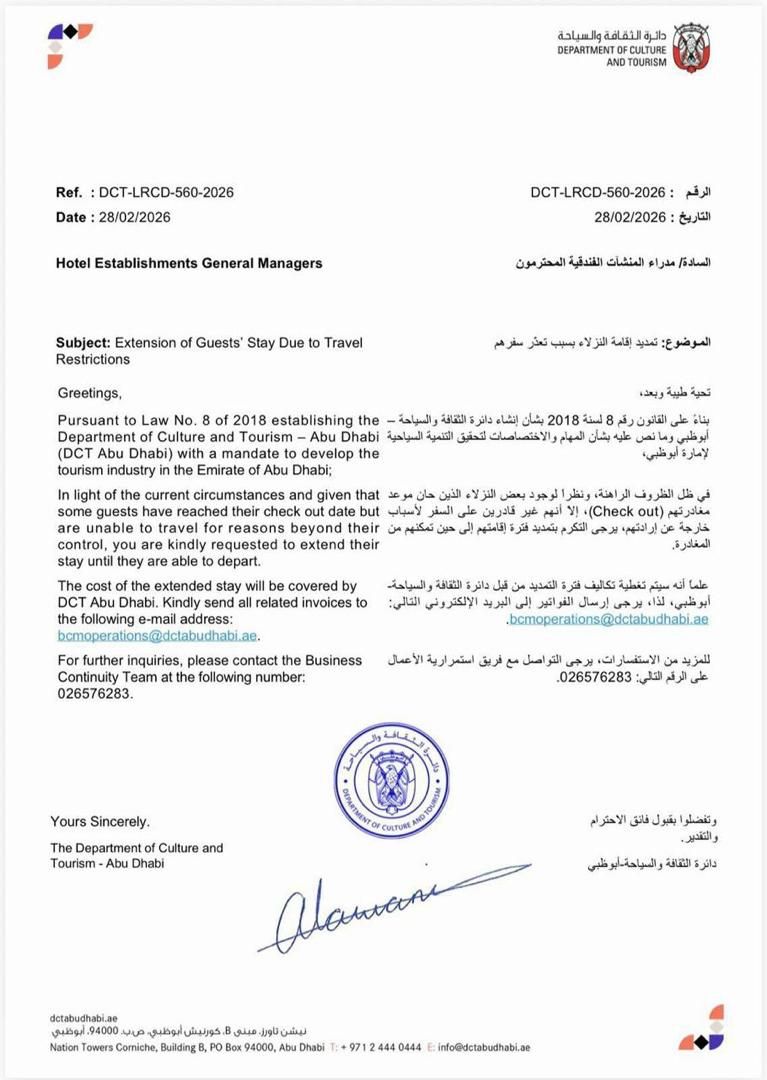
The letter dated 28 February 2026 bears the official seal and authority of the Department of Culture and Tourism – Abu Dhabi, the government authority tasked with overseeing tourism development in Abu Dhabi. On the surface, it reads like a standard administrative notice addressed to hotel general managers. Yet beneath its formal language lies a clear narrative of crisis response, coordination, and accountability toward stranded travelers.
The reference number (DCT-LRCD-560-2026) and its bilingual presentation immediately establish it as a formal directive requiring serious attention. Issued in late February 2026, the timing points to an unforeseen development—most likely sudden travel restrictions that disrupted visitors’ departure plans across the emirate.
The subject line, “Extension of Guests’ Stay Due to Travel Restrictions,” clearly frames the situation. It explains that certain hotel guests were unable to depart as scheduled, despite having reached their check-out dates. By acknowledging that the delay was beyond the guests’ control, the letter removes any implication of fault and emphasizes fairness and compassion in the official response.
The document cites Law No. 8 of 2018, the legislation that established the Department and defined its mandate to regulate and develop the tourism sector. Referencing this law reinforces that the instruction is grounded in legal authority, not merely a recommendation, but a directive supported by governance.
Central to the letter is the request that hotel managers extend the stays of affected guests until they are able to travel. Although phrased courteously, the request carries urgency. Hotels are required to adjust operations—room allocations, housekeeping schedules, and planning—often at short notice, to accommodate stranded visitors.
Importantly, the letter ensures that neither guests nor hotels bear the financial cost. It clearly states that the Department will cover expenses related to the extended stays. This measure protects the tourism sector’s reputation, prevents potential disputes at hotel reception desks, and guarantees that visitors are treated with dignity during an uncertain period. The inclusion of a designated email address for invoice submission further demonstrates a structured and accountable reimbursement process.
The mention of a Business Continuity Team and its contact number indicates that the situation warranted coordinated emergency planning. This suggests collaboration across multiple entities, possibly including airlines, immigration authorities, and public safety agencies, to manage the disruption effectively.
Finally, the official stamp and signature validate the document’s authenticity and accountability. The dual-language format—Arabic and English—ensures accessibility for both local officials and international hospitality operators.
In essence, this letter represents more than administrative communication. It reflects responsive governance in action—an authority stepping forward to manage disruption, safeguard visitors, support hotels, and preserve confidence in the emirate’s tourism framework. What appears routine at first glance is, in reality, a structured and compassionate response to an unexpected challenge.


Happy
0 %

Sad
0 %

Excited
0 %

Sleepy
0 %

Angry
0 %

Surprise
0 %
 0
0
 0
0