
DEBT WORSE THAN LEPROSY, DESTROYS GENERATIONS — OBASANJO TELLS TINUBU
Read Time:2 Minute, 39 Second
By ‘Sefiu Ajape
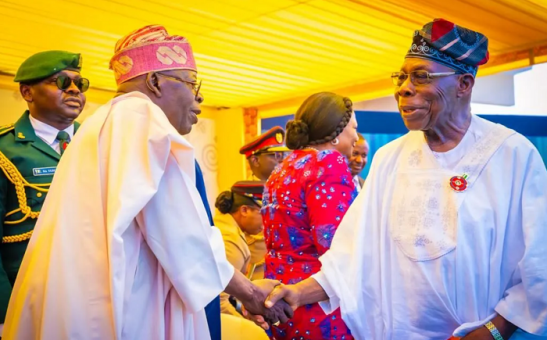
Former President Olusegun Obasanjo has criticised President Bola Tinubu’s position on borrowing, declaring that debt is worse than leprosy because of its long-term consequences for generations.
Obasanjo spoke at a symposium in Abeokuta, Ogun State, focused on how Artificial Intelligence could be leveraged to address grassroots challenges and accelerate national development.
Tinubu had said in April that borrowing should not be viewed negatively, arguing that the government would take loans when necessary, provided it had the capacity to repay them.
However, Obasanjo disagreed with the position, describing it as absolute nonsense.
The former president also questioned Nigeria’s economic performance over the decades, recalling that when he established his farm 47 years ago, the naira exchanged at ₦1 to $1.85.
He challenged the country’s leadership to explain the depreciation of the naira to about ₦1,500 to the dollar, asking what Nigeria had achieved over the period.
Meanwhile, the guest speaker at the symposium, historian and public policy scholar, Umar Ardo, warned that artificial intelligence could deepen Africa’s dependence on foreign powers if the continent failed to control its technology and digital infrastructure.
Ardo said that without investments in chip fabrication, data centres, African-owned datasets and continental cooperation, artificial intelligence could become another tool for managing Africa rather than empowering the continent to determine its own future.
Obasanjo’s criticism comes amid renewed defence of the Federal Government’s borrowing plans by Tinubu, who on Thursday argued that Nigeria needed long-term investments in infrastructure to achieve its ambition of becoming a $1 trillion economy by 2030.
In a statement titled “From Reforms to Delivery: Our Infrastructure Investment and Growth Strategy,” the President said the proposed loans would fund road construction, improve electricity supply, upgrade ports, and support other projects expected to create jobs, grow businesses, and provide opportunities for future generations.
He maintained that attention should be focused on the outcomes of borrowing rather than the amount being borrowed.
“The key question is not how much we borrow, but what we build, the value we create, and the future we leave behind,” he said.
Tinubu listed the Lagos-Calabar Coastal Highway, Sokoto-Badagry Superhighway, Trans-Sahara Superhighway, electricity grid improvements and upgrades to major commercial ports in Lagos among the projects his administration plans to fund.
According to him, the projects, alongside investments in healthcare, education, and vocational training, would connect economic regions, reduce the cost of transporting goods, support agriculture and industries, and attract private investors.
The President projected that the Lagos-Calabar Coastal Highway alone could reduce transport costs along its route by 15 to 20 percent and contribute up to two percent to Nigeria’s Gross Domestic Product through increased trade, tourism, and industrial activities.
He also estimated that the highway would generate about 100,000 direct jobs in construction and engineering, as well as more than 150,000 indirect jobs in logistics, building materials, and related services.
The statement came as the Nigeria Labour Congress questioned the Federal Government’s request to the National Assembly for approval to borrow $20.5bn and €1.45bn, despite claims that government revenue had increased following the removal of the petrol subsidy.


Happy
0 %

Sad
0 %

Excited
0 %

Sleepy
0 %

Angry
0 %

Surprise
0 %
 0
 0