NEARLY 1,000 ARRESTED AS COST-OF-LIVING PROTESTS TURN VIOLENT IN FRANCE
Read Time:3 Minute, 11 Second
Agency Report
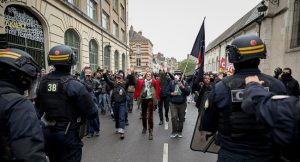
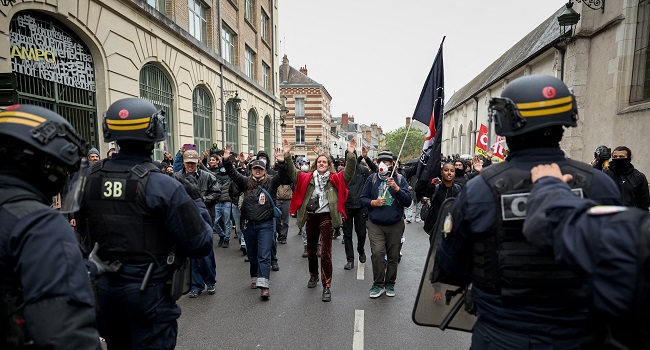
Nearly 1,000 people have been arrested across France following clashes between police and protesters during demonstrations against the rising cost of living, as President Emmanuel Macron’s government intensifies efforts to restore public order.
French Interior Minister Laurent Nunez said on Saturday that officers faced an “extremely elevated level of violence” from black-clad groups described by authorities as “ultra-left” extremists.
Riot police fired tear gas at demonstrators in Paris, Marseille, Lyon, Bordeaux, Lille, Toulouse, Montpellier and Nantes, while authorities deployed 70,000 security personnel nationwide to manage the protests.
Nunez said two people were seriously injured during the unrest, including a man in Toulouse who reportedly had several fingers blown off. The second injured person was in Clermont-Ferrand, although the minister did not provide further details.
The demonstrations came a week after violent unrest that saw public buildings vandalised, hundreds of shops looted and 2,700 people arrested.
Nunez described Saturday’s outcome as more positive than the previous week’s, saying increased police presence, earlier interventions, pre-demonstration checks and improved protection for businesses had helped contain the violence.
However, the government’s response has drawn criticism from protesters who consider the restrictions an attack on the right to demonstrate.
Estimates of Saturday’s turnout ranged from 410,000 to 800,000 nationwide, according to figures from the authorities and the organising General Confederation of Labour union, known as the CGT.
In Paris, the main march attracted between 110,000 and 250,000 people, according to the respective estimates.
The government had directed police to prevent protesters from reaching city centres, where businesses are concentrated. Partial curfews were also imposed in certain urban areas, while Macron ordered non-union demonstrations to be banned as “illegitimate”.
The main Paris march passed largely peacefully after authorities redirected it to the capital’s southeastern outskirts shortly before it began.
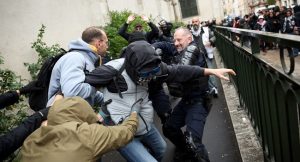
However, clashes erupted as demonstrators dispersed. Nunez said the confrontations lasted about two hours and involved approximately 500 rioters at the rear of the march.
Agence France-Presse journalists reported seeing police charge protesters several times and use tear gas and batons against some demonstrators.
One protester, identified only as David, who was bleeding from a baton injury to his face, accused officers of indiscriminate violence.
In Nantes, thousands of demonstrators reportedly broke through police lines, despite tear gas and water cannon being deployed, to reach the city centre.
In Lyon, police used tear gas to disperse about 1,000 people gathered in the southern part of the city.
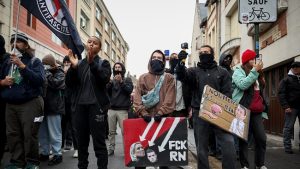
The unrest also coincided with an unusual confrontation involving far-right activists in Cannes and Montpellier, where groups reportedly took to the streets seeking clashes with ultra-left militants.
Meanwhile, the Yellow Vests movement, which organised disruptive protests against Macron eight years ago, called for further demonstrations on October 31 under the slogan of defending the freedom to protest.
Far-left presidential candidate Jean-Luc Melenchon, who participated in the Paris march, predicted that the demonstrations would continue weekly.
Political tensions were further heightened by a rally in Orleans organised by Marine Le Pen’s National Rally party to launch her presidential campaign.
Thousands of counter-protesters marched through the city chanting anti-fascist slogans. Police estimated their number at 13,000, while organisers claimed the turnout was twice as high.
The unrest has underscored France’s tense political climate ahead of the presidential election, with Le Pen leading in opinion polls, according to the report.
The protests have been driven largely by concerns over the rising cost of living, particularly fuel prices, which have surged since the Middle East war began in February.
Similar demonstrations have taken place in Italy, Belgium, Spain and Portugal over various issues, including inflation and education. Italy has also deployed 500 troops to Milan following street violence there.
AFP


Happy
0 %

Sad
0 %

Excited
0 %

Sleepy
0 %

Angry
0 %

Surprise
0 %
 0
 0