
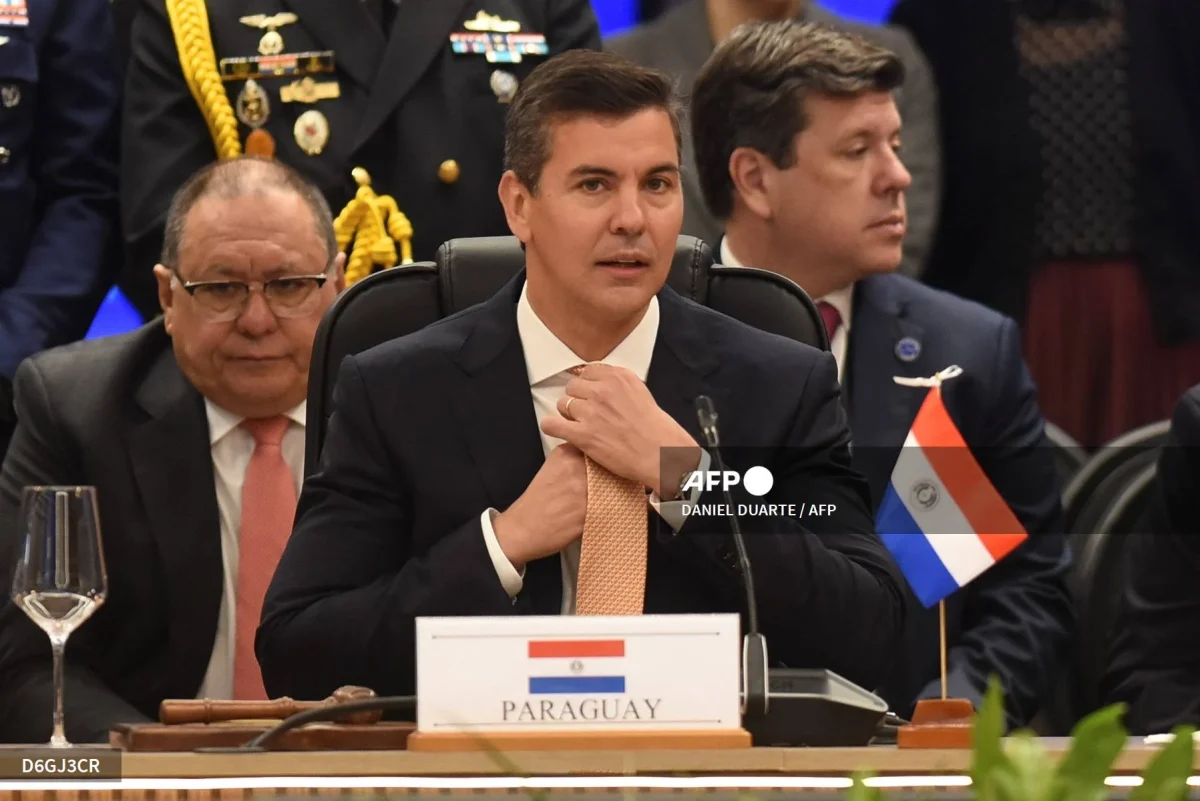
PARAGUAY SENATORS IMPEACH PRESIDENT PENA OVER MAJOR BANKING CRISIS
Read Time:3 Minute, 39 Second
Agency Report
Pedro Alliana has assumed office as Paraguay’s president following the impeachment of his predecessor, Santiago Pena, over a major banking crisis that left nearly half the country’s population unable to access their bank accounts.
Alliana, who previously served as vice president, was appointed by senators shortly after they voted to remove Pena over the collapse of Ueno Bank, a financial institution linked to the former president.
Senate President Basilio Nunez announced Pena’s removal after 44 of the 45 senators voted in favour of impeachment, with one lawmaker absent. He was found guilty of poor performance in the discharge of his duties.
Hundreds of protesters gathered outside the National Congress and celebrated the decision, demanding justice and the recovery of their lost savings.
“Justice has been done. Now we want him to give us back our money and go to jail,” a 32-year-old protester, Jessica Aquino, told AFP.
Following his removal, Paraguayan authorities placed Pena under house arrest, according to prosecutor Silvia Margarita Gonzalez Vester.
In his first remarks as president, Alliana pledged to protect the interests of nearly three million depositors, including pensioners, affected by Ueno Bank’s takeover amid concerns over its insolvency.
He assured citizens that those affected by the financial crisis would receive full compensation, adding that he would remain in office until 2028.
Meanwhile, an impeachment motion filed against Alliana by opposition lawmakers over the crisis failed to secure congressional approval.
Funds recovery begins
The collapse of Ueno Bank triggered widespread protests across Paraguay, with thousands of customers demanding the return of their savings and accountability from Pena.
The bank’s failure also attracted scrutiny because the former president reportedly held a stake in Grupo Vazquez, the conglomerate that controlled Ueno, until last year.
The Central Bank began advance payments to some affected depositors on Thursday afternoon, according to an official who spoke to AFP.
Jose Maciel of the Central Bank’s Deposit Guarantee Fund said the first phase of payments, covering amounts of up to approximately $1,600, would target customers without outstanding loans who have accounts with other banks or financial institutions in Paraguay.
He added that other beneficiaries would be announced gradually as the payment process continued.
Although Pena had offered to resign over the crisis, lawmakers proceeded with impeachment, stripping him of his political immunity.
Opposition lawmakers accused him of a conflict of interest, an allegation he denied.
The Attorney General’s Office said it was investigating his alleged involvement in the supervision and resolution of Ueno Bank, as well as the placement of public funds in the institution.
Pena is expected to face questioning over alleged breach of trust, influence peddling and misappropriation of funds, prosecutor Gonzalez Vester said.
Shortly before his removal, Pena called for national unity in a post on X, urging Paraguayans to work together to rebuild public institutions and restore confidence.
The United States Embassy in Paraguay also expressed solidarity with the country’s citizens on Friday but made no direct reference to the former president.
Protests spread across the country
The banking crisis sparked several days of demonstrations in Asuncion, the capital, and other cities, with protesters demanding accountability and the return of their deposits.
Thousands took to the streets for a third consecutive night on Thursday, while security operatives dispersed some demonstrations using tear gas and water cannons.
One protester, Cynthia Farina, told AFP that the crisis had affected numerous families and businesses, including her son, who had savings deposited with Ueno Bank.
Ueno initially operated as a small digital-focused financial technology company before expanding rapidly into a major banking institution serving low-income customers, handling state pensions and managing accounts belonging to several government agencies.
The scandal has also led to the removal of Central Bank President Carlos Carvallo and Interior Minister Enrique Riera, while eight executives of Ueno Bank have been arrested.
Police also carried out raids at several locations linked to Grupo Vazquez on Wednesday and Thursday.
The crisis extended beyond Paraguay, affecting neighbouring Argentina, where about 1,000 employees of ITTI, a technology company affiliated with Grupo Vazquez, were suspended for 30 days without pay.
The country’s football sector was also affected, as Ueno Bank sponsors several first-division clubs and the national team.
In a statement posted on X, members of Paraguay’s national team said they had also been victims of the situation.


Happy
0 %

Sad
0 %

Excited
0 %

Sleepy
0 %

Angry
0 %

Surprise
0 %
 0
 0