
SENEGAL DENIES CONTACT WITH CAS OVER 2025 AFCON TITLE RULING
Read Time:1 Minute, 46 Second
By ‘Sefiu Ajape
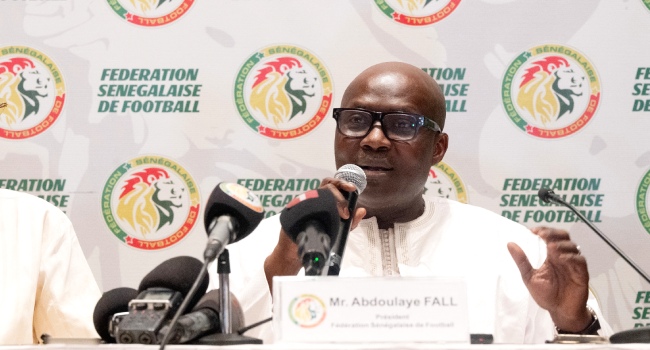
Senegalese Football Federation (FSF) president Abdoulaye Fall has denied allegations by Morocco that he had “contact” with a Court of Arbitration for Sport (CAS) arbitrator who ruled in favour of Senegal in the dispute over the 2025 Africa Cup of Nations title.
The Moroccan Football Federation (FRMF) had alleged following Tuesday’s ruling that Fall held “contact” with German arbitrator Ulrich Haas, one of the three members of the CAS panel, 48 hours before the tribunal “unanimously” declared Senegal the rightful champions.
Fall dismissed the allegation, insisting he had no communication with any member of the arbitration body.
“That is absolutely false. I have never had any exchange with any member of CAS,” he said in an interview with private television channel TFM.
“It surprised and astonished me that such accusations could even be made. I have never been in contact with anyone in connection with this procedure.”
Senegal initially won the controversial final 1-0 after extra time in January. However, the Confederation of African Football (CAF) overturned the result two months later, awarding Morocco a 3-0 victory and the title.
The decision followed a protest by several Senegalese players, who left the pitch after the referee awarded the hosts a penalty while the match was still goalless. The players later returned, allowing the final to continue.
CAF’s Appeals Committee had based its decision on Articles 82 and 84 of the AFCON Regulations, which provide that a team that “refuses to play or leaves the ground before the regular end of the match without the authorisation of the referee, it shall be considered (loser) and shall be eliminated for good from the current competition”.
However, the CAS panel found that the referee’s decision to restart the match indicated that “the conditions for resuming the match had been met,” making Articles 82 and 84 “not applicable in this case.”
Following its ruling in Senegal’s favour, the Moroccan federation can still challenge the decision before the Swiss Federal Supreme Court. However, the court does not review the merits of the dispute and is limited to examining procedural matters.


Happy
0 %

Sad
0 %

Excited
0 %

Sleepy
0 %

Angry
0 %

Surprise
0 %
 0
 0