
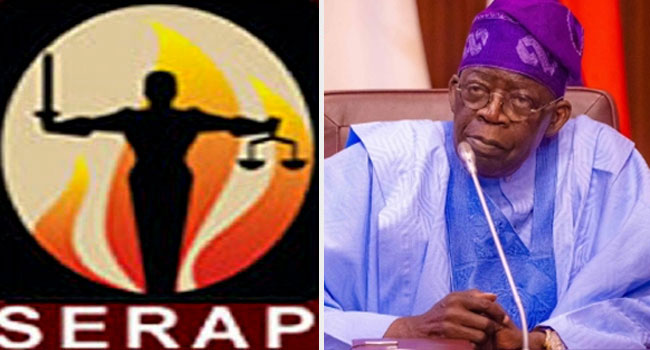
SERAP SUES FG OVER ALLEGED N78.8BN CASH-TRANSFER FUND IRREGULARITIES
Read Time:4 Minute, 22 Second
By Aishat Momoh. O.

The Socio-Economic Rights and Accountability Project (SERAP) has sued the Federal Government before the ECOWAS Community Court of Justice over alleged diversion, irregular expenditure and failure to account for ₦78.8bn allocated to cash-transfer and social-protection programmes.
SERAP disclosed this in a statement on Sunday by its Deputy Director, Kolawole Oluwadare, saying the allegations involved the Ministry of Humanitarian Affairs and Poverty Reduction, the National Cash Transfer Office and the National Social Safety Nets Coordinating Office.
The allegations were contained in the Auditor-General of the Federation’s 2024 Annual Report, published on August 7, 2026, covering findings from various periods between January 2023 and December 31, 2024.
In the suit, marked ECW/CCJ/APP/42/26 and filed last week, the organisation is seeking a declaration that the government’s alleged failure to account for the funds violates Nigeria’s international human rights obligations.
It is also asking the court to order a comprehensive account of the questioned funds, an investigation into the alleged irregularities, the recovery of any money found to have been improperly spent or diverted, and stronger financial oversight of social-protection programmes.
SERAP argued that the alleged irregularities could undermine vulnerable Nigerians’ rights to social security and an adequate standard of living, including access to food, clothing and housing.
“The funds were intended to benefit over 3.2 million households across 35 states, whose access to financial assistance has been affected by the allegations made by the Auditor-General,” the statement said.
The suit, filed by SERAP’s lawyers, Kolawole Oluwadare and Kehinde Oyewumi, argued that the government’s failure to investigate the findings and recover any improperly spent funds breached its obligations to protect vulnerable households.
“The failure to investigate the N78.8 billion cash-transfer scandal, account for the questioned funds and recover any unlawfully spent amounts violates Nigeria’s obligations to protect the human rights of vulnerable households,” the suit stated.
According to SERAP, the Auditor-General questioned approximately ₦33.751bn reportedly transferred to more than 3.2 million households across 35 states in 2023, noting that adequate records to verify the payments and reconcile beneficiary details were not provided.
The report also identified ₦36.744bn in payments allegedly made without prepayment audits, ₦4.616bn in unsupported expenditures, ₦350.182m for enrolment, ₦89.511m for store purchases and ₦17.422m in diesel advances.
SERAP said the case was instituted under Article 9(4) of the ECOWAS Court Protocol to protect affected households and promote accountability for public funds allocated to social protection.
It maintained that cash-transfer programmes could help tackle extreme poverty and enable vulnerable people to meet their basic needs, but stressed that the government had a responsibility to ensure the funds were properly managed.
“The right to social security cannot be effectively realised merely by establishing a formal cash-transfer programme where the State fails to maintain reasonable systems for identifying beneficiaries, maintaining records, reconciling disbursements, monitoring expenditure, investigating irregularities and remedying losses,” the statement added.
The organisation also relied on Articles 1 and 2 of the African Charter on Human and Peoples’ Rights, arguing that Nigeria must take effective measures to protect human rights and prevent failures in social-protection programmes from resulting in discriminatory exclusion or unequal access to benefits.
It further cited Article 21 of the African Charter and Article 9 of the United Nations Convention against Corruption in support of its arguments on protecting public resources, transparent financial management, investigating irregularities and recovering funds where losses or improper expenditure are established.
SERAP also referred to the constitutional responsibilities of the Auditor-General to audit and report on the public accounts of the Federation and federal government agencies, describing the audit findings as important official records of public expenditure.
The organisation said it had previously written to President Bola Tinubu and relevant authorities, requesting that the questioned funds be accounted for, audit records published, irregular expenditures investigated and any unlawfully spent or diverted money recovered.
Following the publication of the Auditor-General’s report, SERAP said it issued a public statement and sent a letter dated September 5, 2026, requesting action on the findings. It also sought payment and beneficiary records, verification documents and explanations for missing REMITA records.
“The deadline given to the government to address the Auditor-General’s findings had elapsed without adequate action,” the organisation said.
SERAP further cited legal scholarship on corruption and human rights, including works by Kolawole Olaniyan, arguing that corruption and the misuse of public resources could undermine protected rights and the effective delivery of public services.
The organisation is asking the court to order an independent, prompt and effective investigation into the identified irregularities, with appropriate legal or administrative action against anyone found responsible, in accordance with due process.
It also wants the government to strengthen beneficiary verification, auditing, financial reconciliation and oversight mechanisms to prevent a recurrence and ensure eligible households receive their intended benefits.
Additionally, SERAP is seeking an order restraining the government from administering or disbursing cash-transfer and social-protection funds without adequate accountability and oversight mechanisms, as well as appropriate remedies for any established adverse effects on beneficiaries’ rights.
No date has been fixed for the hearing of the suit.


Happy
0 %

Sad
0 %

Excited
0 %

Sleepy
0 %

Angry
0 %

Surprise
0 %
 0
 0