
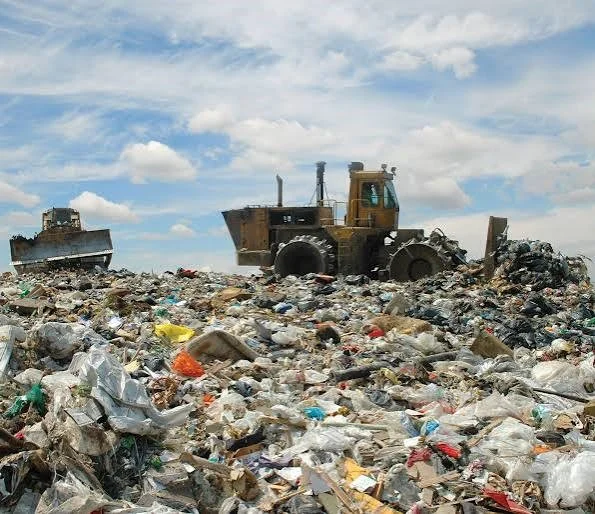
WHY LAGOS IS STRUGGLING WITH WASTE MANAGEMENT — HAMZAT
Read Time:4 Minute, 15 Second
By ‘Sefiu Ajape
Lagos State Deputy Governor, Obafemi Hamzat, has attributed the worsening waste situation in the state to rising waste generation, a shortage of functional collection trucks, and operational challenges confronting private waste operators.
Hamzat said the Lagos Waste Management Authority, which is responsible for waste management in the state, was now dealing with a volume of refuse significantly higher than earlier projections.
The Deputy Governor disclosed this during an interview on Nigerian Info 99.3FM on Tuesday.
According to him, the state initially estimated that Lagos generated about 13,000 tonnes of waste daily but later discovered that the figure was closer to 17,000 tonnes.
“Well, so, you know, it’s easy for me to just throw the agency under the bus, but I won’t do that. That’s the agency that’s responsible, that we all know, LAWMA. But we’ve asked them to do a job, the scale of which we did not predict,” Hamzat said.
“And that scale is really unprecedented in this part of the world. So we thought that we are generating 13,000 tonnes on a daily basis. It turns out we are generating about 17,000,” he added.
Hamzat said the gap between the estimated and actual volume of waste had complicated the government’s efforts to plan and effectively manage refuse collection across the state.
He stressed the importance of accurate data in waste management, noting that proper planning would be difficult without knowing the actual volume of waste being generated.
“So that’s why we said, you know, if you go around every part of Africa, if you go to Accra, Lagos, Lome, Freetown, what you see is disorganisation,” he said.
“As a people, the first thing we need to do is we need to organise ourselves. So how do you plan for something you can’t measure? How? So if you don’t, what you can’t measure, it’s difficult to plan and manage it,” he noted.
The Deputy Governor also pointed to the activities of people living and operating on the streets as contributing to the volume of waste generated, making it more difficult for authorities to determine the total amount of refuse produced.
“Do you understand? So the people that sleep on the street, that man or those men or young boys that went and scraped the street, they generate refuse. How do we plan for that? How do we know?” he asked.
Hamzat also identified the shortage of functional waste collection trucks as another major challenge affecting refuse evacuation in the state.
He said Lagos had about 420 Private Sector Participants involved in waste collection, with each operator required under its agreement with the government to have at least two trucks.
“So we have about 420 or so PSPs. So these are private sector people that carry the refuse. Each of them, by agreement, must have two trucks before you can do. So we are expected about over 800 trucks,” he said.
However, Hamzat said many of the operators no longer had the required number of trucks, as some vehicles had become unusable while some businesses had shut down.
He added that the rising cost of diesel had also affected the operations of private waste collectors, with some operators asking the government to approve higher tariffs.
“The reality is that a lot of them don’t have two anymore. Either it has shut down. They wanted to; they came to us to say, Well, cost of diesel has gone up. We want to increase the tariff,” Hamzat said.
The Deputy Governor said the state government rejected the proposed tariff increase but agreed to provide additional financial support to the operators.
“And finally we said, no, don’t increase the tariff. Let the state pay,” he said.
Hamzat said the government later discovered that a significant number of the existing waste collection trucks were no longer fit for use, prompting it to order new vehicles.
“The second challenge is that we realise that a lot of the trucks are no longer usable. So we order trucks,” he said.
According to him, Lagos has 57 local government areas and local council development areas, with two trucks planned for each, amounting to 114 vehicles.
He added that the state government ordered an additional 100 trucks to further strengthen waste collection operations.
“We were supposed to get delivery in July. Unfortunately, they now said it’s going to be September,” Hamzat said.
He said the delay in the delivery of the new trucks had contributed to the current challenges affecting waste collection across the state.
Hamzat therefore said it would be unfair to place the entire blame for the worsening waste situation on LAWMA.
“So when I said I will not throw LAWMA under the bus, it’s because of something like that. It’s not technically their fault. Maybe we should have ordered earlier. Maybe. I mean, we must take responsibility,” the Deputy Governor said.
He assured residents that the state government was working to address the identified challenges and improve waste collection and management across Lagos.


Happy
0 %

Sad
0 %

Excited
0 %

Sleepy
0 %

Angry
0 %

Surprise
0 %
 0
0
 0
0