
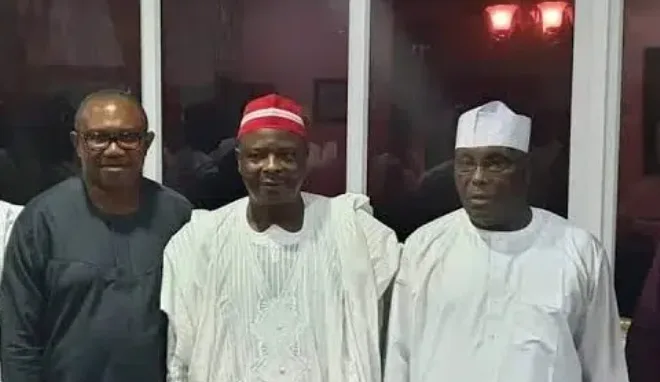
2027: ATIKU, OBI CONSIDER OPTIONS AHEAD OF SINGLE-CANDIDATE SUMMIT
Read Time:4 Minute, 32 Second
By:Tajudeen Aminat
Uncertainty Continues to Trail Opposition’s Single-Candidate Plan Ahead of 2027
The proposal for a single opposition presidential candidate ahead of the 2027 general election has continued to generate uncertainty, with political parties and movements expressing varying positions on the initiative.
The development followed a call by the Group of 100 Nigerians, led by former All Progressives Congress chieftain Salisu Lukman, for opposition presidential candidates and leaders to unite and present a common candidate against President Bola Tinubu in 2027.
The group urged former Vice President Atiku Abubakar of the African Democratic Congress, Peter Obi of the Nigeria Democratic Congress, their respective running mates, Rotimi Amaechi and Rabiu Kwankwaso, as well as other opposition figures, to put personal interests aside in the broader interest of defeating the APC-led government.
According to the G-100, a fragmented opposition, regardless of its numerical strength, would find it difficult to unseat the ruling party, making a single presidential candidate necessary to consolidate opposition votes.
Lukman had earlier announced that the group would convene an opposition summit in Abuja on August 18, with the aim of bringing various opposition groups and political tendencies together to discuss the proposed alliance.
However, responses from some of the parties and political movements expected to participate suggest that reaching an agreement may prove challenging.
Atiku’s Senior Special Assistant on Public Communication, Phrank Shaibu, declined to confirm whether the former vice president would attend the summit, saying his participation would be announced after his schedule had been finalised.
Shaibu said Atiku welcomed genuine efforts aimed at strengthening the opposition and providing Nigerians with a credible alternative to the Tinubu administration.
He, however, stressed that any coalition-building process must be transparent, inclusive and democratic, with the ultimate goal of producing a candidate capable of winning the confidence of Nigerians.
On the proposal for a single opposition candidate, Shaibu said Atiku was consulting with political leaders and stakeholders across the opposition, adding that such discussions were necessary at this stage.
He noted that the objective should be to strengthen the opposition, protect democracy and provide Nigerians with an alternative to the present administration.
Similarly, the Obidient Movement, which forms the support base of Peter Obi, confirmed that an invitation had been extended to the former Anambra State governor to attend the proposed summit.
The movement’s National Coordinator, Tanko Yunusa, said the decision on whether Obi would attend rested with him.
Yunusa, however, welcomed the idea of opposition cooperation, saying it would be beneficial for opposition parties and movements to work together under one umbrella.
The Labour Party, meanwhile, supported opposition collaboration but insisted that any coalition seeking to defeat the APC should be built around its existing structure rather than create an entirely new platform.
The party’s National Publicity Secretary, Ken Asogwa, said the Labour Party recognised the need for broad-based cooperation among opposition forces but maintained that its existing structure made it the strongest platform for a presidential contest.
According to Asogwa, the party’s relationship with the Nigeria Labour Congress and the Trade Union Congress gives it a nationwide organisational advantage.
He argued that the structure extends from the national level to polling units, wards, local government areas and communities.
The Labour Party spokesman therefore called on groups and individuals seeking to build a formidable opposition alliance to strengthen and consolidate around the party.
The Democratic Leadership Alliance adopted a more cautious position, welcoming opposition cooperation but distancing itself from any immediate commitment to a single-candidate arrangement.
The party’s Deputy National Publicity Secretary, Judith Aguenu, said the DLA was not currently negotiating with the G-100 or any political party or group over the adoption of a common presidential candidate.
She said the party’s immediate priority was to strengthen its platform and position itself as a credible alternative ahead of the election.
Aguenu, however, said the DLA remained open to discussions with opposition parties, political movements and civil society groups committed to accountable governance.
The Coalition of United Political Parties, on its part, backed the initiative and expressed its readiness to support the proposed summit.
CUPP spokesman Agu Bryan said the coalition had consistently advocated for the possibility of a single, formidable opposition presidential candidate where practicable.
He said CUPP would support a consensus candidate if major opposition contenders, including Atiku, Obi and others, could reach a mutually acceptable agreement in the national interest.
Bryan also stressed the need for opposition unity to be accompanied by sustained demands for free, fair, transparent and credible elections.
The emerging positions highlight the major challenge facing efforts to establish a unified opposition ahead of 2027.
While the G-100 believes that a common candidate is necessary to prevent opposition votes from being divided, several political actors appear unwilling to abandon their existing platforms without clear agreements on leadership, structure and the principles guiding any coalition.
The question of who would emerge as the coalition’s presidential candidate is also expected to be contentious, given the political weight of figures such as Atiku, Obi and Kwankwaso.
The August 18 summit is therefore expected to provide an early indication of whether the various opposition groups can move beyond individual interests and agree on a common strategy ahead of the 2027 election.
While there is broad support for opposition cooperation, the divergent positions already emerging suggest that reaching consensus on a single presidential candidate could prove considerably more difficult.


Happy
0 %

Sad
0 %

Excited
0 %

Sleepy
0 %

Angry
0 %

Surprise
0 %
 0
0
 0
0