
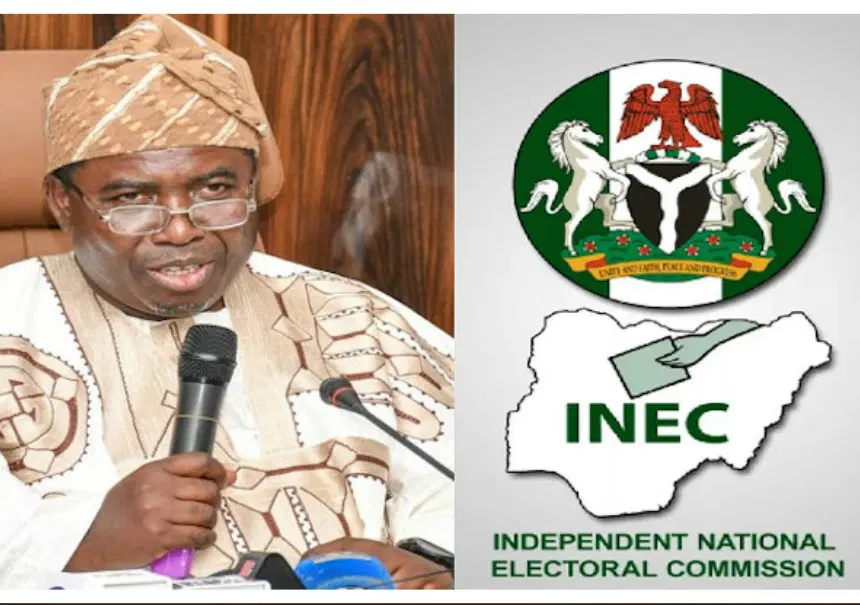
2027: ‘NIGERIANS ARE NOT ASKING FOR EXCUSES,’ INEC CHAIRMAN TELLS 37 RECs
Read Time:5 Minute, 6 Second
Agency report
The Chairman of the Independent National Electoral Commission (INEC), Professor Joash Amupitan, SAN, has told Resident Electoral Commissioners (RECs) that Nigerians expect competence, transparency and results, rather than excuses, as the Commission intensifies preparations for the 2027 General Elections.
“The Nigerian people are not asking us for excuses or explanations after the fact; they are asking for competence, impartiality, transparency, and courage in the execution of our constitutional mandate,” the Chairman said.
Amupitan spoke on Wednesday, November 25, 2026, in Abuja, while declaring open a strategic consultative meeting with RECs from the 36 states and the Federal Capital Territory (FCT), 51 days ahead of the Presidential and National Assembly elections scheduled for January 16, 2027.
Addressing the Commissioners, he described the electoral cycle as a defining moment for the Commission, stressing the weight of the responsibility entrusted to it.
“History has placed a demanding and consequential national trust on our shoulders,” he said.
He noted that the Commission’s preparations were attracting attention across Nigeria and the West African region, with stakeholders closely monitoring how electoral reforms and technological upgrades would translate into credible election-day operations.
“Across Nigeria and across West Africa, citizens, political stakeholders, development partners, and observers are watching how we translate legal reforms and technical upgrades into dependable field execution,” he said.
According to the INEC Chairman, the Commission had reached a stage where implementation must take precedence over further deliberations, with policies and operational systems developed at the Headquarters expected to be effectively deployed across states, Local Government Areas and Registration Areas.
“At this decisive stage of the electoral cycle, the calendar no longer allows for leisurely deliberation or deferred action,” he said.
Amupitan described RECs as the Commission’s principal operational leaders at the state level, tasked with translating national directives into practical realities on the ground.
“As Resident Electoral Commissioners, you are the Commission’s chief operational commanders in the field,” Professor Amupitan said. “You stand at the intersection of national policy and grassroots reality.”
He highlighted the scale of the forthcoming elections, noting that millions of voters would cast ballots across 177,299 polling units, with a verified register of over 100 million voters, 57,000 newly procured Bimodal Voter Accreditation System (BVAS) devices and more than 1.41 million ad hoc personnel expected to be deployed.
“In an exercise of that scale, even minor administrative lapses in one state can trigger national headlines and cast doubt on otherwise solid work elsewhere,” he said. “Margin for error simply does not exist.”
The Chairman identified the nationwide mock accreditation and result transmission exercise scheduled for Saturday, November 28, 2026, as the Commission’s next major operational test.
He described the exercise as “far more than a routine ceremonial drill,” saying it would serve as “a live operational stress test” of the upgraded BVAS devices, logistics workflows and automated result validation safeguards on the INEC Result Viewing Portal (IReV).
He directed every REC to personally supervise preparations in their respective states and submit a comprehensive technical audit to Headquarters by Monday, November 30, 2026.
The reports, he said, must identify network dead zones, device anomalies and procedural bottlenecks to enable technical teams to address the challenges before the elections.
On logistics, Amupitan emphasised the need for timely commencement of voting, warning that delays could undermine public confidence in the process.
“Delayed openings breed suspicion, anxiety, and avoidable tension,” he said.
He also called for proactive election security measures, urging RECs to work closely with security agencies and deploy the Commission’s Election Risk Management (ERM) maps to identify and address potential threats.
“Election security must be preventive, intelligence-led, and granular rather than reactive,” the Chairman said.
On misinformation, he warned that delays or ambiguity in official communication could create opportunities for false narratives and coordinated disinformation campaigns.
“Disinformation, synthetic media, and coordinated false narratives spread like contagion whenever official information is delayed or ambiguous,” he said, urging RECs to sustain engagement with political parties, observers, civil society organisations and the media.
Amupitan also reiterated the Commission’s commitment to institutional neutrality, warning that officials who compromise the integrity of the electoral process would face accountability.
“Under the Electoral Act 2026, the Commission will not shield any staff member or official who compromises neutrality, facilitates malpractice, or breaches statutory rules,” he said.
He urged the Commissioners to use the meeting to address operational challenges, strengthen coordination and prepare adequately for the mock exercise and the 2027 elections.
“Let us use today’s consultative session to examine every field challenge candidly, resolve operational bottlenecks decisively, and leave Abuja fully aligned and focused for Saturday’s nationwide mock exercise and the historic general elections in January and February 2027,” he said.
The Chairman said the conduct of the RECs in the coming weeks would significantly influence the credibility of the elections.
“Every detail you verify today, every contingency plan you test on Saturday, and every standard of neutrality you uphold in your state brings us closer to an election whose outcome reflects the genuine, peaceful choice of the voters,” he said.
He further stressed the importance of leadership, supervision and accountability among the Commissioners.
“Your leadership sets the ethical and operational tone in your respective states,” the Chairman said.
He directed the RECs to maintain close supervision of Electoral Officers, personally oversee field audits and provide accurate reports of operational realities to Headquarters.
“Stay close to your Electoral Officers, supervise field audits personally rather than relying solely on secondhand assurances, and report realities on the ground with complete candour so Headquarters can support you swiftly,” he directed.
The Presidential and National Assembly elections are scheduled for Saturday, January 16, 2027, while the Governorship and State Houses of Assembly elections will hold on Saturday, February 6, 2027.
Amupitan thanked the RECs for their service and commitment to the Commission before formally declaring the meeting open.
“I thank you once again for your dedicated service, steady leadership, and commitment to the Commission and the nation,” he said.
The meeting was attended by National Commissioners, the Secretary to the Commission, Directors and senior officials of INEC, technical aides to the Chairman and members of the press.


Happy
0 %

Sad
0 %

Excited
0 %

Sleepy
0 %

Angry
0 %

Surprise
0 %
 0
 0