
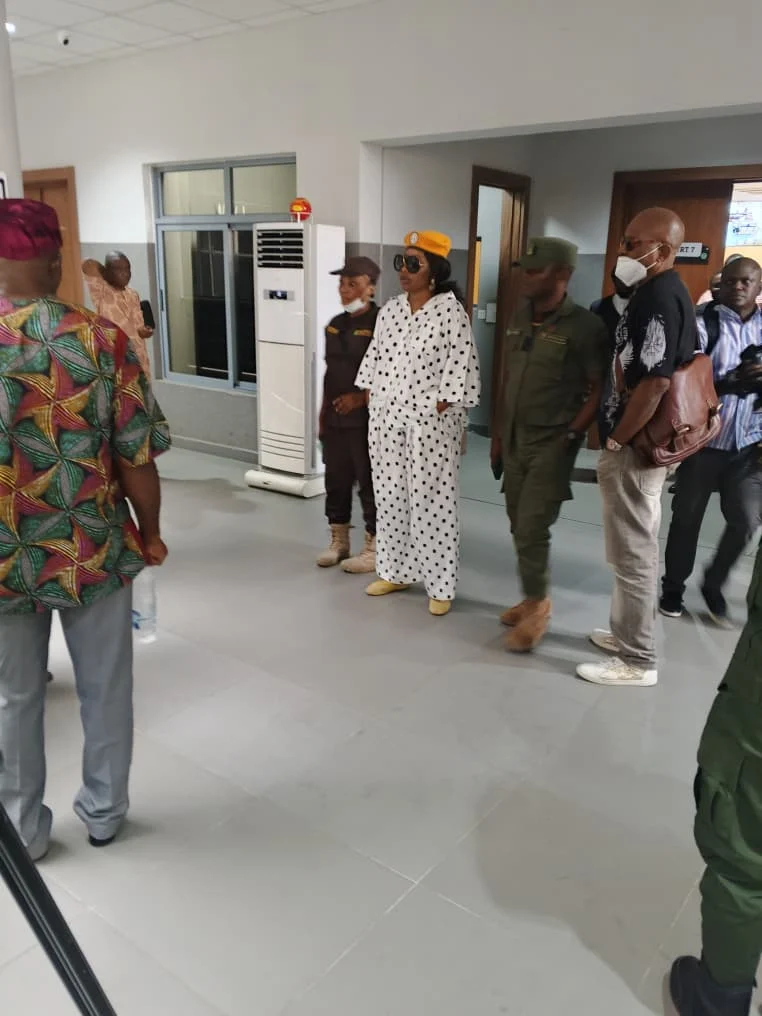
DORIS OGALA KNEELS, APOLOGISES TO COURT AS BAIL RULING IS FIXED FOR NOVEMBER 6
Read Time:6 Minute, 16 Second
By Aishat Momoh. O.
Nollywood actress Doris Ogala on Friday knelt before a Federal High Court in Lagos to apologise for her unruly conduct during an earlier sitting in her alleged cyberstalking and attempted extortion case involving Pastor Chris Okafor.
However, the actress was returned to the Kirikiri Correctional Centre after the court reserved ruling on her bail application till November 6, 2026.
Ogala, who was remanded following her arraignment on Wednesday, expressed remorse before Justice Akintayo Aluko, promising not to repeat the conduct that disrupted proceedings at the previous sitting.
“I am very sorry, my Lord. I apologise for my bad behaviour. I have never been to prison before and I wasn’t expecting that I would do that.
“I regret my actions and I apologise to my Lord. I tender my apologies wholeheartedly. Sorry, this will never happen again going forward,” she said.
Her apology followed the judge’s expression of displeasure over her conduct on Wednesday, when she allegedly shouted and sang in the courtroom, disrupting proceedings and forcing the court to rise.
Justice Aluko said the incident prevented the court from hearing more than seven other cases scheduled for that day.
The judge disclosed that he had considered committing the actress for contempt but decided against it, despite believing that her conduct warranted punishment.
“She should have been given some form of imprisonment, right, on that day, but I kept my cool and I rose,” he said.
Aluko added that the actress could have received at least two months’ imprisonment for obstructing court proceedings.
“Why do you have to start shouting and start singing in the open court? You conducted yourself in a manner that forced the court to rise. That’s what you did, and it’s already recorded,” he said.
The judge also faulted the defence counsel for failing to acknowledge the incident and explain his client’s conduct before commencing his address on the bail application.
He recalled that he had directed an accelerated hearing of the bail application and taken steps to ensure it was considered within 48 hours.
Ogala’s counsel, Marshal Abubakar, also apologised to the court, describing the incident as regrettable and assuring the judge that such behaviour was not consistent with his client’s character.
He said he had known the actress for some time and did not expect her to behave in that manner.
Following the apologies, the court proceeded to hear arguments on the bail application.
Abubakar urged the court to admit Ogala to bail, arguing that the prosecution had effectively acknowledged her entitlement to bail by proposing conditions for her release in its counter-affidavit.
He submitted that the prosecution was not opposed to her release but was concerned about the conditions attached to it.
The defence counsel argued that bail conditions should be reasonable and should not unnecessarily restrict the liberty of an accused person pending trial.
However, the prosecution, led by Tolulope Mokolu, urged the court to impose stringent conditions, citing concerns about Ogala’s social media activities and the possibility of interference with witnesses.
Mokolu argued that although the defendant had constitutional rights to freedom of speech and expression, such rights were not absolute and must be exercised within the limits of the law.
He urged the court to restrict her contact with witnesses and their addresses and prevent her from making social media publications capable of influencing witnesses or undermining the proceedings.
The prosecution further argued that any breach of the proposed bail conditions should attract appropriate sanctions.
After listening to both parties, Justice Aluko reserved ruling on the application till November 6, 2026.
Ogala was subsequently returned to the Kirikiri Correctional Centre pending the court’s decision.
The actress was arraigned on Wednesday by the Office of the Attorney-General of the Federation on three counts bordering on alleged cyberbullying, cyberstalking and attempted extortion involving Pastor Okafor.
Prosecution counsel, Mokolu, alleged that the offences were committed between September 2024 and March 2026.
He told the court that Ogala allegedly published nude and intimate photographs of Okafor on her social media accounts without his consent, exposing him to embarrassment, emotional distress and reputational damage.
She pleaded not guilty to the charges.
Meanwhile, Abubakar has said he will petition the Attorney-General of the Federation and Minister of Justice, Lateef Fagbemi, to withdraw the charges against his client, describing the dispute as a private matter between former lovers.
The lawyer disclosed this while speaking with journalists after Friday’s proceedings, saying he believed the prosecution of Ogala infringed on her fundamental rights.
He argued that the dispute arose from a failed relationship and should not have resulted in criminal charges.
“I strongly believe that the arrest of Doris Ogala, the investigation as far as this matter is concerned, and the subsequent filing of charges against her are an affront to her fundamental rights.
“The subject matter that led to this entire transaction in this matter was purely a matter between a boyfriend and a girlfriend. Where former lovers fell apart, and one of the lovers felt cheated, and she reacted through the platform that she has,” he said.
Abubakar argued that the state should not ordinarily intervene in private disputes of such nature, adding that Nigerians had the right to express their grievances.
“As far as I am concerned, these are private issues and private matters that the state ordinarily should not involve itself with. Nigerians have a fundamental right to express their grievances and express themselves in manners that they deem fit and appropriate,” he said.
He criticised what he described as the criminalisation of free speech, arguing that individuals who felt defamed should seek redress through civil proceedings rather than criminal prosecution.
According to him, democracy accommodates dissent and criticism, even where the expressions are considered offensive.
“The natural remedy for such a person is to file a civil matter under the tort of defamation. If I feel strongly defamed by the utterances of a particular person, what I naturally would want to do is to go to court, where my integrity and reputation can be put on the line,” he said.
The lawyer also called for the removal of provisions of the Cybercrimes Act which, according to him, criminalise free speech.
He recalled that challenges were brought before the courts in 2022 against provisions of the Cybercrimes Act 2015, particularly Section 24, which he said had been declared unconstitutional in two separate judgments for violating freedom of expression and provisions of the African Charter on Human and Peoples’ Rights.
He said the National Assembly subsequently amended the Act in 2024 to address concerns over the criminalisation of free speech.
However, he alleged that security agencies had continued to apply the law without adequately reflecting the amendments.
Abubakar also accused some influential individuals and public officials of using law enforcement agencies to intimidate critics, arguing that such practices undermined democratic freedoms.
He said he would formally write to the Attorney-General and Minister of Justice, urging him to intervene and discontinue the prosecution.
“It is also my honest belief that this matter should be discontinued and the charges withdrawn. In that regard, I will be filing an application to the Minister of Justice and the Attorney-General to withdraw this charge because it ought not to have been filed in the first place,” he said.
He added that the request would be made in the interest of justice, insisting that the dispute should not proceed as a criminal case against a Nigerian citizen.


Happy
0 %

Sad
0 %

Excited
0 %

Sleepy
0 %

Angry
0 %

Surprise
0 %
 0
 0