
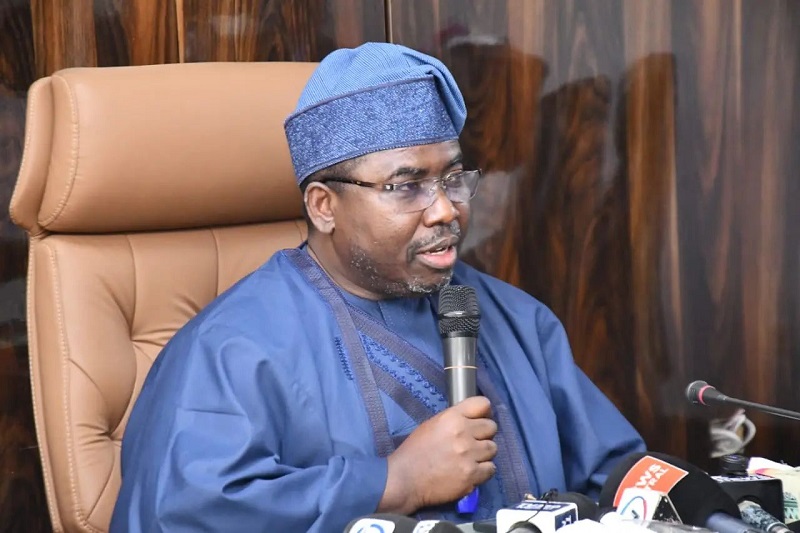
INEC CHAIRMAN CONDEMNS ELECTORAL VIOLENCE, REAFFIRMS COMMITMENT TO PROTECTING VOTES
Read Time:4 Minute, 22 Second
Agency report
The Chairman of the Independent National Electoral Commission (INEC), Professor Joash Amupitan, SAN, has condemned campaign-related violence, attacks on electoral workers and threats against journalists ahead of the 2027 General Elections, reaffirming the Commission’s commitment to safeguarding the votes of Nigerians.
Amupitan, who was represented by his Chief Press Secretary and Media Adviser, Adedayo Oketola, spoke on Wednesday, November 25, 2026, in Abuja, during a keynote address at the Nigeria Election Risk and Readiness Summit 2026, organised by the Centre for Journalism Innovation and Development (CJID).
In his address, the INEC Chairman said the Commission condemned electoral violence “in the strongest possible terms.”
“Election officials and accredited reporters are not combatants in a partisan war; they are constitutional public servants and civic watchdogs discharging a sacred national duty,” he said.
He described assaults, intimidation, and blackmail against electoral officials and journalists as “a direct attack on the Nigerian state and the sovereign rights of voters.”
The Chairman noted that since the commencement of open campaigns, there had been attacks on campaign convoys, party offices, and supporters, alongside harassment and hostility directed at INEC officials, field staff, and ad hoc workers. He also expressed concern over recurring threats against journalists covering political activities.
Amupitan disclosed that INEC would deploy more than 1.41 million ad hoc personnel for the elections, predominantly National Youth Service Corps (NYSC) members, alongside university academics and career civil servants, with the exercise also involving security operatives, journalists, and election observers.
“Electoral democracy does not run on software; it runs on human courage,” he said.
He clarified that INEC’s mandate was limited to electoral management, noting that the Commission lacked the constitutional authority and operational capacity to maintain public order, make arrests, or deploy armed security personnel.
“INEC is an electoral management body, not a security agency; we lack both the constitutional mandate and the operational capacity to maintain public order, effect arrests, or deploy armed security,” he said.
According to him, responsibility for maintaining public order rests with the Nigeria Police Force and other security agencies, which he urged to ensure prompt arrests, thorough investigations, and timely submission of case files to the Commission.
He said the measures were necessary “so that impunity is decisively checked well before January.”
The INEC Chairman also reminded political parties, candidates, and their supporters of provisions of the Electoral Act 2026, which he said had strengthened sanctions against electoral misconduct.
He explained that Section 96 prohibits abusive, slanderous, or inflammatory language capable of inciting violence, while also prohibiting political parties and candidates from retaining, organising, training or equipping groups to use physical force.
Section 97, he said, prohibits threats or coercion aimed at compelling or preventing political support, with penalties of up to ₦5 million or 12 months’ imprisonment for individuals and up to ₦10 million for political parties for initial breaches.
Amupitan further noted that Section 148 empowers the Commission to prosecute electoral offenders directly upon receipt of investigative case files from the Police.
“Party leaders bear direct responsibility for the conduct of their supporters and must refrain from financing or mobilising groups that disrupt public peace,” he said.
On information integrity, the Chairman warned that the 2027 electoral cycle was unfolding amid growing threats from generative artificial intelligence, deepfake videos, and Foreign Information Manipulation and Interference (FIMI).
“Disinformation is no longer merely a nuisance; it is an operational security risk,” he said.
He disclosed that INEC had established a dedicated Artificial Intelligence Division within its ICT Department to identify and detect coordinated manipulation targeting electoral infrastructure.
However, he stressed that the Commission could not address the threat alone, calling for stronger collaboration among INEC, fact-checking organisations such as DUBAWA, newsrooms, civil society groups, and the National Orientation Agency (NOA).
On election security, Amupitan said the Commission had worked with the Office of the National Security Adviser (ONSA) and the Nigeria Police Force to restructure the Inter-Agency Consultative Committee on Election Security (ICCES) into decentralised ICCES Tentacles extending to Local Government Areas and Registration Areas, also known as wards.
He said the arrangement was guided by the Election Risk Management (ERM) Tool, which categorises states, Local Government Areas and wards according to actionable risk levels.
The Chairman maintained that preventing electoral violence required collective responsibility beyond the Police and other security agencies.
“Peace is a collective civic covenant,” he said, urging political parties, traditional rulers, religious leaders, civil society organisations and the media to contribute to peaceful elections.
He reiterated INEC’s commitment to neutrality, insisting that the Commission would not favour any political party or candidate.
“We have no preferred party, no favoured candidate, and no hidden agenda beyond ensuring that every eligible citizen can vote safely and that every valid vote counts,” he said.
Amupitan also confirmed that the Presidential and National Assembly elections would hold on Saturday, January 16, 2027, followed by the Governorship and State Houses of Assembly elections on Saturday, February 6, 2027.
He said the Commission would also conduct a nationwide mock accreditation and result transmission exercise on Saturday, November 28, 2026, as part of its preparations.
The Chairman commended CJID, DUBAWA, and other partners for organising the summit, urging stakeholders to complement the Commission’s efforts with “unwavering vigilance, ethical reporting, and civic responsibility.”


Happy
0 %

Sad
0 %

Excited
0 %

Sleepy
0 %

Angry
0 %

Surprise
0 %
 0
 0