
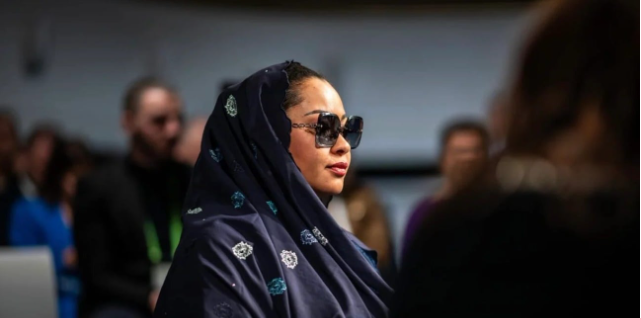
COURT ADJOURNS NATASHA’S CYBERCRIME TRIAL TILL OCT 20
Read Time:3 Minute, 49 Second

By Shodayo Sunmisola Michael
The anticipated initiation of the trial concerning the cybercrime allegations against suspended Kogi Central Senator, Natasha Akpoti-Uduaghan, in the Federal High Court in Abuja was postponed on Monday due to a challenge posed by her legal representative, Ehiogie West-Idahosa, SAN.
Akpoti-Uduaghan faces a six-count indictment under case number FHC/ABJ/CR/195/2025, instituted in accordance with the Cybercrimes (Prohibition, Prevention, etc.) (Amendment) Act, 2024, by the Federal Government.
Having been arraigned on June 30 and subsequently granted bail on her own recognizance, Akpoti-Uduaghan is accused of disseminating false and damaging information through electronic methods with the intent to defame, incite, jeopardize lives, and disrupt public order.
The charges presented by the Director of Public Prosecutions of the Federation, Mohammed Abubakar, allege that during an address to a gathering on April 4, 2025, in Ihima, Kogi State, Akpoti-Uduaghan claimed that the Senate President, Senator Godswill Akpabio, instructed former Governor Yahaya Bello to orchestrate her assassination in Kogi State.
READ MORE:
She is further accused of reiterating this allegation during a television interview, claiming that the Senate President and the former Governor of Kogi State conspired to eliminate her.
Some counts in the indictment specify, “That on or about April 1, 2025, while addressing an assembly of individuals at Ihima Community, Kogi State, you — Senator Natasha Akpoti-Uduaghan — willfully facilitated the transmission of the following communication via a computer system and network, to wit:
“…and Akpabio told Yahaya Bello, I am saying, standing by what I have said. He told him that he should make sure that killing me does not happen in Abuja, it should be done here, so it will seem as if it is the people that killed me here…” And you, Senator Natasha Akpoti-Uduaghan, knew this contained a threat that could harm the reputation of Senator Godswill Obot Akpabio, GCON, as the President of the Senate of the Federal Republic of Nigeria. You thereby committed an offence contrary to Section 24(2)(c) of the Cybercrimes (Prohibition, Prevention, etc.) (Amendment) Act, 2024, and punishable under the same Act.”
Another charge asserts that, on or about April 1, 2025, during your address to a gathering at Ihima Community, Kogi State, within this Honourable Court’s jurisdiction, you — Senator Natasha Akpoti-Uduaghan — deliberately caused the transmission of the following communication via a computer system and network, to wit:
“…and Akpabio told Yahaya Bello, I am saying, standing by what I have said. He told him that he should make sure that killing me does not happen in Abuja, it should be done here, so it will seem as if it is the people that killed me here…” And you, Senator Natasha Akpoti-Uduaghan, knew this contained a threat that could harm the reputation of Yahaya Adoza Bello, a former Governor of Kogi State. You thereby committed an offence contrary to Section 24(2)(c) of the Cybercrimes (Prohibition, Prevention, etc.) (Amendment) Act, 2024, and punishable under the same section of the Act.”
At the reconvened session, the prosecuting attorney, David Kaswe, apprised the court that the agenda for the day was for the prosecution to initiate its case by summoning its initial witness.
Kaswe, who had arranged for a television display to be installed in the courtroom in anticipation of the proceedings, informed the court that the prosecution had its witness present and was prepared to advance.
In response, defense counsel, West-Idahosa, expressed concerns regarding the potential for the prosecution to commence its case.
West-Idahosa conveyed to the court that his client had submitted a notice of preliminary objection questioning the jurisdiction of the court to adjudicate the matter.
He clarified that the objection was not aimed at the substance of the charge itself but at what he characterized as a purported misuse of the prosecutorial authority by the Attorney-General of the Federation.
The defense attorney also raised objections regarding the lack of receipt of copies of the statements from the prosecution’s witnesses.
Despite Kaswe’s vigorous assertion that the objection put forth by the defendant should not impede the proceedings of the day, Justice Umar maintained that the prosecution must first address the objection.
The presiding judge, Justice Mohammed Umar, indicated that he intended to first resolve the preliminary objection raised by the defense before proceeding with any further actions in the case.
He subsequently postponed the case until October 20 for the consideration of the objection and the commencement of the trial.


Happy
0 %

Sad
0 %

Excited
0 %

Sleepy
0 %

Angry
0 %

Surprise
0 %
 0
0
 0
0