

SENATE SUPPORT DEATH PENALTY FOR KIDNAPPERS
Read Time:2 Minute, 46 Second
HOTJIST NEWS
The Senate on Wednesday started working on making Nigeria’s anti–kidnapping laws stronger by suggesting that kidnappers, and anyone who helps fund, supports, or gives information to them, should face the death penalty. This came as lawmakers discussed changes to the 2022 Terrorism (Prevention and Prohibition) Act.
The idea was put forward by the Senate Leader, Opeyemi Bamidele.
It aims to treat kidnapping, taking hostages, and related crimes as terrorism. This would give security agencies more power to monitor, stop, and take legal action against criminal groups throughout the country.
The discussion was a major part of Wednesday’s meeting.
Important senators like Adams Oshiomhole, Orji Uzor Kalu, and Minority Leader Abba Moro all shared their thoughts on the matter.
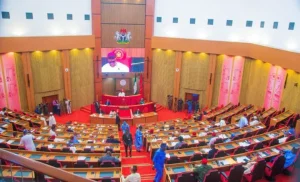
The session was presided over by Senate President Godswill Akpabio.
After spending many hours discussing the issue, the Senate agreed completely on the amendment bill and decided to send it to several committees for more work. These committees include the Committee on Judiciary, Human Rights and Legal Matters (which is the main one), National Security and Intelligence, and Interior.
The committees are supposed to give their report back in two weeks.
Bamidele led the discussion on the bill and explained that the goal was to “make kidnapping, hostage–taking, and related crimes considered as terrorist acts and set the death penalty for these crimes, with no option for a fine or any other type of punishment.”
He said that kidnapping has become a serious problem, carried out by organized criminal groups in a planned and professional way.
He added that kidnapping has caused fear in communities, affected the economy and farming, stopped children from going to school, made families go bankrupt because they had to pay money for ransom, put too much pressure on security forces, and taken the lives of many innocent people.
He also said that the violence connected with kidnapping now looks like terrorism, so it needs to be treated as a terrorism–related issue.
Bamidele said the bill would give security agencies more power to deal with terrorists and those who help them. He explained that the death penalty would apply not just to people who kidnap others, but also to those who provide information, help with planning, transport, hide, or support kidnapping in any way. He also mentioned that even trying to kidnap or encouraging someone to do so would result in the same punishment.
“Nigerians are kidnapped on highways, in schools, in homes, on farms and in markets,” he said. “This is not a mere crime. It is terrorism in its purest form.”
Backing the amendment, Oshiomhole criticised deradicalisation programmes for terror suspects, arguing that many offenders returned to crime.
“He said, ‘We shouldn’t keep running deradicalisation programmes again. No more de–radicalisation. If someone is caught and found guilty of terrorist acts, they should face the death penalty.‘”
Kalu also backed the bill, saying that those who provide information or support to kidnappers should “face the consequences.
“He said, ‘Nigerians have been hurt by kidnappers.
Young girls have been raped. Women have become widows for no reason. This must not happen again.‘”
Senate Minority Leader Moro called the bill “a unanimous decision of the Senate,” explaining that it was needed to impose the death penalty “so that kidnappers face the punishment they deserve.


Happy
0 %

Sad
0 %

Excited
0 %

Sleepy
0 %

Angry
0 %

Surprise
0 %
 0
0
 0
0