
LAGOS STATE, FEDERAL PARASTATALS SEEK STRONGER COLLABORATION AT MAIDEN GOVERNANCE SUMMIT
Read Time:4 Minute, 13 Second
By: Muftau Fatimo
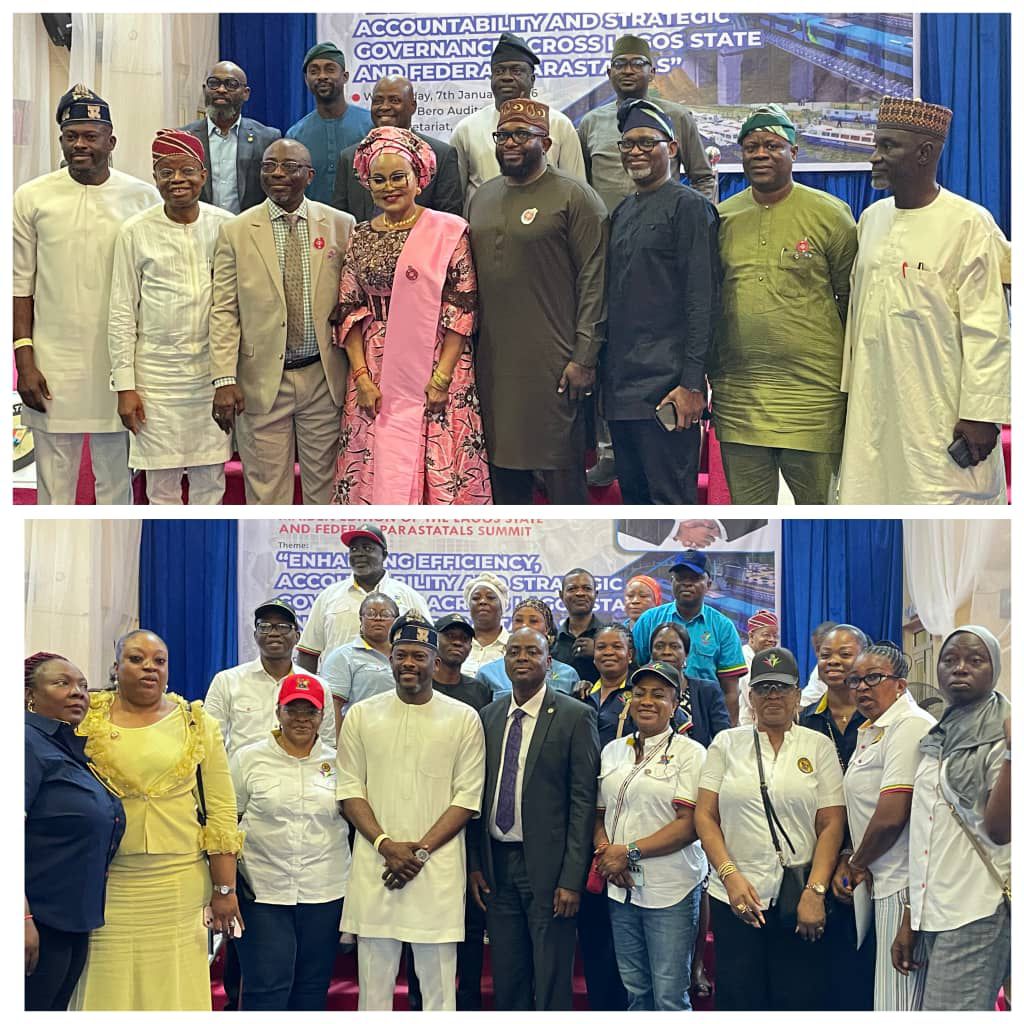
Stakeholders from Lagos State and Federal Government Parastatals on Wednesday, 7th January 2026, converged at the Adeyemi Bero Auditorium, The Secretariat, Alausa, Ikeja, for the maiden edition of the Lagos State and Federal Parastatals Summit, aimed at strengthening institutional collaboration, improving service delivery, and promoting accountability across public institutions.
The summit, organised by the Lagos State Parastatals Monitoring Office, was themed “Enhancing Efficiency, Accountability and Strategic Governance across Lagos State and Federal Parastatals.” It brought together Heads of Parastatals, Chief Executive Officers, senior government officials, and representatives of both State and Federal Government agencies operating within Lagos State.
Governor Babajide Olusola Sanwo-Olu was duly represented at the summit by the Secretary to the State Government (SSG), Barrister Abimbola Salu-Hundeyin, who delivered the Governor’s address. In his message, Governor Sanwo-Olu expressed strong belief in the summit, describing it as not only significant for Lagos State but also critical to Nigeria’s broader governance and development aspirations.
Delivering his key note address at the summit, the Governor noted that he was delighted and encouraged by the strong presence of leadership across Federal and State institutions, describing it as a clear demonstration of shared commitment to effective governance. He stated that under the leadership of President Bola Ahmed Tinubu, GCFR, the Federal Government’s Renewed Hope Agenda continues to advance improved economic outcomes and restore public confidence in governance.
Governor Sanwo-Olu reaffirmed that Lagos remains the heartbeat of Nigeria’s economy a dynamic mega city where transportation, security, infrastructure, energy, environmental management, and social services intersect daily. According to him, the quality of governance in Lagos is largely defined by how efficiently, transparently, and strategically institutions collaborate and deliver on their responsibilities.
He noted that the theme of the summit speaks directly to the realities confronting governance today and the future that must be deliberately built, stressing that effective governance in a complex environment can no longer be presumed but must be intentionally achieved through alignment, coordination, collaboration, and shared purpose.
Earlier in his welcome address, the Special Adviser to the Governor on Parastatals Monitoring, Hon. Ibrahim Babajide Obanikoro, described the summit as strategic and timely, noting that the evolving demands of governance require stronger collaboration, coordination, and collective responsibility among public institutions.
He explained that Lagos State hosts a significant concentration of Federal and State Parastatals operating within the same socio-economic space, yet limited coordination has often resulted in policy duplication, overlapping mandates, inefficiencies, and underutilisation of shared resources factors that negatively impact service delivery to citizens.
According to him, the summit was convened to bridge institutional divides, encourage structured engagement, and foster practical collaboration between Federal and Lagos State Parastatals, in alignment with the T.H.E.M.E.S+ Agenda of the Lagos State Government.
In his goodwill message, the Head of Service of Lagos State, Mr. Bode Agoro, described the summit as historic, marking the first formal convergence of Lagos State and Federal Parastatals under a shared governance framework. He emphasised that parastatals are the delivery arms of government and play a crucial role in shaping public confidence in governance.
Mr. Agoro noted that efficiency in today’s public service requires lean processes, competent personnel, and intelligent use of technology, while accountability demands transparency, measurable outcomes, and consequences for failure. He reaffirmed the commitment of the Lagos State Public Service to professionalism, ethical standards, and performance-driven governance.
The summit featured technical presentations by seasoned experts. Professor Lere Baale delivered a presentation on “Collaborative Governance for Efficient Service Delivery and Sustainable Development,” where he highlighted the importance of cooperation among institutions as a catalyst for sustainable growth and improved public service outcomes.
The second presentation was delivered by Mr. Toba Otusanya, who spoke on “Agile Transformation: An Effective Vehicle for Enhanced Inter-Agency Collaboration.” He underscored the need for adaptive, flexible, and innovation-driven approaches to governance, noting that agility is essential for institutions seeking to respond effectively to modern governance challenges.
In his vote of thanks, the Permanent Secretary, Parastatals Monitoring Office, Dr. Olugbemiga Aina, expressed profound appreciation to all stakeholders whose contributions ensured the success of the maiden summit.
He commended Governor Babajide Olusola Sanwo-Olu for his visionary leadership and unwavering commitment to good governance in line with the T.H.E.M.E.S+ Agenda, as well as the strategic guidance of the Special Adviser on Parastatals Monitoring, which provided the impetus for convening the summit.
Dr. Aina appreciated the participation of Federal Government representatives, Heads of Federal and State Parastatals, and Chief Executive Officers, noting that their presence reinforced the importance of structured engagement and collaboration among institutions operating within the same economic and developmental environment.
He expressed optimism that the resolutions and partnerships formed at the summit would translate into sustained collaboration, improved coordination, and measurable outcomes that would advance harmonised development across Lagos State.
The summit concluded with a collective commitment by participants to move from dialogue to implementation, signalling renewed resolve to strengthen governance, enhance service delivery, and restore public confidence in government institutions.


Happy
0 %

Sad
0 %

Excited
0 %

Sleepy
0 %

Angry
0 %

Surprise
0 %
 0
0
 0
0