
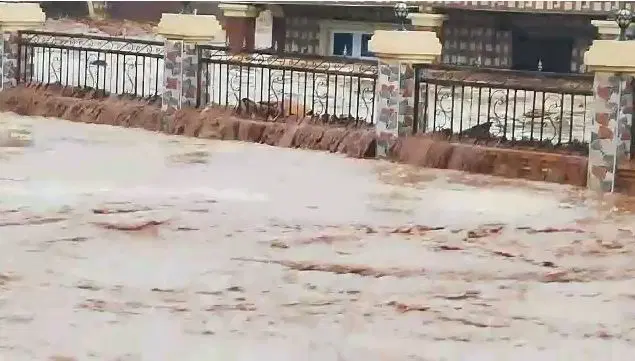
FG DECLARES FLOOD PREVENTION A NATIONAL SECURITY PRIORITY, UNVEILS NEW ANTICIPATORY ACTION FRAMEWORK
Read Time:2 Minute, 52 Second
By Aishat Momoh. O.
The Federal Government has elevated flood prevention to a matter of national security with the launch of a new Anticipatory Action Framework on Floods, designed to transition Nigeria’s disaster management approach from reactive to proactive and coordinated early response.
Unveiled on Wednesday at the Presidential Villa, Abuja, the framework was officially presented by the Anticipatory Action Task Force (AATF) alongside a consolidated budget for national flood preparedness.
Vice President Kashim Shettima, while receiving the draft framework, emphasized the urgent need to embrace scientific approaches in disaster prevention and resilience-building.
“Disasters are security issues. Over the years, we have only been reacting instead of practicing proactive disaster management,” Shettima said. “By seizing this initiative and believing in science, we have carried out all the due processes of finding a roadmap.”
The Vice President commended President Bola Tinubu for his commitment to strengthening Nigeria’s disaster preparedness architecture, and lauded the Office of the National Security Adviser (ONSA) for coordinating the multi-agency effort.
He also called on stakeholders across the country to support the initiative, stressing the importance of collective action in addressing recurring flood crises.
Earlier, the Minister of Humanitarian Affairs and Poverty Alleviation, Prof. Nentawe Goshwe Yilwatda, said the framework marks a major paradigm shift in the way Nigeria tackles disasters.
“We are shifting from reaction to recovery. We are also shifting from losses to prevention. That is the main purpose of why we are here today,” Yilwatda stated.
“We looked at the evidence available. In 2004 alone, about 1.2 million people were displaced, and about 1.3 million hectares of arable farmlands were destroyed by the floods, and in terms of cost, it was over $1 billion in losses. If we can allocate just one per cent of that money, we can save much more than what we lost,” the Minister said.
Also, the National Security Adviser (NSA), Mallam Nuhu Ribadu, stressed the need to act swiftly and proactively, noting that “often, natural disasters are outside of our control, but reaction is ours.
“And this is what matters the most — the ability for us to get ready for a situation that is not under our control. Despite all the resources one has, as long as one is not in a position to anticipate and be able to react, one is likely going to suffer the worst consequences of natural disasters,” Ribadu warned.
Providing details of the work done by the task force, Special Assistant to the President on Humanitarian Affairs and Development Partners, Mrs Inna Audu, said the group had followed a defined timeline since March, starting with the inauguration of the AATF, conducting a validation workshop, and completing data collection through scientific and traditional methods for evidence-based decision making.
She explained that a Strategic Communication Working Group had been created under the NSA’s office, within the National Counter Terrorism Centre (NCTC), headed by Major General Adamu Garba Laka.
“This is to implement a tiered communication and advocacy plan based on information from the Trigger Group and to ensure that states, LGAs, and communities are well informed, engaged, and prepared to act on the early warning triggers,” she said.
The new framework incorporates both scientific and traditional data-gathering methods, establishes clear triggers for early action, and introduces a unified budget line for swift and targeted flood response. It is aimed at building long-term resilience in flood-prone states and communities across Nigeria.


Happy
0 %

Sad
0 %

Excited
0 %

Sleepy
0 %

Angry
0 %

Surprise
0 %
 0
0
 0
0