
KATSINA GOV COMMISSIONS $1M PROJECT TO BOOST FARMERS’ RESILIENCE TO FLOODS, DROUGHT
Read Time:3 Minute, 7 Second
By:Aminat Tajudeen
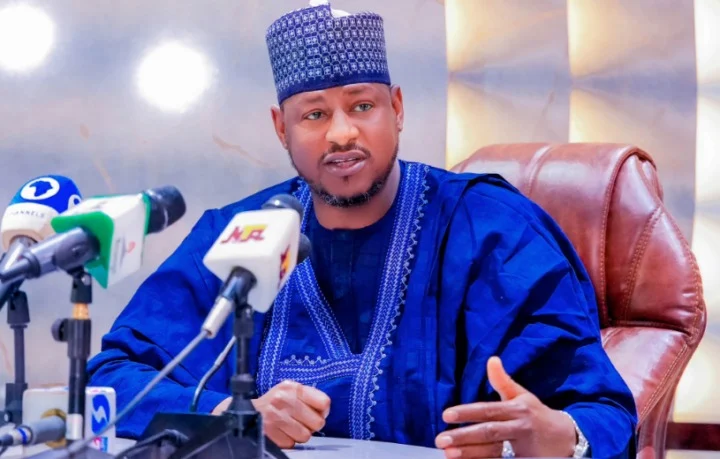
Katsina State Governor, Dikko Radda, has launched a $1m climate-resilience project aimed at protecting vulnerable farming communities from the effects of floods, drought, soil degradation and post-harvest losses.
The 12-month intervention, titled “Protecting Food Security Against Recurring Floods and Drought,” will initially be implemented in Bindawa, Bakori and Kafur Local Government Areas by Mercy Corps Nigeria, in partnership with the Katsina State Development Management Board and the Ministry of Budget and Economic Planning.
Speaking at the project launch in Katsina on Thursday, Radda described climate change as an increasing threat to the state’s agricultural economy, stressing the need for government and development partners to adopt practical measures to safeguard livelihoods and food production.
“Climate change is a reality. We have no way to hide from it, and we must confront it with all our capacity and ability so that together we can fight it,” the governor said.
Radda noted that Katsina is largely agrarian, with a significant portion of its population dependent on agriculture, adding that interventions aimed at protecting land and water resources were essential to boosting food production, household incomes and economic stability.
He directed the Ministry of Budget and Economic Planning and the Katsina State Development Management Board to strengthen coordination among government agencies and development partners involved in the project.
The governor also urged the three beneficiary local governments to provide the necessary support for effective implementation and directed the Ministry of Environment and the Department of Climate Change to assess the initiative for possible expansion to other parts of the state.
“Our aim is for every local government in the state to benefit from this laudable initiative,” Radda said.
Earlier, the Executive Secretary of the Katsina State Development Management Board, Dr Mustapha Shehu, said the $1m project was designed to address vulnerabilities identified through available data and baseline assessments in the three beneficiary local government areas.
Shehu said the intervention would be coordinated by the Ministry of Budget and Economic Planning and implemented in collaboration with relevant ministries, including Agriculture, Livestock Development, Youth, Women Affairs, and Security and Home Affairs.
He added that the project builds on previous partnerships between Katsina State and development organisations, particularly Mercy Corps, in strengthening community resilience, peace and social cohesion.
Giving details of the intervention, Mercy Corps Nigeria Programme Manager, Philip Ikita, said the project would adopt a “prevention-first” approach focused on protecting agricultural assets and strengthening communities’ capacity to withstand climate-related shocks.
According to him, soil bunds, contour barriers and drainage systems would be constructed on 150 selected farms, while degraded land would be restored through vegetation under a cash-for-work programme involving 180 people.
Ikita said at least 12 solar-powered water systems would also be rehabilitated to support farming and livestock communities, particularly during the dry season. Water committees and technicians would be trained to ensure the sustainability of the facilities.
The project will further rehabilitate 150 food storage facilities, distribute 500 hermetic storage bags and train households on improved storage practices to reduce post-harvest losses.
About 300 women are also expected to receive support for livelihood diversification, while farmers will be trained in climate-smart agricultural practices.
Ikita added that beneficiary communities would receive training in hazard mapping, contingency planning and preparedness to improve their ability to respond to changing weather conditions.
He said priority would be given to smallholder farmers, households dependent on grazing land, women and women-headed households, vulnerable families with young children, youths participating in the cash-for-work programme, persons with disabilities and other vulnerable groups.
The Commissioner for Budget and Economic Planning, Malik Anas, described the intervention as timely, stressing that its success would depend largely on effective grassroots monitoring and coordination.


Happy
0 %

Sad
0 %

Excited
0 %

Sleepy
0 %

Angry
0 %

Surprise
0 %
 0
0
 0
0