
NEPAL-TIBET FLOODS, LANDSLIDES DEATH TOLL RISES TO 750, OVER 3,000 MISSING
Read Time:3 Minute, 53 Second
Agency Report
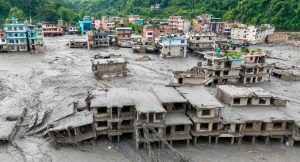
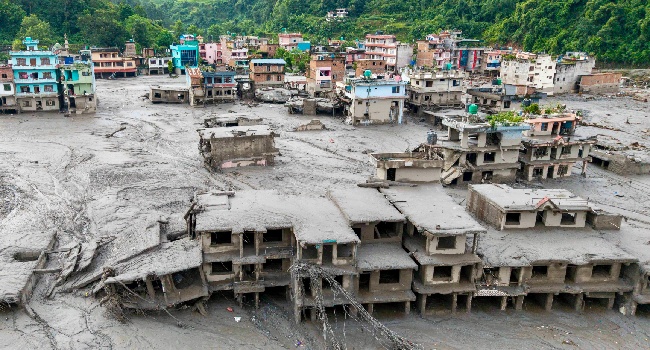
The death toll from devastating floods and landslides near the Nepal-China border has risen to 750, with more than 3,000 people still missing as rescue operations entered their fifth day on Sunday.
Nepal’s disaster authorities said 734 people had died and 2,498 remained unaccounted for, while Chinese state media reported 16 deaths and 546 missing people in Tibet.
The combined figures put the death toll at 750 and the number of missing people at 3,044 across Nepal and Tibet.
The disaster struck on Wednesday after a torrent of water, ice and debris swept through communities and hydropower projects along rivers in the Himalayan region.
Nepal’s National Disaster Risk Reduction and Management Authority said the number of missing people had risen from 2,426 recorded in its previous update on Saturday.
The authority said 589 foreign nationals were among those reported missing, while another 933 workers at hydropower projects along the affected rivers remained unaccounted for.
Rescue teams have so far rescued or recovered 8,186 people in Nepal, including 227 foreign nationals.
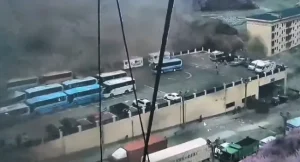
In neighbouring India, authorities said seven bodies had been recovered from rivers flowing from Nepal and were believed to be victims of the floods. The deaths have not been included in Nepal’s official toll.
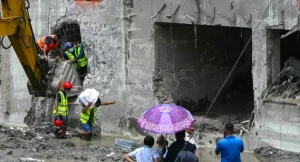
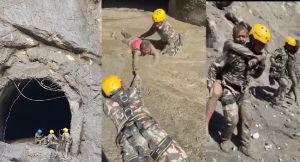
More than 100 workers are also believed to be trapped inside several hydropower tunnels in Nepal.
At the Trishuli 3A hydroelectric project, the Nepali Army inserted a pipe into one of the tunnels late on Saturday and began pumping air into the facility in an effort to sustain the trapped workers.
However, overnight rain and rising river levels continued to hamper rescue efforts, prompting disaster authorities to caution rescue teams.
India has deployed an 11-member specialised rescue team to support the operation, while China has sent a nine-member tunnel rescue team.
Rescue efforts were further complicated by the formation of a new lake near the Nepal-Tibet border following another landslide on Saturday evening.
China’s state broadcaster CCTV reported that a new barrier lake was forming about 2.8 kilometres from a previously drained lake that had posed a threat to rescue operations.
Authorities subsequently moved rescue personnel near the Gyirong border port to safer locations while China’s Ministry of Emergency Management convened experts to assess the situation.
Tibet has remained largely inaccessible to foreign journalists, making independent verification of the scale of the destruction there difficult.
Nepal’s Foreign Minister, Shisir Khanal, said rebuilding communities affected by the disaster could cost billions of dollars, while appealing to the international community for assistance.
At an army base in Bidur, a key rescue hub, relatives of missing people gathered around lists of survivors in search of their loved ones.
The disaster has also affected foreign nationals, including Australians. Cara Severino, a 24-year-old Australian woman reported missing after the floods, was found safe and well on Friday, according to her parents.
However, at least 42 Australians remain unaccounted for, many of them pilgrims who had travelled to Nepal to visit religious sites.
The precise cause of the disaster remains under investigation, although scientists and officials have linked the devastation to the vulnerability of the Himalayan region to climate-related hazards.
The United States Geological Survey said a glacial collapse near the high-altitude China-Nepal border triggered a torrent of debris downstream.
China’s state news agency, Xinhua, reported that experts concluded that a glacier on the southern slope of Lirung Peak in Nepal fractured, triggering an ice-rock avalanche.
UN climate chief Simon Stiell said the disaster highlighted the vulnerability of mountain environments to such hazards.
The International Federation of Red Cross and Red Crescent Societies estimates that as many as 93,000 people in Nepal could be affected by the disaster.
Nepal has appealed for international assistance and specialised rescue equipment, including heavy-lift drones, DNA testing kits and body-freezer storage units.
The United States and Canada have each pledged about $3.6 million in humanitarian assistance, while the United Kingdom has offered $6.8 million.
The United Nations has released $2.5 million in emergency funding, while the European Union has pledged $2.3 million.
The International Federation of Red Cross and Red Crescent Societies has allocated more than $1 million and launched an emergency appeal for $31 million.
China has also offered assistance, while Malaysia announced plans to deploy its Malaysian Special Search and Rescue Team and contribute $1 million towards recovery efforts and support for victims.
Rescue operations continued on Sunday as authorities in Nepal and China worked to locate missing people, rescue trapped workers and assess the full extent of the destruction.


Happy
0 %

Sad
0 %

Excited
0 %

Sleepy
0 %

Angry
0 %

Surprise
0 %
 0
0
 0
0