
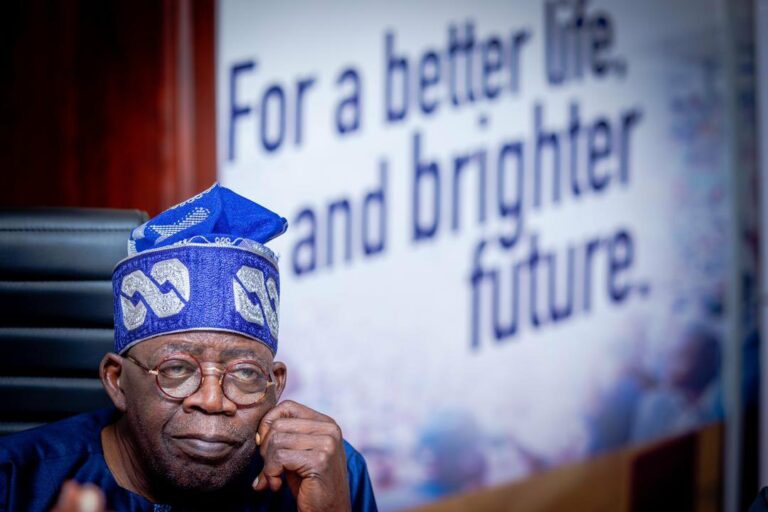
NIGERIA@66: WE WILL NOT MANAGE POVERTY, WE WILL DEFEAT IT – PRES. TINUBU
Read Time:4 Minute, 32 Second
By Aishat Momoh. O.
President Bola Tinubu has acknowledged that millions of Nigerians are still struggling to afford basic necessities, including food, school fees, medical bills and transportation, but pledged that his administration would not settle for merely managing poverty.
Tinubu made the commitment in his 66th Independence Day address to the nation on Thursday, where he said the hardship facing many households was the result of structural challenges that had accumulated over decades.
According to the President, low productivity, inadequate infrastructure, limited economic opportunities and weak institutions had contributed to the difficulties confronting Nigerians.
He, however, said his administration had a responsibility to change the country’s trajectory and progressively improve the living conditions of vulnerable citizens.
“Millions of our fellow citizens cannot wait for tomorrow. Some Nigerian families still struggle today for the next meal, the next school fee, the next medical bill, or simply enough money to get to work,” Tinubu said.
He noted that while the government could not reverse in four years problems that had accumulated over several generations, it could establish the foundation for sustained economic growth and poverty reduction.
“We cannot erase in four years what accumulated over generations. But we can change its course,” he said.
The President said the Federal Government was strengthening direct support for poor households and improving the National Social Register to ensure that social interventions reached those who genuinely needed them.
He also highlighted the Nigerian Education Loan Fund as a means of helping students from low-income families access higher education, while citing the Consumer Credit Corporation, CREDICORP, as another initiative designed to enable working Nigerians to acquire essential assets such as vehicles, solar systems and digital devices.
Tinubu said the government would continue to work with state and local governments to improve primary healthcare, basic education and other essential public services.
He also stated that salaries and pensions had been paid on time and in full since 2023, while reforms to the national pension system were being implemented to benefit retirees and vulnerable Nigerians.
The President, however, stressed that social interventions were not intended to replace economic prosperity.
“These programmes are not substitutes for prosperity. They are a bridge to aid our nation’s citizens on their path towards it. Our objective is not to manage poverty more efficiently. We will defeat it,” he declared.
Tinubu said reducing the cost of living would be a central priority in the next phase of his administration, with emphasis on lowering the cost of producing and transporting goods.
He identified increased agricultural production, mechanised irrigation, improved access to seeds and fertiliser, better storage facilities and transportation infrastructure as key measures for reducing food prices.
According to him, the government is also investing in roads, railways and ports to improve the movement of goods between farms, factories and markets.
“When a farmer produces more cheaply, when fewer crops are lost between the farm and the market, when a manufacturer spends less on electricity, when a truck reaches its destination faster, and when the business environment fosters fair competition, all those savings will ultimately find their way into the price of goods in the market,” he said.
The President also linked poverty reduction to job creation, particularly as millions of young Nigerians enter the labour market each year.
He said the government would focus on using gas to power new industries, supporting businesses seeking to revive factories, expanding digital connectivity and investing in skills demanded by employers.
“Nigeria is a young country. Millions of young Nigerians enter adulthood every year with talent, energy and ambition. Our responsibility is to ensure that this great demographic strength becomes an engine of production rather than a source of despair,” Tinubu said.
He added that jobs, enterprise and industrial growth would remain central to the administration’s economic agenda.
The address came amid the government’s continued defence of its economic reforms, which officials have argued are necessary to address long-standing structural weaknesses and establish the basis for sustainable growth.
In his May 2026 third-anniversary address, Tinubu acknowledged that the reforms had placed significant pressure on families, workers and businesses, while maintaining that the economy had begun to stabilise.
The Federal Government also acknowledged in July that improvements in macroeconomic indicators would need to translate into tangible benefits for households.
In Thursday’s address, Tinubu therefore placed renewed emphasis on closing the gap between macroeconomic recovery and the everyday experiences of Nigerians.
He said the ultimate measure of his administration’s success would be an economy that steadily lifts people out of poverty, creates productive opportunities and enables Nigerians to afford basic necessities.
“I want to see more Nigerians making things. I want to see more Nigerian farms feeding our cities and supplying our factories. I want to see Nigerian businesses selling Nigerian goods to the whole world,” he said.
Tinubu also expressed his ambition to see young Nigerians build globally competitive businesses and create employment opportunities within the country.
He concluded by urging Nigerians to remain committed to the country’s future, promising that the sacrifices associated with the reform period would eventually yield tangible benefits.
“The Promised Land before us is a Nigeria of abundance and opportunity; a nation where prosperity is broadly shared, where every child can dream beyond the circumstances of his birth, and where our country’s immense promise is finally reflected in the lives of our people,” the President said.


Happy
0 %

Sad
0 %

Excited
0 %

Sleepy
0 %

Angry
0 %

Surprise
0 %
 0
0
 0
0