

STICK TO YOUR TIMETABLE APC TELLS INEC
Read Time:4 Minute, 18 Second
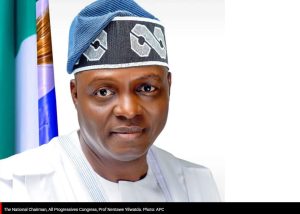
BY JENN NOMAMIUKOR
The ruling All Progressives Congress (APC) has called upon the Independent National Electoral Commission (INEC) to rigorously observe its published schedule for the 2027 general elections, emphasizing that regulatory provisions must be applied with equal rigor to all political parties.
During the visit of an ECOWAS pre–election fact–finding mission to the party‘s National Secretariat in Abuja, APC national chairman Professor Nentawe Goshwe Yilwatda articulated the demand.
In a statement issued Sunday from Abuja, Mr. Abimbola Tooki, the National Chairman’s Special Adviser on Media and Information Strategy, reported that the mission, spearheaded by former Vice-President Victor Bockarie Foh of Sierra Leone and accompanied by members of the National Working Committee (NWC), was duly received by Yilwatda.
Yilwatda asserted that the Independent National Electoral Commission ought to adhere strictly to its established schedule, emphasizing that regulatory frameworks must be applied with uniformity across all political entities.
He underscored the imperative for an electoral process characterized by fairness, transparency, and predictability, warning against any modification of deadlines that might confer an unjustified advantage upon any specific party.
According to his statement, the APC has already finalized and inaugurated its campaign council, initiated its campaign operations, and uploaded its candidate roster to the INEC portal, accomplishing these milestones ahead of its political competitors.
In his assessment, the party has fielded candidates for every elective position under contestation, a decisive advantage distinguishing it from the operational hurdles faced by certain opposition factions in both nominating contenders and finalizing their submission protocols.
He further asserted that the All Progressives Congress’s robust organizational infrastructure positions it significantly ahead of rival parties.
“As the preeminent political entity in Nigeria, our party stands unparalleled in its structure, organizational capacity, and membership base; indeed, no rival can approach our scale, boasting a size approximately threefold greater than that of the nation‘s second–largest party,” he stated.
He revealed that the party boasts a membership base of approximately 13 million individuals across all local government areas, with identity cards engineered to facilitate verification via National Identification Numbers (NIN) and voter registration details.
The chairman further noted that the APC maintains a robust membership base exceeding 261,000 executives, spanning the entire organizational hierarchy from the ward level up to the national tier.
Regarding elected representation, he highlighted the party‘s commanding position in the nation‘s executive and legislative branches, holding 31 of the 36 governorship seats, 88 of the 109 Senate positions, and 208 out of the 360 seats in the House of Representatives.Moreover, he underscored the party‘s substantial influence within the State Houses of Assembly.
“These edifices constitute the bedrock of our resilience; we have cultivated an organization with a pan–national reach, empowering us to engage Nigerians across all demographic spectrums,” he remarked.
Although Yilwatda reported that over 7,000 aspirants vied for diverse positions within the party‘s primaries, it observed a surprisingly limited number of post–primary legal challenges, a figure that stands in stark contrast to the magnitude of the contests.
He noted that numerous politicians who were unsuccessful in securing the APC endorsement subsequently secured nominations from opposition formations, including the African Democratic Congress (ADC) and the Nigeria Democratic Congress (NDC). This phenomenon, he argued, vividly illustrates the ferocity of the contest for the APC’s nomination.
Yet, Yilwatda delineated a distinct boundary separating sheer magnitude from actual dominance.
He asserted that holding the status of the nation‘s largest political party does not imply an intent to suppress any other group, emphasizing instead a commitment to fostering a democratic environment where all parties are free to organize, campaign, and garner support from Nigerians without fear.
The chairman underscored that the party‘s preparedness rested firmly on its organizational strength, the readiness of its candidates, and its nationwide infrastructure, rather than on any presumption of an inevitable victory.
He pledged to the ECOWAS mission that the APC would refrain from leveraging its dominance to stifle opposition parties, emphasizing that all political entities must be granted equitable access to media platforms, campaign infrastructure, and other legitimate avenues for presenting their policy platforms to the electorate.
Yilwatda pointed to public protests challenging President Bola Tinubu’s administration, notably the “Tinubu Must Go” demonstrations, as proof that citizens and opposition factions are capable of voicing dissent without facing automatic arrest or intimidation.
He further highlighted the political realignments that ensued following the All Progressives Congress’s setbacks in the Anambra and Osun governorship elections.
According to him, the party proactively engaged key stakeholders in the aftermath of those losses, and these dialogues proved instrumental in forging broader alliances that underpinned the campaign for Tinubu’s re–election.
Previously, Foh elucidated that the mission‘s mandate entailed conducting a political assessment designed to bolster the integrity, equity, and transparency of Nigeria’s electoral process. Our monitoring is scientific, and our decisions on issues are based on scientific observation.
We validate all information prior to issuing any declaration, employing a rigorous application framework for data collection; consequently, our reports are not arbitrary, he stated.
Foh lauded Yilwatda’s comprehensive presentation, noting that it provided the mission with invaluable insights into the APC’s organizational structure, membership composition, internal operational mechanisms, and preparations for the upcoming elections.


Happy
0 %

Sad
0 %

Excited
0 %

Sleepy
0 %

Angry
0 %

Surprise
0 %
 0
 0