
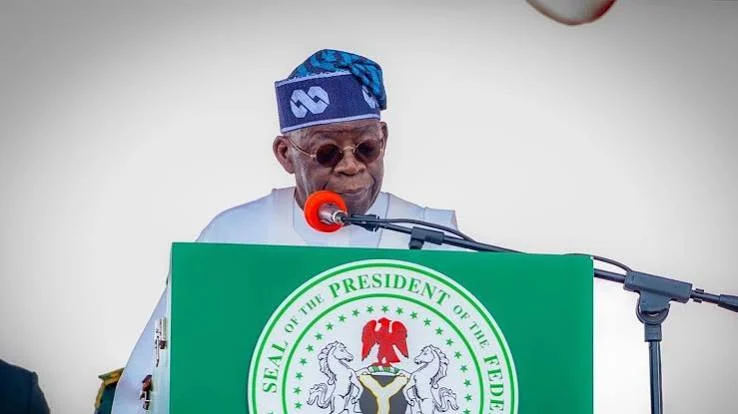
TINUBU ORDERS TOTAL RECONSTRUCTION OF BENIN-ASABA ROAD, OTHER FEDERAL HIGHWAYS
Read Time:4 Minute, 52 Second
By Aishat Momoh. O.
President Bola Tinubu has directed the total reconstruction and redesign of the Benin-Agbor-Asaba road and other major federal highways in Edo State and adjoining corridors, as the Federal Government intensifies efforts to address the deteriorating condition of critical roads across the country.
The directive was disclosed on Tuesday by the Minister of Works, David Umahi, during an on-the-spot assessment of the Benin-Agbor-Asaba highway in Edo State, where motorists and residents have endured severe gridlock, prolonged delays and rising transportation costs.
Umahi apologised to commuters over the condition of the road and took responsibility for the failure of the concession arrangement, while sharply criticising the Benin-Asaba Expressway Concessions Company (BAECC), the firm handling the reconstruction.
The highway was concessioned to BAECC in 2025 for reconstruction and expansion from four to 10 lanes. However, Umahi accused the concessionaire of lacking the technical competence required for the project and of removing asphalt from the existing road despite warnings from the ministry.
He said the President had directed the Ministry of Works to do everything possible to restore the road, stressing that temporary palliative measures would not provide a lasting solution.
According to Umahi, the ministry would redesign roads stretching from Kogi to Warri and across Edo State, with concrete pavement being considered for the reconstruction.
He said the government would also review the performance and competence of concessionaires handling major road projects, adding that public interest would take precedence where existing agreements failed to protect road users.
The BAECC chief executive officer, Samuel Daramola, attributed the slow pace of work to heavy rainfall and intense vehicular traffic, explaining that keeping the highway open while constructing drainage infrastructure had complicated the project.
However, the project consultant’s representative, Toyin Akinlapa, said the concessionaire failed to follow instructions to construct drainage facilities before proceeding with other aspects of the work.
The Chairman of the House Committee on Works, Akin Alabi, urged the Federal Government to review concession agreements to ensure that companies handling major highways had the technical and financial capacity to deliver.
Meanwhile, commuters and businesses along the Benin-Asaba corridor have continued to bear the economic consequences of the deteriorating road.
Drivers said journeys that previously took about 90 minutes now take as long as five hours, resulting in increased fuel consumption, frequent vehicle repairs and fewer trips.
A regular driver on the route, Nobel Akanuibiam, said his fuel expenditure had risen from about N20,000-N25,000 to approximately N45,000 on some journeys. He also complained that components such as ball joints and shock absorbers now require more frequent repairs.
Traders and residents said the delays had increased transportation costs and forced some businesses to close, while flooding and muddy sections of the road had further disrupted commercial activities.
The crisis is not limited to Edo State. Reports from other parts of the country indicate that several major federal highways are in poor condition, including the Ibadan-Abeokuta, Lagos-Badagry and Ibadan-Ife-Ilesa roads in the South-West; Onitsha-Enugu, Enugu-Abakaliki and Onitsha-Owerri roads in the South-East; and the East-West, Warri-Sapele and Benin-Sapele roads in the South-South.
In the North, motorists have also raised concerns over the Abuja-Kaduna, Abuja-Lokoja, Lokoja-Okene, Kaduna-Kano, Kano-Katsina, Sokoto-Gusau, Maiduguri-Damaturu, Bauchi-Jos and Gombe-Yola corridors.
FEDERAL GOVERNMENT MOVES TO FIX EKITI ROADS
The Minister of State for Works, Bello Goronyo, also inspected critical federal roads in Ekiti State, including the Ifaki-Oye-Kabba and Efon-Iwaraja roads.
At Oye-Ekiti, motorists complained that a severely damaged section of the Ifaki-Oye-Kabba Road had left articulated vehicles stranded for days.
Goronyo said emergency intervention had commenced through the Federal Roads Maintenance Agency, with equipment and materials deployed to the affected section.
He said the Federal Government was reviewing the funding arrangement for the rehabilitation contract, which was awarded to Gamji in 2025, after the contractor complained of inadequate funding.
The minister said the emergency work was expected to restore access within 48 hours, while articulated vehicles would temporarily be prevented from using the affected section.
Goronyo also inspected the Efon-Iwaraja Road and promised immediate remedial work to restore access to motorists and residents.
He described the roads as critical economic corridors linking communities and facilitating the movement of agricultural produce, goods and people between the South-West and other parts of the country.
According to him, the administration’s major road projects include the approximately 1,068-kilometre Illela-Sokoto-Badagry Highway, the 750-kilometre Lagos-Calabar Coastal Highway and the Abuja-Kaduna-Kano Road.
He said the Federal Government was determined to address the country’s road infrastructure deficit, stressing that functional roads were essential to economic growth, security, employment, agriculture and healthcare.
ZARIA ROAD RECONSTRUCTION CAUSES KANO TRAFFIC
In Kano State, ongoing reconstruction along the Zaria Road corridor has also triggered traffic congestion and delays for motorists and commuters.
The work is being carried out along an estimated 1.5-kilometre stretch from the Ado Bayero Flyover, popularly known as Gadar Lado, towards Unguwa Uku Motor Park.
The reconstruction has narrowed the available carriageway, causing significant traffic build-up, particularly during peak periods.
The development has raised concerns among motorists who rely on the busy route to connect different parts of Kano metropolis.
Details on the project’s total cost, contractor, duration and expected completion date were not immediately available.
The Federal Government has nevertheless maintained that the series of interventions form part of President Tinubu’s broader directive to address critical road failures nationwide.
For motorists, traders and communities affected by the deteriorating highways, however, the immediate priority remains the same: restoring safe, reliable and accessible roads to reduce travel time, transport costs and the wider economic burden created by Nigeria’s failing road infrastructure.


Happy
0 %

Sad
0 %

Excited
0 %

Sleepy
0 %

Angry
0 %

Surprise
0 %
 0
0
 0
0