
WORLD FACES GROWING NUCLEAR THREAT, RESEARCHERS WARN
Read Time:3 Minute, 41 Second
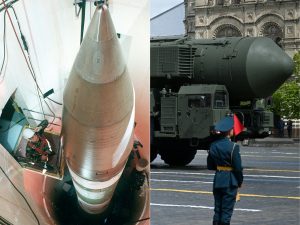
(FILES) This US Air Force handout file image shows an Air Force technician inspecting an LGM-30G Minuteman III missile inside a silo about 60 miles from Grand Forks Air Force Base, in North Dakota. (FILES) A RS-24 Yars intercontinental ballistic missile system drives across Red Square during the Victory Day military parade in central Moscow on May 9, 2025.. The last nuclear treaty between Russia and the United States expired on February 5, 2026, abruptly ending decades of restrictions on how many warheads the two top powers can deploy and triggering fears of a global arms race. (Photo by Kirill KUDRYAVTSEV and Handout / various sources / AFP)
By: Muftau Fatimo
Researchers warned on Monday that nuclear-armed states were taking their arms out of storage and putting them on delivery systems, as the weapons of mass destruction are playing an increased role in global politics.
The Stockholm International Peace Research Institute (SIPRI) said the world’s nuclear powers had an estimated total of 12,187 warheads, with about 9,745 of them in stockpiles for potential use.
That was a marginal decrease compared to the year before, as since the end of the Cold War old warheads have generally been dismantled more quickly than new ones have been deployed, resulting in a decrease in the overall number.
The more worrying news is that even though we have lower numbers of nuclear weapons, the level of nuclear dangers and nuclear risks are rising,” SIPRI director Karim Haggag told AFP.
SIPRI also predicts that the trend of declining nuclear arms stockpiles is likely to be reversed in the coming years “as the pace of dismantlement is slowing, while the deployment of new nuclear weapons is accelerating”, it said in a statement.
Haggag also listed several worrying signs, such as a breakdown in strategic arms controls such as international agreements and competition between great powers with nuclear arms.
Out of storage –
Another worrying trend is one “whereby states that have nuclear weapons are taking them out of storage and deploying them on nuclear-capable delivery systems. And so we see more deployed nuclear weapons”, Haggag said.
The United States and Russia together hold around 83 percent of the world’s stockpile of nuclear arms, with more than 5,000 warheads each.
Both countries have programmes to modernise their arsenals but both have also run into challenges.
The United States’ nuclear modernisation programme is progressing but has faced “planning and funding challenges that are likely to further delay and significantly increase the cost of the programme”, SIPRI said.
Russia’s programme has also struggled with failed tests of intercontinental ballistic missiles (ICBMs) while economic sanctions and competing demands linked to the war in Ukraine also seem to have had an effect.
Geopolitical competition –
China is expanding its nuclear arsenal faster than any other country.
“Intensifying geopolitical competition means a very strong incentive on the part of China to increase its reliance on nuclear weapons,” Haggag said.
SIPRI estimates that China now has 620 warheads and, depending on how it decides to structure its forces, could have as many ICBMs as the United States and Russia by 2030.
But the institute noted that even if the country reaches 1,000 nuclear warheads by that time it will still only correspond to a quarter of each of the US and Russian stockpiles.
In Europe, France and the UK kept their nuclear arsenals steady at 290 and 225 respectively but SIPRI noted that the UK’s stockpile is expected to grow following a 2021 review that recommended a raised ceiling.
France’s President Emmanuel Macron likewise in March ordered an increase of the French stockpile.
SIPRI said that India is believed to have slightly expanded its nuclear arsenal to 190.
India’s neighbour and arch-rival Pakistan’s number remained stable at 170 but the country continued to accumulate fissile material, “suggesting that its nuclear arsenal might expand over the coming decade”.
North Korea is also continuing to “fulfil its stated goal of ‘exponentially’ expanding its nuclear arsenal,” according to SIPRI, which estimates that North Korea has about 60 nuclear warheads.
Israel, which does not acknowledge its nuclear weapons, is also believed to be modernising its arsenal, which SIPRI estimated was about 90 warheads at the start of the year.
AFP


Happy
0 %

Sad
0 %

Excited
0 %

Sleepy
0 %

Angry
0 %

Surprise
0 %
 0
0
 0
0