

INSECURITY: SOUTHERN STATES TO INTRODUCE RESIDENTS’ ID CARD SCHEME, REGIONAL SECURITY FUND
Read Time:3 Minute, 36 Second
By ‘Leke Yusuf
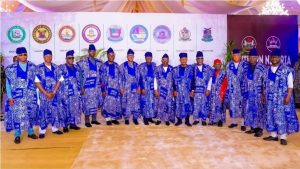
Governors and traditional rulers from the three geopolitical zones of Southern Nigeria gathered in Iperu, Ogun state, to discuss pressing issues affecting the regions.
Hosted by Ogun Governor Dapo Abiodun, the meeting focused on regional security, cooperation, and shared development priorities.
The leaders reviewed the country’s security situation, expressing concern over recent attacks on military personnel in Borno and mass abductions in Kebbi, Kwara, and Niger states.
They commended President Bola Tinubu’s efforts to stabilize the economy, tackle inflation, strengthen security institutions, and push ahead with major infrastructure projects like the Lagos-Calabar coastal road and the Sokoto-Badagry superhighway.
Key resolutions adopted at the meeting include the creation of a zonal security fund to enhance regional security, an improved intelligence-sharing system to combat crime, and renewed advocacy for state police to tackle internal security challenges.
The leaders also supported a unified resident identification scheme and stronger backing for regional and local security outfits.
The governors and traditional rulers urged member states to collaborate with traditional rulers to regulate land allocation and tackle illegal mining, which has contributed to insecurity in some parts of the country.
They passed a vote of confidence in President Tinubu and reiterated the long-standing position of the southern region, as articulated in the 2021 Asaba Accord, which supports a president from the south.
The southern states remain united and committed to peaceful coexistence across religious and cultural lines.
The region will continue to work with the federal government to promote peace, prosperity, and inclusive development, ensuring that the country moves forward in a unified and sustainable manner.
RESOLUTIONS:
1. Creation of a Zonal Security Fund: Member states of each geopolitical
zone will contribute to a dedicated fund to support zonal security operations
and capacity building. A monthly Zonal Security Coordination Meeting of
Security Advisers will be institutionalized.
2. Enhanced Intelligence Communication Infrastructure: The Forum
adopted an intelligence-sharing framework supported by modern
communication equipment and surveillance technologies, enabling real-
time monitoring and coordinated responses across states. To this end, the
forum resolved that each member state in each zone (that is SW, SE & SS)shall jointly invest in equipment that will allow effective communication
across states lines.
3. Advocacy for State Policing: The Forum reiterated its longstanding call for
the establishment of State Police as a constitutional imperative. It
emphasized that the success of community-based and regional security
outfits underscores the urgent need for decentralized policing.
4. Resident Identification Programme: Member states were encouraged to
collaborate with the National Identity Management Commission (NIMC) to
implement a unified state resident identification system.
5. Support for Regional Security Structures: The Forum resolved to enhance
regional and local security outfits including hunter associations and
community-based surveillance units through the provision of equipment,
logistics, and operational support.
6. Governance of Land and Mining Activities: States were urged to partner
with traditional rulers to regulate land allocation and prevent indiscriminate
practices that could lead to security risks. The Forum also resolved to
combat illegal mining activities, which have caused significant ecological
damage, by working with environmental authorities and traditional councils.
7. Institutional Strengthening of Traditional Councils: Member states were
encouraged to provide direct financial and operational support to their
traditional councils, enabling them to play a more effective role in
governance, security, and peacebuilding.
In a strong demonstration of unity, the Forum and the Southern Nigeria
Traditional Rulers Council jointly passed a Vote of Confidence in President Bola
Ahmed Tinubu, GCFR, in recognition of his leadership and unwavering
commitment to national stability and reform.
The Forum recalled the Asaba Accord, wherein Southern Governors, in May 2021,
unanimously advocated for a President of Southern extraction. Again, the forum
restates its support for a Southern President and in person of President Bola
Ahmed Tinubu GCFR.
Finally, the Forum addressed attempts to sow discord and propagate
disinformation and fear within the region. It reassured all citizens that Southern
Nigeria remains united, indivisible, and committed to peaceful co-
existence across religious and cultural lines. The Forum pledged to continue
speaking with one voice, advancing the collective interests of the South, and
working collaboratively with the Federal Government to promote peace,
prosperity, and progress for all Nigerians.


Happy
0 %

Sad
0 %

Excited
0 %

Sleepy
0 %

Angry
0 %

Surprise
0 %
 0
0
 0
0