
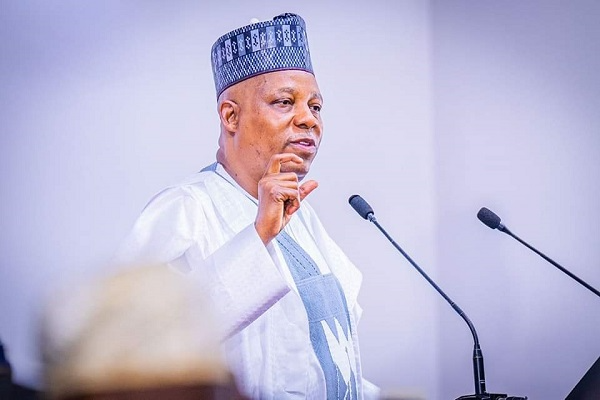
SHETTIMA LEADS NIGERIA DELEGATION AS ECOWAS HOLDS 68TH HEADS OF STATE SUMMIT IN ABUJA
Read Time:3 Minute, 30 Second
By Aishat Momoh. O.
President Bola Tinubu on Sunday attended the 68th Ordinary Session of the ECOWAS Authority of Heads of State and Government at the State House Conference Centre, Abuja, as West African leaders convened to deliberate on the future of the regional bloc amid growing political and security challenges.
Despite being in the country, Tinubu delegated Vice President Kashim Shettima to lead Nigeria’s delegation to the summit, marking the first time Shettima has headed an ECOWAS meeting on home soil while the President remains present in Nigeria. No official explanation was given for the decision.
Tinubu had served as Chairman of the Economic Community of West African States from July 2023 to July 2025, before handing over the leadership of the bloc to President Julius Bio of Sierra Leone.
The summit, which commenced at about 3:00 p.m. local time, featured a “special debate on the future of the Community,” according to the draft agenda obtained by reporters. The meeting comes at a critical moment for ECOWAS following years of political instability, military coups and strained relations among member states.
Leaders present at the summit included ECOWAS Chair and Sierra Leonean President Julius Bio; President Patrice Talon of Benin; President José Maria Neves of Cabo Verde; President Alassane Ouattara of Côte d’Ivoire; President Adama Barrow of The Gambia; President John Mahama of Ghana; President Umaro Embaló of Guinea-Bissau; President Joseph Boakai of Liberia; President Bassirou Faye of Senegal; and President Faure Gnassingbé of Togo.
Mahama recently returned as Ghana’s president in January 2025, succeeding Nana Akufo-Addo.
The public opening ceremony featured welcome remarks by the host country, a statement by ECOWAS Commission President Dr. Omar Touray, and an opening address by President Julius Bio. The Chief of the United Nations Office for West Africa and the Sahel (UNOWAS), Leonardo Santos Simão, and the African Union Commissioner for Political Affairs, Peace and Security, Bankole Adeoye, were also scheduled to address the gathering before deliberations moved into a closed-door session.
Items listed for consideration at the summit include the 2025 State of the Community Report, updates from the ECOWAS Mediation and Security Council, and a report on the ECOWAS Trade Liberalisation Scheme. Leaders are also expected to review special country reports on Guinea-Bissau and Benin, confirm a host country for the West African Health Organisation headquarters, and assess the transition process in Guinea.
The meeting follows five turbulent years for West Africa, marked by a wave of military coups in Mali (2020 and 2021), Burkina Faso (two coups in 2022), and Niger (2023). These developments severely strained the regional order and culminated in the juntas in Niger, Mali and Burkina Faso announcing their withdrawal from ECOWAS in early 2024.
Recent flashpoints include an attempted coup in Benin on December 7, 2025, and renewed political instability in Guinea-Bissau, which former Nigerian President Goodluck Jonathan described as a “ceremonial coup.”
Following the attempted coup in Benin, President Tinubu, acting on requests from the Beninese government, ordered the deployment of Nigerian jets and troops to support efforts to restore calm. The Nigerian Senate subsequently approved the deployment of troops to the Republic of Benin on December 9.
Benin’s foreign ministry has confirmed that about 200 West African soldiers, mainly from Nigeria and Côte d’Ivoire, are currently deployed in the country. Officials have noted that Benin’s stability is closely tied to Nigeria’s economic interests, as Cotonou’s port serves as a major gateway for Nigerian-bound goods, including vehicles and consumer products.
The Sèmè border crossing along the Lagos–Abidjan corridor remains one of the busiest trade and commuting routes in West Africa. In addition, the 2,000-kilometre Niger–Benin export pipeline, built by China, transports crude oil from landlocked Niger to the offshore terminal at Sèmè-Kpodji, making Benin a strategic energy hub.
At the Abuja summit, ECOWAS leaders are also expected to deliberate on tighter regional security cooperation, possible sanctions, and economic integration tools aimed at stabilising the bloc. The leaders will review the ECOWAS Commission President’s report and set the date and venue for the 69th Ordinary Session of the Authority of Heads of State and Government.


Happy
0 %

Sad
0 %

Excited
0 %

Sleepy
0 %

Angry
0 %

Surprise
0 %
 0
0
 0
0