
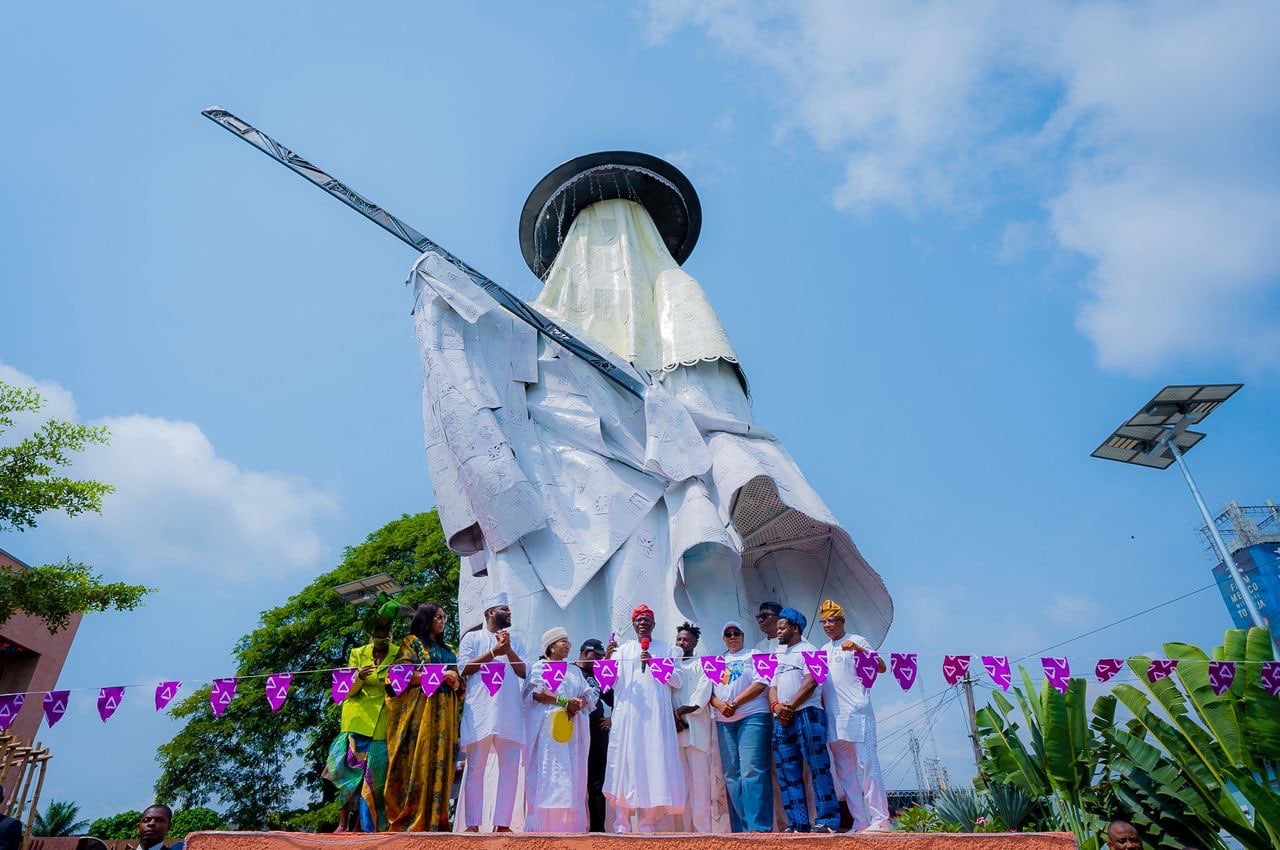
SANWO-OLU UNVEILS EYO MONUMENT, REAFFIRMS LAGOS’ CULTURAL HERITAGE DRIVE
Read Time:3 Minute, 7 Second

By: Sefiu Ajape
The Governor of Lagos State, Mr. Babajide Sanwo-Olu, on Friday commissioned the Eyo Monument at the John Randle Centre for Yoruba Culture and History in the Onikan area of Lagos Island.

The commissioning comes days after the Lagos State Government issued a travel advisory on Wednesday, announcing widespread traffic restrictions on Lagos Island ahead of the Eyo Festival scheduled for Saturday, December 27, 2025.
Speaking last Sunday at the ‘Ijade Opa Eyo’ ceremony held at Marina, Sanwo-Olu expressed delight that the festival would hold this year.
According to the Lagos State Government, the nearly 40-foot-high monument is “a powerful symbol of Lagos’ heritage” and is expected to provide “a major boost to the state’s cultural tourism drive,” serving educational and tourism purposes while contributing to the state’s economic and cultural development.
These details were contained in a statement shared on Friday by the governor’s Special Adviser on Media and Publicity, Gboyega Akosile, titled, “Sanwo-Olu commissions Eyo monument, reaffirms commitment to Lagos’ cultural identity.”
Speaking at the commissioning ceremony, Sanwo-Olu said the monument represents the essence of Lagos culture and identity, adding that its location within the John Randle Centre for Yoruba Culture and History, Onikan, makes it “a fitting landmark for preserving and showcasing Yoruba art, history and tradition.”
The governor noted that the Eyo, as a cultural symbol, tells the story of Lagos to the world, explaining that the newly commissioned monument would serve as a unique attraction for visitors.
He said the monument would provide a space “where visitors can learn, take photographs and share the history of the state.”
Sanwo-Olu added that the installation of the Eyo monument reinforces Lagos’ commitment to protecting its cultural assets while positioning the state as a global destination for arts and heritage tourism.
He commended the curator, Dotun Popoola, for his craftsmanship and intellectual depth, describing the work as “a reflection of Nigerian creativity and excellence,” and noted that the project demonstrates how indigenous talent can be harnessed to interpret and preserve history through art.
The governor also highlighted that the John Randle Centre for Yoruba Culture and History offers a comprehensive cultural experience, with facilities including exhibition spaces, an amphitheatre, a village square, a gift shop and other creative activations designed to immerse visitors in Yoruba culture.
While acknowledging the support of the Ministry of Tourism, Arts and Culture, stakeholders and traditional institutions, Sanwo-Olu particularly recognised the Oba of Lagos, Oba Rilwan Akiolu, stressing that collaboration between government, cultural institutions and traditional authorities is essential for sustaining Lagos’ rich cultural legacy.
Earlier, the Chief Executive Officer of the John Randle Centre for Yoruba Culture and History, Qudus Onikeku, described the Eyo monument as a major cultural achievement for Lagos.
He said the structure was deliberately designed to allow visitors to explore its interior, where “the story of Lagos, its communities and its history will be showcased through exhibitions and installations.”
Onikeku noted that the monument, created by curator and renowned Nigerian artist, Dotun Popoola, stands on a six-foot base and rises to almost 40 feet, making it the tallest of its kind in Lagos State.
He disclosed that plans are underway to produce a documentary film chronicling the story of the monument, the Eyo tradition and the broader cultural heritage of Lagos, adding that the project will deepen public engagement with the state’s history.
Also speaking, Popoola said the Eyo monument was conceived as a storytelling structure that reflects the diverse areas and historical journey of Lagos.
He explained that visitors would be able to climb into the monument to explore curated spaces and visual narratives that interpret the state’s cultural evolution.


Happy
0 %

Sad
0 %

Excited
0 %

Sleepy
0 %

Angry
0 %

Surprise
0 %
 0
0
 0
0