
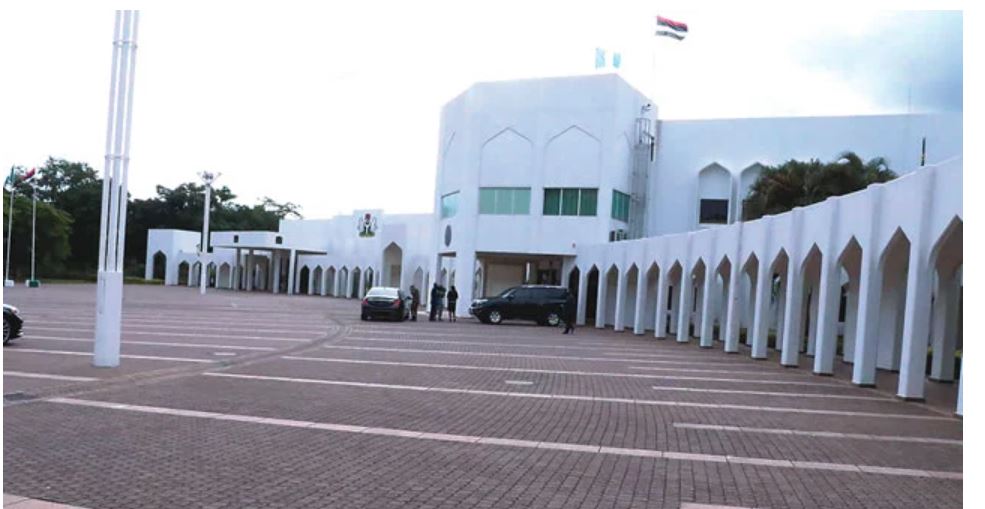
ASO ROCK SET TO DISCONNECT FROM NATIONAL GRID IN MARCH – PERM SEC
Read Time:3 Minute, 45 Second

By: Balogun Ibrahim
The Aso Rock Presidential Villa is set to fully disconnect from the national electricity grid by March 2026 following the completion of its solar power project, the State House Permanent Secretary, Temitope Fashedemi, has revealed.
Fashedemi made the disclosure on Wednesday while presenting and defending the State House 2026 budget before the Senate Committee on Special Duties at the National Assembly complex in Abuja.
According to details of the proceedings shared with State House correspondents by the Presidency, he informed the committee, chaired by Senator Kaka Lawan (Borno Central), that the solar power installation was completed towards the end of 2025 and has been undergoing testing since December.
“We are optimistic that by March we will be able to achieve a full cutover,” Fashedemi said, noting that the transition is expected to generate substantial cost savings for the government.
He pointed to the State House Medical Centre as evidence of the project’s effectiveness, explaining that the facility completed its own solar installation in May 2025 and has been operating entirely without generator power since then.
He explained, “Since that time, the generator at the State House Medical Centre has not been switched on for a single minute since May of last year. Only for a few months did we draw about three per cent of power from AEDC (Abuja Electricity Distribution Company); the rest has come entirely from the solar system and battery storage.”
The Federal Government had allocated N10 billion in 2025 for the “Solarisation of the Villa with Solar Mini Grid” project, a move that drew criticism from some Nigerians who argued that installing solar panels at Aso Rock highlighted the administration’s inability to resolve the country’s unstable power supply.
The 2026 Appropriation Bill includes an additional N7 billion for the project.
Defending the initiative, the Director-General of the Energy Commission of Nigeria, Mustapha Abdullahi, stated in April 2025 that it was unsustainable for the Villa to continue paying an estimated N47 billion annually on electricity.
Bayo Onanuga, Special Adviser to the President on Information and Strategy, also cited the White House’s use of solar energy as a model for the project.
Prior to the solar transition, the State House had racked up nearly N1 billion in electricity debts.
In February 2024, the Abuja Electricity Distribution Company (AEDC) ranked the Presidential Villa among the top government debtors, with an outstanding bill of N923.87 million.
Following a reconciliation process, the outstanding electricity debt was revised to N342.35 million, which President Bola Tinubu ordered to be paid immediately.
Fashedemi informed senators that the testing phase of the solar project had revealed systemic overbilling by AEDC, with some transformers charging for electricity that was never supplied.
He explained, “During the testing phase, we discovered significant overbilling. Several transformers were billing for power that was not actually delivered. We are using this period to address the issue with AEDC and hopefully reconcile this legacy liability.”
The Permanent Secretary expressed confidence that once the full solar cutover is completed, the Villa’s ageing generators, installed when the complex was first built, would no longer be necessary.
“We’ve been under considerable pressure from service providers to replace the generators,” he said, adding, “But given the performance we are seeing at the State House Medical Centre, we are confident that after the cutover, replacement won’t be required. Perhaps we will keep a couple as backup, but the solar infrastructure should be sufficient.”
Meanwhile, Senator Kaka Lawan criticised the N127 million allocation for SUVs in the State House budget, calling it grossly inadequate. “I will join my colleague Aminu in rejecting the N127 million for SUV cars in the Villa. It is not even enough to buy a bulletproof used vehicle,” the committee chairman said.
He added, “We cannot have a situation where a visiting president is forced to use a tokunbo (fairly used vehicle) at the airport. That is completely unacceptable.”
Senator Lawan directed the Budget Office of the Federation to review the allocation upward, stressing, “They must do justice to your request and not reduce it to a paltry sum that would only purchase a tokunbo.”
The senator also praised the State House for appearing before the committee on schedule, saying it set a positive example for other ministries, departments, and agencies.
“If the State House can appear before this committee as you have, there is no reason why other MDAs should not follow. You have led by example,” Lawan said.


Happy
0 %

Sad
0 %

Excited
0 %

Sleepy
0 %

Angry
0 %

Surprise
0 %
 0
0
 0
0