
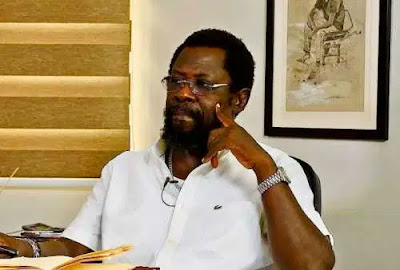
2027 ELECTION: FAROTIMI CLAIMS NIGERIA DOESN’T CONDUCT TRUE ELECTIONS
Read Time:4 Minute, 22 Second
By: Balogun Ibrahim
ABUJA – The National Organising Secretary of Afenifere, Barrister Dele Farotimi, has alleged that Nigeria does not hold genuine elections, warning that the country’s political system gives citizens little real influence over who governs them.
His comments come amid growing debates over the credibility of Nigeria’s electoral system ahead of the 2027 Nigerian general election, with participants at a Christian political forum urging citizens to unite around common national issues to achieve meaningful change.
Farotimi spoke alongside Pastor Bosun Emmanuel, Executive Secretary of the Christian Social Movement of Nigeria (CSMN), and Luka Binniyat, spokesman of the Middle Belt Forum, during a Christian Consultative Assembly held over the weekend via Zoom and organised by CSMN.
During the discussion, Farotimi assessed Nigeria’s political and electoral system, delivering a blunt conclusion.
“It therefore behoves me to state clearly that you do not have elections in Nigeria, and you truly need to stop lying to yourselves, especially since this is a gathering of Christians. Christians are meant to be servants of truth, because the living God is the God of truth. What we have is a hollow ritual that pretends to be an election,” Farotimi said.
He cautioned that discussions about political ‘options’ are meaningless if the system does not allow citizens to genuinely determine outcomes.
“To talk about options suggests that something may genuinely be chosen. It suggests that you have agency over your choice. The unfortunate news I bring this afternoon is that you do not have such rights. You do not have those options as things stand today.
“The reality is that you are not citizens. Citizens vote, or at the very least take for granted that their votes will count, because they are citizens. A citizen is a subject of the law of the country… where Mr A, B, C, D and whoever else are treated exactly the same in the eyes of the law. That is a place ruled by law.”
READ MORE…
ARMY WARNS OF IPOB-LINKED ONLINE CAMPAIGN TO UNDERMINE OPERATIONS IN SOUTHEAST
Farotimi further linked Nigeria’s political challenges to what he described as a flawed foundational idea that has shaped the country’s governance.
“A flawed idea governs Nigeria. From its founding, the country was structured around a very poor concept, and that idea has shaped its rule to this day. This concept is rooted in feudalism combined with religion,” Farotimi said.
“That is why our votes were not counted in 2023, and why the National Assembly remains so overwhelmingly ineffective,” Farotimi claimed.
Despite his criticism, he stressed that peaceful change is still achievable if citizens organise and engage strategically.
“There is only one way to change Nigeria peacefully, and that is still through the electoral process, even though it is not properly organised. Mobilise around ideas, not personalities or narrow interests.
“The Christian child desires quality education just as much as the Muslim child. The Muslim seeks security just as much as the Christian,” he advised.
Farotimi also highlighted low voter turnout as a factor that makes electoral manipulation easier.
“Even according to INEC’s own figures, there were about 90 million registered voters in the last election, yet barely 20 million actually cast their votes. The only way to change that is through organisation,” he said.
Speaking from the perspective of the Middle Belt, Binniyat noted that religion has historically played a significant role in politics worldwide.
“When it comes to politics, religion is an important factor across the globe,” he said, adding that communities in the Middle Belt have historically fought for political autonomy within the former Northern Region.
“When Nigeria was preparing for independence, while other regions competed for power, the Middle Belt was fighting for freedom from the domination of the Fulani emirate system,” Binniyat said.
He added that political alliances between regions could influence future elections.
“If the Middle Belt and the South collaborate politically, their combined numbers could secure a national election. We need a president who will genuinely consider the interests of every citizen in this country,” he said.
Forum participants also raised questions about unity within the Christian community and how religious groups can help address Nigeria’s political challenges.
In response, Farotimi emphasized that Nigerians across the country face many shared struggles and can achieve progress if they organise around common ideas.
“Across Nigeria, there are people willing to work together if they recognise the strength and sincerity of your ideas.
“It will not be easy. I am not wearing rose-tinted glasses—it won’t be a walk in the park. But that is no reason not to try,” Farotimi stated.
Earlier, Pastor Emmanuel explained that the Christian Social Movement of Nigeria was established to encourage greater Christian participation in governance and public affairs.
“The Nigerian church has two main arms: the Christian Association of Nigeria and the Christian Social Movement of Nigeria,” he said, noting that while the Christian Association of Nigeria focuses on promoting Christian unity, CSMN, founded in 2000, seeks to mobilise Christians around social and political issues.
“We are dedicated to fostering a new mindset… If we can organise and unite the community effectively, meaningful change is possible,” the cleric added.


Happy
0 %

Sad
0 %

Excited
0 %

Sleepy
0 %

Angry
0 %

Surprise
0 %
 0
0
 0
0