
FG LAUNCHES UNIFIED POVERTY REGISTER, TARGETS N3.2TN TO BOOST PROSPERITY
Read Time:4 Minute, 45 Second

By: Balogun Ibrahim
The Federal Government has unveiled a unified national poverty register and proposed a N3.2tn humanitarian and poverty reduction fund to streamline interventions, enhance coordination, and promote sustainable economic growth nationwide.
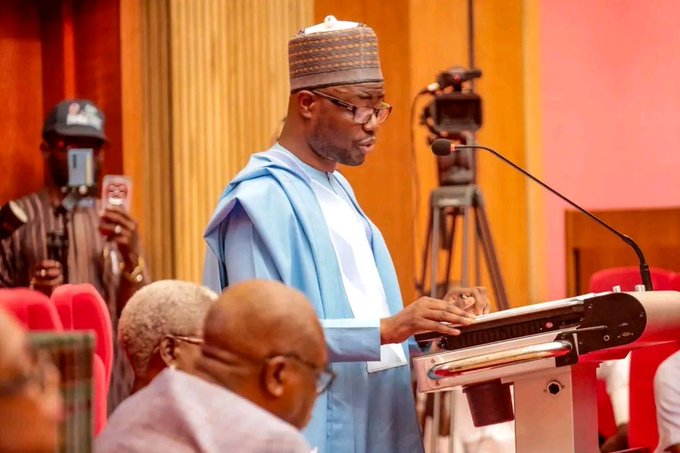
The initiative was announced on Tuesday during a workshop on the One Humanitarian One Poverty Response System. Speaking at the event, the Minister of Humanitarian Affairs and Poverty Reduction, Bernard Doro, said the programme would consolidate fragmented efforts into a single, outcome-driven framework focused on long-term impact.
According to him, the unified register is designed to support individuals in transitioning out of poverty through skills development, asset provision, livelihood support, coaching, and mentoring. Beneficiaries who achieve economic stability would then be moved to a Unified National Growth Register for continued monitoring, aimed at sustaining progress and preventing a return to vulnerability.
Doro stressed the importance of a coordinated national framework, noting that the One Humanitarian One Poverty Response System (OHOPRS) would unify currently fragmented strategies and data systems. He explained that the initiative would consolidate multiple existing registers into a single national database, improving efficiency and alignment.
He further stated that the system would strengthen monitoring and governance by replacing manual tracking processes with real-time digital tracking, while introducing structured coordination and a clear exit strategy for beneficiaries. According to him, OHOPRS would also enable a more comprehensive approach to poverty evaluation.
The minister emphasised that tackling poverty requires addressing its multidimensional nature, adding that strong collaboration across government institutions would be critical to the success of the initiative.
Doro stressed the importance of a coordinated national framework, noting that the One Humanitarian One Poverty Response System (OHOPRS) would unify currently fragmented strategies and data systems. He explained that the initiative would consolidate multiple existing registers into a single national database, improving efficiency and alignment.
He further stated that the system would strengthen monitoring and governance by replacing manual tracking processes with real-time digital tracking, while introducing structured coordination and a clear exit strategy for beneficiaries. According to him, OHOPRS would also enable a more comprehensive approach to poverty evaluation.
The minister emphasised that tackling poverty requires addressing its multidimensional nature, adding that strong collaboration across government institutions would be critical to the success of the initiative.
A breakdown of the proposed funding indicates that N1.5tn is expected from the Federal Government, N800bn from development partners, N600bn from the private sector and impact finance, and N300bn from climate and global funds.
Officials said the fund would attract contributions from multilateral and international partners, including development institutions, donor agencies, and philanthropic organisations. They added that the initiative is designed to reduce fragmentation, improve efficiency, and strengthen coordination in poverty intervention efforts.
Describing the reform as far-reaching, the minister said the initiative marks a shift from short-term relief measures to long-term, results-driven outcomes. He noted that the OHOPRS represents a national framework aimed at moving citizens from poverty to prosperity, with a renewed focus on sustainable economic advancement.
Also speaking, the Statistician-General of the Federation and Chief Executive Officer of the National Bureau of Statistics, Adeyemi Adeniran, highlighted the critical role of reliable data in tackling poverty. He warned that without timely, credible, and interoperable data, interventions risk becoming fragmented, duplicative, and misaligned with the needs of vulnerable populations.
Citing recent figures, Adeniran said about 63 per cent of Nigeria’s population—roughly 133 million people—are multidimensionally poor, with major deprivations recorded in housing, sanitation, health, education, and security.
He added that findings from both national and international assessments reinforce the need for an integrated, data-driven approach, stressing that the figures represent real households and communities whose vulnerabilities require coordinated and evidence-based responses.
Adeniran said the success of the new system would depend largely on data integrity and strong institutional collaboration. He explained that the National Bureau of Statistics would play a central role in ensuring data quality and harmonisation, stressing the agency’s commitment to upholding robust statistical standards.
According to him, this includes harmonising datasets, strengthening metadata documentation, and ensuring that all data integrated into the system meets national quality benchmarks. He noted that only verified and standardised data would be used, warning that poor-quality data could undermine the entire initiative and erode public trust.
He emphasised that high-quality data is essential for accurate targeting and effective implementation, adding that the NBS is also focused on enabling interoperability across systems. This, he said, would allow seamless data-sharing among ministries, departments, and agencies involved in poverty and humanitarian programmes.
Adeniran further disclosed that the bureau is working closely with relevant institutions to enhance data systems, including efforts to adopt national metadata standards and assign unique identifiers to beneficiaries and citizens. He added that collaboration with agencies such as the National Identity Management Commission is already underway to support secure data-sharing while safeguarding privacy and security.
Adeniran disclosed that the bureau recently strengthened its data protection efforts through a collaboration with the National Data Protection Commission, aimed at ensuring that all data generated and integrated into the system remains secure and compliant with privacy standards.
He emphasised the need for collective action, noting that the provision of strong analytical capacity would be critical to supporting informed decision-making. He added that collaboration among stakeholders has been identified as a key pillar for the success of the initiative.
According to him, no single institution can effectively tackle the complexities of poverty and humanitarian challenges alone. He stressed the importance of partnerships across government, development partners, civil society, and the private sector to build a system that is transparent, inclusive, and responsive, describing the workshop as a significant step toward achieving that goal.


Happy
0 %

Sad
0 %

Excited
0 %

Sleepy
0 %

Angry
0 %

Surprise
0 %
 0
0
 0
0