
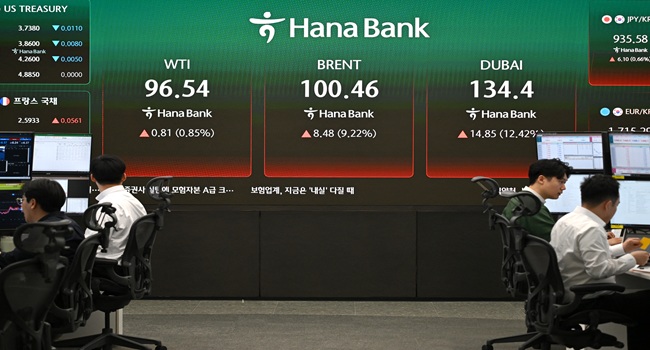
GLOBAL STOCKS TRADE MIXED, OIL ADVANCES AFTER US AND IRAN SEEK END TO ATTACKS
Read Time:1 Minute, 49 Second
Global investors remained cautious on Monday following last week’s market turbulence driven by the Middle East conflict and growing fears that the artificial intelligence (AI) boom may have inflated a technology bubble.
Although expectations are rising that the United States and Iran could reach an agreement to end hostilities and fully reopen the Strait of Hormuz, tensions remain high after recent military exchanges disrupted shipping through the strategic waterway.
The US Central Command said it struck 10 Iranian military targets in response to what it described as continued aggression against commercial vessels. Iran, in turn, claimed responsibility for attacks on US bases in Kuwait and Bahrain, both of which condemned the strikes.
Despite the hostilities, reports indicate Washington and Tehran have agreed to halt further attacks and continue negotiations in Qatar, raising hopes for a diplomatic resolution.
Oil prices rebounded, with West Texas Intermediate crude rising more than one percent, while global stock markets delivered mixed performances. Gains were recorded in Hong Kong and several Asia-Pacific markets, while Tokyo, Seoul, and Singapore closed lower.
Technology stocks remained under pressure amid concerns that AI-related valuations have become overstretched. Investors are increasingly questioning when companies will begin generating returns on the massive sums invested in artificial intelligence.
The Bank for International Settlements warned that disappointment in AI-related returns could trigger a sharp decline in investment and broader market corrections.
Market attention is now shifting to upcoming US jobs data, which could influence the Federal Reserve’s interest-rate decisions. Strong employment figures may reinforce expectations of higher rates for longer, while weaker data could ease pressure on growth and technology stocks.


Happy
0 %

Sad
0 %

Excited
0 %

Sleepy
0 %

Angry
0 %

Surprise
0 %
 0
0
 0
0