MAN FOUND ALIVE EIGHT DAYS AFTER DEVASTATING QUAKES IN VENEZUELA
Read Time:3 Minute, 14 Second
By; Ganiyat Sunmola
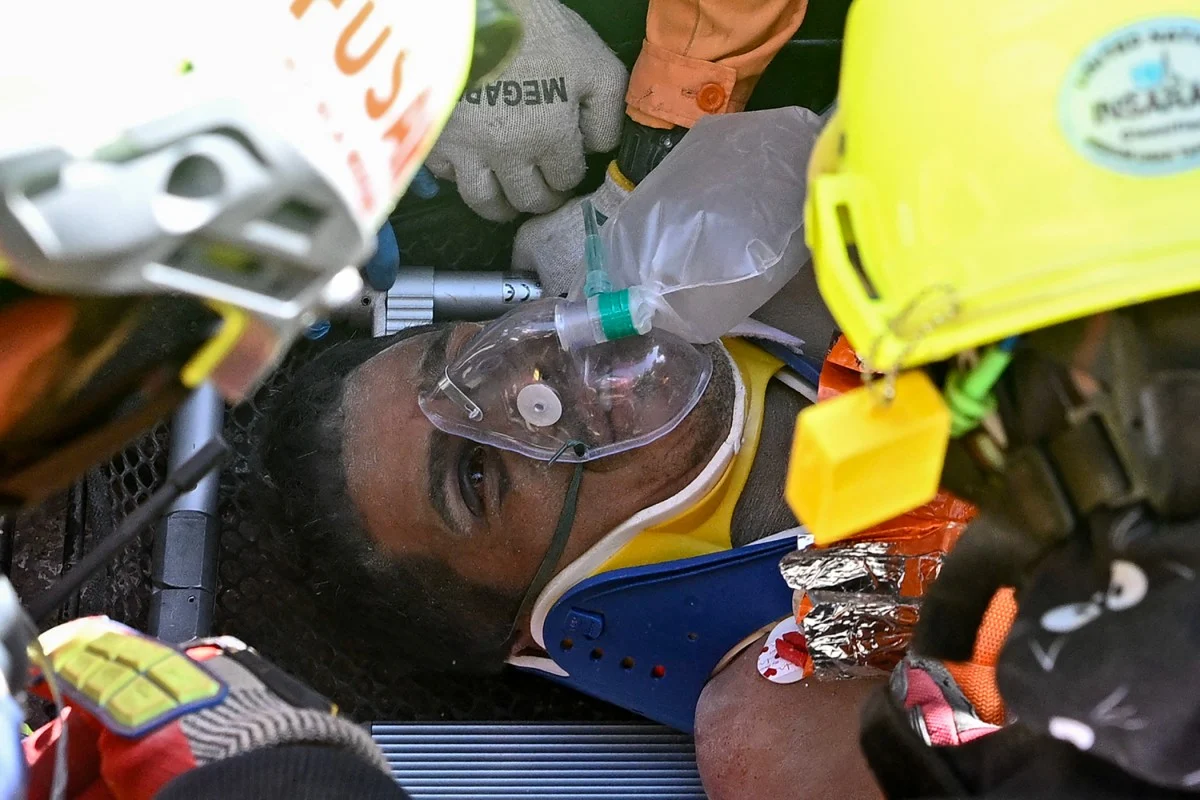
Hundreds of rescue workers in Venezuela celebrated on Thursday after pulling a 43-year-old man alive from the rubble of a collapsed building, eight days after two powerful earthquakes devastated parts of the country.
AFP journalists at the scene reported that rescuers cheered and embraced as Hernan Gil, a security guard, was brought out alive following a painstaking rescue operation.
Gil was trapped beneath the ruins of the seven-storey building where he worked in Catia La Mar, a coastal community that was largely destroyed by the June 24 earthquakes.
His wife, Gusbimar Gonzalez, described his survival as nothing short of a miracle.
“This is truly a miracle,” she told AFP while the rescue operation was underway.
Rescue teams from Venezuela, Chile, the United States, Portugal, Costa Rica, El Salvador and Mexico spent three days working continuously to reach Gil.
During the operation, rescuers supplied him with more than 10 litres of water through a hose to keep him hydrated and installed an oxygen tube to help him breathe.
In the final phase of the rescue, about 30 emergency workers cleared debris from the building’s parking area while two rescuers dug a three-metre tunnel to reach him.
“It wasn’t easy to reach the exact spot where the victim was located,” said Cristian Vera, leader of the Chilean rescue team.
Despite a handful of remarkable rescues, including that of a three-year-old boy found alive six days after the disaster, hopes of locating more survivors continue to diminish.
Emergency efforts are now shifting towards providing humanitarian assistance to thousands of survivors left homeless by the disaster.
Food and clean water are becoming increasingly scarce, while hospitals remain overwhelmed, raising fears of disease outbreaks.
The twin earthquakes, measuring 7.2 and 7.5 in magnitude, destroyed entire neighbourhoods across the oil-rich nation, where years of economic hardship have weakened infrastructure and healthcare services.
According to NASA estimates, nearly 60,000 buildings were either damaged or destroyed.
Venezuela’s National Assembly President, Jorge Rodriguez, said the death toll had risen to 2,295, with more than 11,000 people injured.
He added that nearly 13,000 people had been displaced and were sheltering in tents set up on streets, parks and open spaces.
Thousands of others remain unaccounted for.
In the hardest-hit city of La Guaira, many collapsed buildings have been marked with the letter “D” to indicate that search teams found no survivors inside.
Rescue workers, volunteers and grieving relatives have increasingly shifted their efforts to recovering the bodies of victims.
In Catia La Mar, emergency responders continued digging through the remains of an eight-storey building that collapsed during the disaster.
Crane operator Manuel Alejos said crews were removing debris slab by slab to recover victims’ bodies.
“We break through slab by slab to retrieve the bodies. The families need them so they can say their final goodbyes,” he said, adding that seven bodies had already been recovered from the site.
Mexican firefighter and search-and-rescue dog handler Cesar Gonzalez said hopes of finding more survivors had faded significantly.
“One dog searches for living victims, while the other detects bodies. Two days ago, there was much more hope. Now, it would take a miracle to find anyone alive,” he said.
Meanwhile, the World Food Programme has appealed for $50 million to provide food assistance to about 500,000 people in Venezuela over the next three months.
Police and military personnel have also been deployed to prevent widespread looting, while queues for humanitarian aid continue to grow.
Many survivors now depend on donations from volunteers and fellow citizens.
Among them is 33-year-old Maria Arteaga, a mother of four, who has been forced to sleep in a makeshift shelter on a football field.
“We lost everything except our lives. We don’t even have shoes,” she told AFP.


Happy
0 %

Sad
0 %

Excited
0 %

Sleepy
0 %

Angry
0 %

Surprise
0 %
 0
0
 0
0