
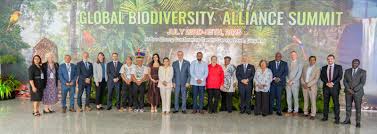
GLOBAL BIODIVERSITY ALLIANCE LAUNCHED IN GUYANA AS WORLD LEADERS UNITE FOR NATURE-POSITIVE FUTURE
Read Time:2 Minute, 32 Second
By Aishat Momoh. O.
The inaugural Global Biodiversity Alliance (GBA) Summit concluded today in Georgetown with the historic launch of the Alliance, the adoption of the Georgetown Declaration, and the unveiling of a global roadmap aimed at halting biodiversity loss and accelerating nature-positive action.
Hosted under the patronage of President Dr. Mohamed Irfaan Ali, the three-day Summit brought together representatives from over 140 countries and organizations, including governments, Indigenous leaders, scientists, financial institutions, NGOs, youth, and the private sector. The gathering marked a new era of multilateral cooperation on biodiversity, positioning the Alliance as a key platform for driving shared implementation, sustainable financing, and collaborative knowledge exchange.
The Georgetown Declaration, endorsed by a wide coalition of stakeholders, recognizes biodiversity as a global public good and commits signatories to integrate nature into national development policies, climate strategies, and financial systems. President Ali’s leadership was widely commended, with COP30 President Ambassador André Corrêa do Lago noting the Alliance’s alignment with global climate goals and its potential to serve as a delivery mechanism ahead of the COP30 Summit in Belém, Brazil.
A major highlight of the event was the signing of a Memorandum of Understanding between the Government of Guyana and the Yale Center for Biodiversity and Global Change, aimed at co-developing the National Biodiversity Information System (NBIS). This digital platform will underpin Guyana’s new biodiversity monitoring strategy and is set to become the world’s first fully standardized, national-scale biodiversity tracking framework.
Throughout the Summit, discussions emphasized the urgent need to integrate biodiversity into global economic planning and climate responses. President Ali described the event as a transformative model of multilateralism built on equity, science, and collaboration. He affirmed that biodiversity can no longer be an afterthought but must become a foundational pillar of climate stability and sustainable development.
Participants explored a wide range of themes, from scaling biodiversity finance tools such as green bonds and debt-for-nature swaps, to embedding local and Indigenous knowledge systems into conservation strategies. Technological innovation also featured prominently, with leading institutions including Yale University and the Indian Space Research Organisation (ISRO) showcasing real-time biodiversity tracking tools.
The Summit’s third day offered delegates field visits to Guyana’s rich ecosystems, including the Mahaica River and the Iwokrama Forest Reserve, highlighting the country’s biodiversity leadership and the vital role of Indigenous stewardship in conservation.
In a strong show of unity, the Summit concluded with a communiqué outlining next steps, including the operationalisation of the NBIS, the implementation of the GBA’s Action Plan, and the presentation of a unified Alliance position at COP30. President Ali, confirmed as the Alliance’s inaugural Chair, urged stakeholders to move from dialogue to action, stating, “Let this Summit be remembered not just as a gathering of ideas, but as the beginning of implementation.”
The 2025 Global Biodiversity Alliance Summit has laid the groundwork for an ambitious, inclusive, and science-driven movement to safeguard the planet’s natural heritage and ensure biodiversity remains central to humanity’s collective future.


Happy
0 %

Sad
0 %

Excited
0 %

Sleepy
0 %

Angry
0 %

Surprise
0 %
 0
0
 0
0