

UPDATED: NIGERIA’S INFLATION RATE EASES 5TH CONSECUTIVE MONTH TO 20.12% IN AUGUST
Read Time:3 Minute, 45 Second
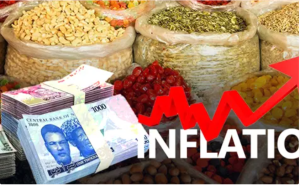
Nigeria’s inflation rate decreased by 1.76 percentage points to 20.12 percent in August 2025, down from 21.88 percent in July 2025.
This marks the fourth consecutive month of reduction since April 2025, when it was recorded at 23.71 percent.
READ MORE:
ZITA WINS HoH FOR THE SECOND TIME, PICKS KOLA AS HOUSE GUEST
The National Bureau of Statistics (NBS) announced this information today in its Consumer Price Index (CPI) Report for August 2025.
Month-on-month inflation stood at 0.74 per cent, lower than 1.99 per cent in July, pointing to slower price increases across the country.
The report read, “The Consumer Price Index rose to 126.8 in August 2025, reflecting a 0.9-point increase from the preceding month (125.9).
“In August 2025, the Headline inflation rate eased to 20.12 per cent relative to the July 2025 headline inflation rate of 21.88 per cent.
“Looking at the movement, the August 2025 Headline inflation rate showed a decrease of 1.76 per cent compared to the July 2025 Headline inflation rate.”
The statistics office observed that inflationary pressures persist in an inconsistent manner. Urban inflation decreased to 19.75 percent year-on-year in August, down from 34.58 percent a year prior, whereas rural inflation was marginally higher at 20.28 percent compared to 29.95 percent in August 2024.
On a monthly scale, inflation in urban regions slowed to 0.49 percent from 1.86 percent in July, while rural inflation registered at 1.38 percent, reduced from 2.30 percent.
The data emphasize the more pronounced effect of inflation in rural areas, where challenges related to transportation, distribution, and supply chains continue to result in greater price increases compared to urban centers.
Food inflation, which remains the predominant factor in Nigeria’s inflation framework, also experienced a moderation in August but remained at elevated levels.
This moderation was attributed to declining prices of essential goods including rice, guinea corn flour, maize flour, millet, semolina, and soya milk.
The twelve-month average for food inflation was recorded at 25.75 percent, lower than the 36.99 percent noted a year prior.
Despite this improvement, food prices remain elevated, particularly in the northern states where insecurity and logistical challenges have consistently hindered supply chains.
Core inflation, which excludes volatile agricultural commodities and energy, was reported at 20.33 percent year-on-year in August, a decrease from 27.58 percent in August 2024.
However, the index increased on a monthly basis to 1.43 percent from 0.97 percent in July, reflecting pressures from categories such as housing, water, electricity, gas, transportation, education, and healthcare.
This trend suggests that while headline inflation is moderating, non-food inflationary pressures persist, raising concerns for policymakers and monetary authorities who closely monitor core inflation as an indicator of structural pressures.
Inflation trends across the states exhibited variability. Ekiti recorded the highest year-on-year headline inflation at 28.17 percent, followed by Kano at 27.27 percent and Oyo at 26.58 percent, whereas Zamfara at 11.82 percent, Anambra at 14.16 percent, and Enugu at 14.20 percent recorded the lowest rates.
Food inflation was highest in Borno at 36.67 percent, Kano at 30.44 percent, and Akwa Ibom at 29.85 percent, while Zamfara at 3.30 percent, Yobe at 3.60 percent, and Sokoto at 6.34 percent recorded the lowest figures.
The index declined to 21.87 percent year-on-year from 37.52 percent in August 2024. On a month-on-month basis, food inflation slowed to 1.65 percent, in contrast to 3.12 percent in July.
On a monthly basis, inflation rose most rapidly in Yobe at 9.20 percent, Katsina at 8.59 percent, and Sokoto at 6.57 percent, while Enugu at –5.32 percent, Taraba at –3.64 percent, and Nasarawa at –3.56 percent experienced declines.
The announcement regarding the slowdown in inflation comes just days before the Central Bank of Nigeria’s Monetary Policy Committee meeting scheduled for September 22 and 23, 2025.
The committee is anticipated to deliberate on whether to sustain or modify the current benchmark interest rate of 27.5 percent.
Although five consecutive months of disinflation may provide the bank with some policy leeway, the ongoing presence of food and core inflation indicates that the Monetary Policy Committee may continue to exercise restraint in its decisions.


Happy
0 %

Sad
0 %

Excited
0 %

Sleepy
0 %

Angry
0 %

Surprise
0 %
 0
0
 0
0