
AUSTRALIA MARKS ONE WEEK OF MOURNING FOR BONDI BEACH SHOOTING VICTIMS
Read Time:3 Minute, 10 Second
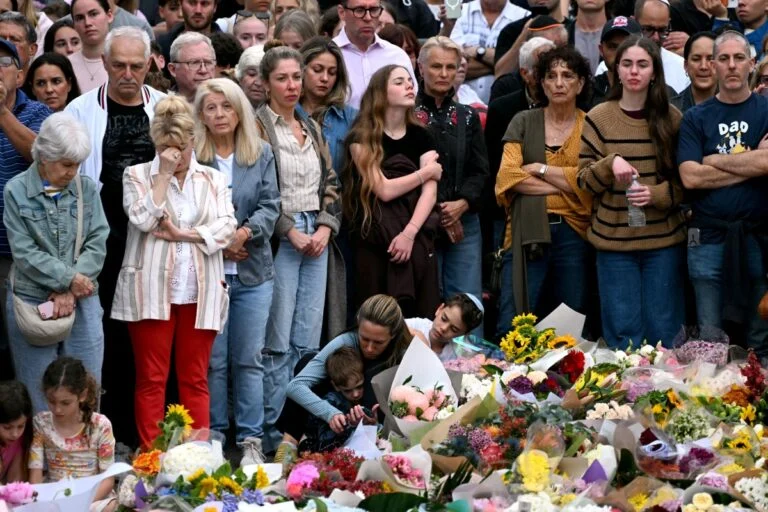
Australians on Sunday observed a nationwide candlelight vigil and minute’s silence to honour the victims of the Bondi Beach shooting, one week after gunmen opened fire on crowds attending a Jewish Hanukkah celebration.
At exactly 6:47 pm local time, the moment the first reports of gunfire emerged a week earlier, the country fell silent. From bustling city centres to quiet rural towns, homes and public spaces were illuminated with candles in a symbolic gesture of “light over darkness.”
The attack, described by authorities as an antisemitic act of terrorism, claimed 15 lives, including children and Holocaust survivors. A father and son, Sajid Akram, 50, and his 24-year-old son Naveed, are accused of carrying out the assault on one of Australia’s most iconic beaches in what has become the deadliest mass shooting in the country in nearly three decades.
At Bondi Beach, mourners gathered at makeshift memorials as flags flew at half-mast across the nation, including atop the Sydney Harbour Bridge. A seaplane circled the coastline trailing a message of love and solidarity for Australia’s Jewish community.
“We’re here together,” said Roslyn Fishall, a member of Sydney’s Jewish community. “Turn to strangers and hug them. Let’s make peace together.”
Many attendees struggled to comprehend the scale of the tragedy. “It’s still really difficult to understand what’s been happening,” said Leona Pemberton at the Bondi memorial. “I guess the tears, they have to flow at some point.”
The shooting shattered a long-held belief among Australians that mass gun violence was largely a phenomenon of the past. The first sounds of gunfire were initially dismissed by some as festive fireworks, underscoring how unthinkable such an attack seemed.
Grief has engulfed the nation in the days since. Parents Michael and Valentyna buried their 10-year-old daughter, Matilda, the youngest victim of the attack. Ukrainian migrants, they had named her after “Waltzing Matilda,” Australia’s iconic folk song. Families and friends have since moved from one funeral to another, many collapsing in anguish.
“The loss is unspeakable,” said Rabbi Levi Wolff.
Authorities say the suspects were inspired by the Islamic State group. The attack has heightened tensions in Australia’s multicultural society, with reports of pig heads dumped on Muslim graves and right-wing groups organising new anti-immigration rallies. Jewish leaders have also accused the government of failing to adequately address a rise in antisemitism.
“Do we feel safe? The honest answer is not really,” said Rabbi Yossi Friedman at a floral memorial for the victims.
Questions are mounting over security failures. Naveed Akram, an unemployed bricklayer, had been flagged by Australia’s intelligence agency in 2019 but was later assessed as posing no immediate threat. The government has announced a review of police and intelligence services, alongside the creation of a counter-terrorism task force investigating the pair’s recent travel to the southern Philippines.
Prime Minister Anthony Albanese has unveiled a suite of national measures targeting gun ownership and hate speech, including a sweeping firearms buyback scheme. It is the largest since 1996, when Australia enacted strict gun reforms following the Port Arthur massacre that killed 35 people.
Amid the tragedy, stories of courage have emerged. Unarmed beachgoers confronted the attackers, shielded strangers, and rushed through gunfire to aid the wounded. Holocaust survivor Alex Kleytman, 87, the oldest victim, was killed while shielding his wife. Shopkeeper Ahmed al Ahmed, a Syrian-born father of two, was praised for disarming one of the attackers after dodging between parked cars.
Sajid Akram, an Indian national who arrived in Australia in 1998, was shot dead by police at the scene. His son Naveed, an Australian citizen, remains in hospital under police guard and faces multiple charges, including terrorism and 15 counts of murder.


Happy
0 %

Sad
0 %

Excited
0 %

Sleepy
0 %

Angry
0 %

Surprise
0 %
 0
0
 0
0