
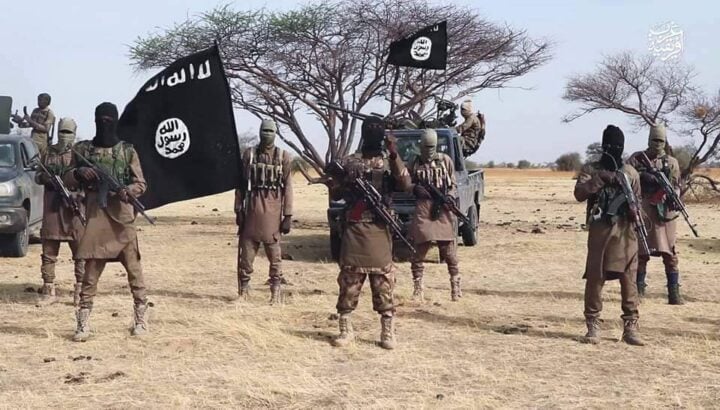
STUDY CONFIRMS ISWAP PRESENCE IN SOKOTO AMID US AIR STRIKES
Read Time:2 Minute, 32 Second
A recent study has confirmed the presence of the Islamic State West Africa Province (ISWAP), an affiliate of the Islamic State group in Nigeria, in Sokoto State, raising fresh questions over the geographic scope of recent United States air strikes targeting jihadist groups in the country.
The confirmation follows a series of US air strikes launched early Friday in Sokoto, a north-western state, despite ISWAP’s traditional strongholds being in the North-East and the Lake Chad Basin.
The study revealed that a militant group locally referred to as “Lakurawa” a Hausa term used to describe armed fighters from neighbouring Sahel countries has been infiltrating communities along the Sokoto–Niger border since late 2017.
According to the research, Lakurawa gained prominence after carrying out several violent attacks on communities in the region late last year. While the group has often been portrayed as a distinct terrorist cell, the study found that its original members were initially affiliated with Jama’a Nusrat ul-Islam wa al-Muslimin (JNIM), al-Qaeda’s Sahel affiliate, between 2017 and 2018.
However, the research noted that the group has since aligned with the Islamic State’s Sahel Province (ISSP).
The study, titled “Kachallas and Kinship: Understanding Jihadi Expansion and Diffusion in Nigeria,” was authored by James Barnett and Umar Musa and published by the Combating Terrorism Centre (CTC). It examined how Nigerian and Sahelian jihadist groups have expanded or relocated across different parts of the country over the past five years.
According to the findings, ISSP militants currently operate in Sokoto and parts of northern Kebbi State under the cover of the Lakurawa identity.
The study also highlighted that Nigeria’s most destructive bandit groups largely originate from and operate in Muslim-majority areas in north-western states, including Zamfara, Sokoto, Katsina, as well as parts of Kaduna, Niger and Kebbi.
“Consequently, Muslim civilians constitute a sizable portion, if not the clear majority, of both the perpetrators and victims of banditry in the northwest,” the study stated.
It further noted that JNIM may be employing similar disguise tactics in Kebbi and Niger states, posing as Lakurawa to mask its operations.
Quoting United Nations experts, the study revealed evidence of ISSP activity in Sokoto and Kebbi, as well as the existence of an ISWAP logistics hub in Sokoto. The hub is reportedly used to coordinate activities between the two Islamic State affiliates, ISSP and ISWAP.
The report added that Lakurawa militants in Sokoto deliberately maintain operational secrecy by withholding their true affiliations from local communities, exploiting the confusion surrounding their identity to their advantage.
Meanwhile, the US Africa Command (AFRICOM) confirmed in a post on X that the recent air strikes were carried out at the request of Nigerian authorities.
This was corroborated by the spokesperson of Nigeria’s Ministry of Foreign Affairs, Mr. Kimiebi Ebienfa, who confirmed the request and disclosed that additional strikes could follow.
Ebienfa said further military action may be necessary as the terrorist groups continue to pose a significant threat to Nigeria’s national security.


Happy
0 %

Sad
0 %

Excited
0 %

Sleepy
0 %

Angry
0 %

Surprise
0 %
 0
0
 0
0