
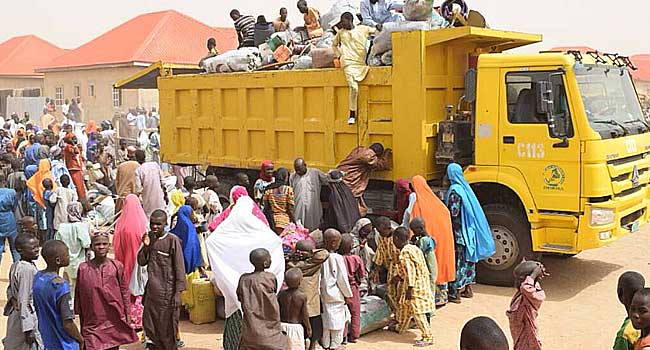
WORLD BANK TIES $12m IDP LOAN TO STRICT DATA, GOVERNANCE BENCHMARKS FOR NIGERIAN STATES
Read Time:3 Minute, 25 Second
By Aishat Momoh. O.

The World Bank has earmarked up to $12 million in performance-based financing for Nigerian states hosting internally displaced persons (IDPs), under a new federal initiative designed to close critical data gaps and strengthen displacement governance.
The funding is part of the Solutions for the Internally Displaced and Host Communities Project, approved by the World Bank on August 7, 2025, and financed through a $300 million concessional credit from the International Development Association (IDA). Access to the funds, however, is conditional on states meeting strict, independently verified performance benchmarks.
According to project documents, disbursement under Performance-Based Condition Two is tied specifically to the registration, profiling, and integration of IDPs living within host communities. Payments will be released only after verifiable results are achieved, with states required to meet escalating targets over a three-year period.
In the first year after the project becomes effective, participating Tier 1 and Tier 2 states must launch IDP registration and profiling in selected host communities and complete comprehensive demographic and vulnerability assessments in at least two wards. States that meet this requirement will receive $250,000 each.
By the second year, Tier 1 states face deeper obligations, including conducting intention surveys and stability index assessments in areas targeted for local integration. They must also produce detailed analyses of displacement drivers, socioeconomic impacts, migration pressures, and risks related to trafficking and smuggling. Successful completion qualifies each Tier 1 state for an additional $500,000.
The largest payout comes in the third year, when 80 per cent of IDPs in host communities across all participating states must be registered and profiled. States that meet this benchmark will receive another $500,000, bringing the total allocation under this performance condition to $12 million.
By the fourth year, the agreement expects displacement-related data gaps to be fully addressed, although no additional payments are attached at that stage.
Beyond IDP data, the financing agreement outlines two other performance-based conditions. Performance-Based Condition One, with up to $9 million allocated, focuses on improving asset management at the local government level. Participating Tier 1 states must issue asset inventory and operations-and-maintenance guidelines aligned with international standards, while selected local governments must produce and secure approval for asset inventories and maintenance plans.
Performance-Based Condition Three targets the long-term integration of IDPs into development processes. Under this condition, Tier 1 states must support IDPs’ access to civil documentation, including birth and marriage certificates, educational records, residence identification, and driving licences. States must also legalise land and property ownership for IDPs, establish mechanisms to manage tensions with host communities, and open at least three development programmes to displaced populations. A total of $12 million is allocated to this condition across multiple milestones.
READ MORE…
NIGERIANS SPEND N1.54TN ON BEER AND OTHER DRINKS IN NINE MONTHS
Eligibility is limited to states with significant displacement burdens. Tier 1 states must host more than 150,000 IDPs, representing over two per cent of their population, while Tier 2 states qualify with at least 100,000 IDPs or an IDP share above one per cent. States must also sign subsidiary agreements with the Federal Government and adopt approved security management plans.
The agreement allows the World Bank to withhold, reallocate, or cancel funds if states fail to meet milestones within specified timelines. All claims must be supported by eligible expenditures and verified by independent agents acceptable to the Bank.
Repayment of the loan is structured as long-term concessional financing. Principal repayments will begin on January 15, 2031, and continue semi-annually until July 15, 2050, with each instalment representing 2.5 per cent of the principal.
The broader $300 million credit supports infrastructure, livelihoods, institutional strengthening, and project management across northern Nigeria, reflecting the World Bank’s growing emphasis on accountability and measurable outcomes in displacement policy.
The World Bank Group remains Nigeria’s largest single creditor, accounting for $19.39 billion, or 41.3 per cent, of the country’s external debt, underscoring its central role in financing Nigeria’s development programmes.


Happy
0 %

Sad
0 %

Excited
0 %

Sleepy
0 %

Angry
0 %

Surprise
0 %
 0
0
 0
0