

TINUBU’S LEADERSHIP REDEFINES THE PROMISE OF DEMOCRATIC DIVIDENDS — WIKE
Read Time:4 Minute, 53 Second
By: Balogun Ibrahim
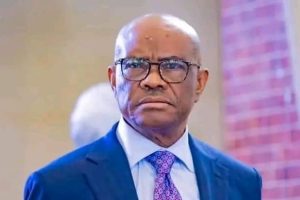
The Minister of the Federal Capital Territory, Nyesom Wike, on Tuesday stated that the leadership of President Bola Tinubu has established a new benchmark in the delivery of democratic dividends.
Wike made the assertion while delivering a Distinguished Personality Lecture titled “The Impact of Political Leadership on Infrastructural Development in Nigeria: Between Dividends of Democracy and Good Governance” at the Faculty of Social Sciences, University of Abuja.
According to him, the Tinubu administration has shown uncommon determination in addressing long-standing structural challenges confronting the nation.
He noted that President Tinubu has emerged as a leader distinguished by the core values of purposeful and servant-oriented leadership, deserving of national recognition.
Wike said President Tinubu’s credentials were firmly established long before his emergence as president, citing his long-standing involvement in the democratic struggle, often at great personal risk.
He noted that Tinubu demonstrated rare political will from his first day in office by removing the fuel subsidy—a policy widely recognised as harmful to the economy but repeatedly avoided by past administrations due to a lack of political courage.
While admitting that the decision faced public resistance, Nyesom Wike maintained that the policy would yield positive long-term benefits for the nation’s economy.
Wike acknowledged that although the reform had brought short-term hardship and resistance, it had also unlocked resources for subnational development, curbed the growth of unsustainable debt, and begun the challenging task of restoring market discipline in the energy sector.
READ MORE…
2027: OYO LP EXPRESSES CONFIDENCE OF VICTORY, PLAYS DOWN FACTIONAL CRISIS
He added that infrastructure development under the current administration was already producing visible outcomes, noting that even critics of President Bola Tinubu would admit that the country was experiencing tangible improvements in infrastructure.
According to him, the Renewed Hope Agenda goes beyond mere rhetoric, reflecting a deliberate reordering of national priorities in favour of sustainable development. He said that through decisive investments and political courage, the administration was confronting deep-rooted structural challenges that previous governments had avoided, stressing that infrastructure remains the foundation upon which meaningful development is built.
Wike explained that his lecture focused on the nexus between political leadership and infrastructure delivery, arguing that democracy should be viewed beyond elections and political slogans.
“Nigeria is at a defining moment where democracy must be seen not as a ritual but as a responsibility, not as a slogan but as a living system that delivers real value to the people,” Nyesom Wike said.
Wike said Nigeria’s democratic practice must evolve into a system anchored on transparency, accountability, and active citizen engagement, stressing that democracy should extend beyond periodic elections.
According to him, the form of democracy the country requires must be reflected in daily governance through openness, responsibility, and meaningful participation by citizens.
He cautioned that the consolidation of democracy demands sustained commitment and vigilance, noting that it cannot thrive automatically without sacrifice and conscious effort.
Describing democracy as a living process rather than a fixed structure, Nyesom Wike emphasised that it must ultimately deliver tangible benefits to ordinary Nigerians in their everyday lives.
Wike said that for ordinary Nigerians—including traders, civil servants, artisans, and students—democracy should not be viewed as an abstract concept.
He stressed that democracy must be reflected in tangible improvements in daily life, such as functional roads, quality schools, effective healthcare facilities, reliable water supply, improved security, and cities that uphold human dignity.
Wike warned that public trust in governance is largely shaped by performance, noting that the delivery of infrastructure strengthens democratic legitimacy, while failure undermines confidence and breeds public cynicism.
He described political leadership as the crucial link between democratic ideals and tangible development, stressing that effective leadership translates principles into real-world outcomes.
According to him, genuine political leadership requires making difficult but necessary choices—prioritising systems over personalities, service above self-interest, accountability over convenience, and the national interest over narrow gains.
Emphasising infrastructure as a key measure of good governance, Nyesom Wike said infrastructure goes beyond roads and bridges, describing it as the backbone of nationhood with social, economic, and moral dimensions.
He further cited developments in the Federal Capital Territory, pointing to the ongoing transformation of Abuja as evidence of this governance philosophy in practice.
Wike highlighted the symbolic significance of the nation’s capital, describing Abuja as more than just a city, but a powerful national statement that reflects Nigeria’s identity and aspirations.
He stressed that good governance remains the ethical bedrock of sustainable development, noting that meaningful progress cannot be achieved without strong moral foundations in leadership.
Acknowledging that reforms often involve difficult and unpopular decisions, Nyesom Wike said leadership is not about satisfying everyone, but about doing what is right, lawful, and necessary for collective advancement.
According to him, infrastructure delivery in the Federal Capital Territory is treated as a fundamental right of citizens rather than a privilege, and as a matter of policy rather than political propaganda.
In his concluding remarks, Wike urged leaders at all levels to ensure that democracy translates into tangible benefits for the people, warning that Nigeria’s future cannot rest on rhetoric alone but on leadership that views democracy as an ongoing responsibility.
He added that while political power is temporary, enduring legacy is built through lasting impact.
President Bola Tinubu assumed office in May 2023 after winning the presidential election, succeeding former President Muhammadu Buhari.
Tinubu’s administration commenced with sweeping economic reforms, including the removal of the long-standing petrol subsidy and the unification of foreign exchange rates—measures aimed at easing fiscal pressures and correcting structural imbalances in the economy.
Although the reforms have attracted criticism due to rising living costs, the government maintains that they are necessary to stabilise public finances and unlock resources for long-term national development.


Happy
0 %

Sad
0 %

Excited
0 %

Sleepy
0 %

Angry
0 %

Surprise
0 %
 0
0
 0
0