
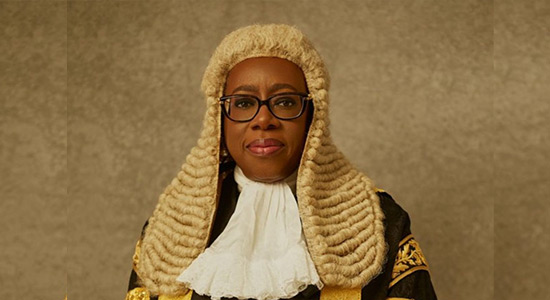
CJN, AGF STRESS JUDICIARY AND MEDIA ROLES AHEAD OF 2027 ELECTIONS
Read Time:3 Minute, 9 Second

By: Balogun Ibrahim
The Chief Justice of Nigeria, Kudirat Kekere-Ekun, and the Attorney General of the Federation, Lateef Fagbemi, on Thursday emphasized the essential role of the judiciary and the media in strengthening Nigeria’s democracy, especially as the country moves toward the 2027 general elections.
They made the remarks at the 2026 National Conference of the National Association of Judiciary Correspondents in Abuja.
Represented by the Administrator of the National Judicial Institute, Babatunde Adejumo, the CJN said judiciary correspondents are vital in helping the public understand court proceedings and in building trust in the justice system.
She stated that “accurate, responsible, and contextual reporting is indispensable to sustaining public confidence in the administration of justice.”
Kekere-Ekun noted that the judiciary’s constitutional role can only fully serve democracy when its decisions are clearly communicated and understood by the public.
“Even the most carefully reasoned judgment achieves its full democratic purpose only when it is clearly understood by the society it serves,” she said.
She cautioned that sensationalism or misrepresentation in judicial reporting could weaken trust in the rule of law, urging journalists to maintain balance and accuracy.
“As Nigeria approaches the 2027 general elections, the responsibilities of both the Judiciary and the media will assume even greater significance,” she added.
She further warned that “misrepresentation or sensational commentary can inflame tensions and undermine confidence,” while stressing that fair reporting promotes public understanding.
READ MORE…
WIKE, NUT HOLD TALKS AS TEACHERS’ STRIKE CONTINUES PENDING REVIEW
Declaring the conference open, she reaffirmed the judiciary’s commitment to independence, transparency, and fairness.
In his remarks, Chairman of the association, Kayode Lawal, said the conference serves as a bridge between the judiciary and the media to strengthen democratic institutions.
He said the theme, “The Role of Judiciary in Deepening Democracy in Nigeria,” was chosen in view of developments ahead of the 2027 elections.
Lawal, however, expressed concern over conflicting court orders in politically sensitive cases, saying such incidents could weaken public confidence in the justice system.
He cited a recent dispute involving jurisdiction between the Federal High Court in Abuja and the High Court of Oyo State over matters relating to the 2025 Peoples Democratic Party (PDP) convention.
According to him, while one court restrained the convention, another allowed it to proceed, describing the situation as potentially destabilizing.
He warned that such contradictions could “cause chaos and set the political stage ablaze.”
Lawal also lamented what he described as growing judicial and political impunity, urging courts to take firmer action against the manipulation of legal processes.
He called for reforms to strengthen judicial independence, including improved funding structures, and urged the Nigerian Bar Association to discipline erring lawyers.
Expressing appreciation to stakeholders, he announced that the conference marked his final outing as chairman after nearly six years in office.
He thanked members for their support and asked for forgiveness for any shortcomings during his tenure.
Also speaking, the Attorney General of the Federation, represented by his Special Assistant on Legislative Drafting, Hussein Oloyede, described the judiciary as “the last hope of the common man.”
He said the courts play a crucial role not only in resolving disputes but also in protecting democratic governance by ensuring adherence to constitutional provisions.
Oloyede noted that judicial review helps prevent abuse of power by both government and citizens.
He added that election adjudication remains one of the judiciary’s most visible functions, shaping electoral processes and strengthening democratic credibility.
He cited landmark cases such as Buhari v. Obasanjo, Atiku v. Yar’Adua, and Oyetola v. Adeleke as examples of judicial influence on Nigeria’s electoral history.
Beyond elections, he stressed that the judiciary remains central to the protection of fundamental rights, including fair hearing, personal liberty, and freedom of expression.


Happy
0 %

Sad
0 %

Excited
0 %

Sleepy
0 %

Angry
0 %

Surprise
0 %
 0
0
 0
0