
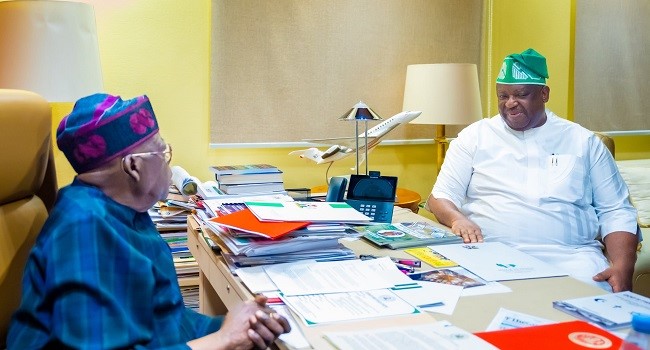
TINUBU HOLDS CLOSED-DOOR MEETING WITH PLATEAU STAKEHOLDERS OVER SECURITY SITUATION
Read Time:1 Minute, 40 Second
By Aishat Momoh. O.

President Bola Tinubu on Tuesday held a closed-door meeting with stakeholders from Plateau State led by Governor Caleb Mutfwang at the Presidential Villa, Abuja.
The delegation arrived at the Villa at about 1:00 p.m. for the meeting, which was scheduled to begin at 2:00 p.m., and discussions reportedly lasted several hours. However, details of the meeting were not made public.
The talks are believed to be a follow-up to the President’s recent visit to Plateau State in the aftermath of the deadly Palm Sunday attack in Angwan Rukuba, Jos, which left dozens of people dead and several others injured.
The April 29 meeting comes about four weeks after the March 29 attack in Jos, where gunmen opened fire at a busy junction, killing at least 28 people, including university students and staff, and injuring 22 others. The incident triggered widespread fear and heightened security concerns across the state.
Following the violence, authorities ordered the temporary closure and evacuation of the University of Jos, while additional security operatives were deployed to restore calm in affected areas.
President Tinubu had visited Plateau State on April 2, where he met with government officials, traditional rulers, and families of victims, assuring residents of federal intervention to restore peace.
During that visit, Governor Mutfwang requested time for stakeholders to fully brief the President on the security situation, a request Tinubu approved.
As part of wider security measures, the President also announced plans to deploy about 5,000 surveillance cameras nationwide to enhance intelligence gathering and support security operations, with the Minister of Communications, Bosun Tijani, tasked to oversee implementation.
Despite government assurances, Plateau State has continued to experience sporadic violence across several local government areas including Riyom, Barkin Ladi, Bokkos, and Kanam, with fresh attacks in recent weeks leading to additional casualties.
Security agencies have recorded some operational successes, including the neutralisation of suspected attackers and recovery of weapons, while investigations into the recurring violence are ongoing.


Happy
0 %

Sad
0 %

Excited
0 %

Sleepy
0 %

Angry
0 %

Surprise
0 %
 0
0
 0
0