
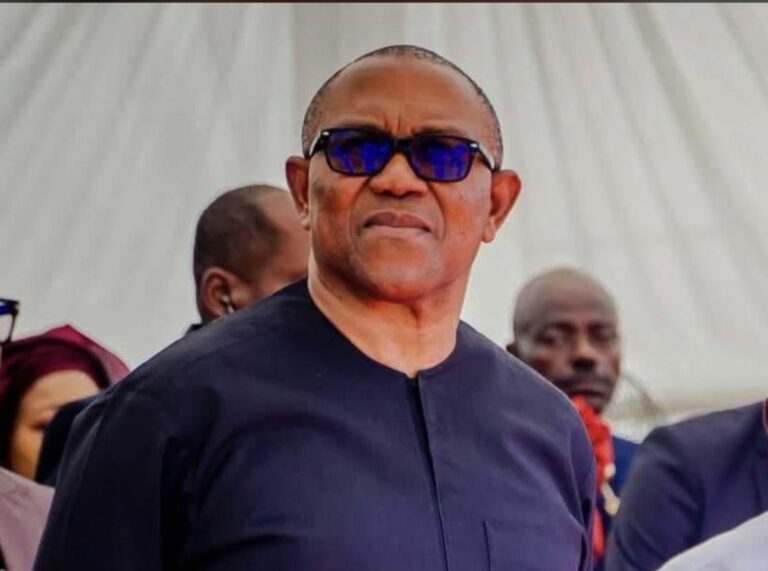
PETER OBI SAYS DECLINING FDI HAMPERS NIGERIA’S ECONOMIC GROWTH
Read Time:2 Minute, 42 Second
BY OWABI OLUWADARA
Former Labour Party presidential aspirant, Peter Obi, has criticized the current administration’s inadequate leadership and ineffective governance for Nigeria’s diminishing Foreign Direct Investment.
On his X page referenced by the media on Friday, Obi asserted that enduring economic advancement and progress cannot be realized through ineffective governance, attributing the reduction in FDIs to subpar leadership.
“Allow me to emphasize: enduring economic advancement and progress cannot be realized through inadequate leadership and ineffective governance—issues that are evidently reflected in the decreasing FDI and our substandard performance on critical governance metrics.
READ MORE:
RUSSIA, UKRAINE EXCHANGE 84 PRISONERS EACH AHEAD OF PUTIN-TRUMP SUMMIT
“While the President, Ministers, and other government officials continue their international pursuits in quest of FDI, our substandard performance on essential governance indicators—such as rule of law, regulatory quality, government effectiveness, and civil liberties—continues to demonstrate that attracting sustainable foreign investment is impossible without effective leadership and governance,” he stated.
He pointed out that according to a recent report by the National Bureau of Statistics, FDI to Nigeria sharply declined by about 70 per cent in the first quarter of 2025, falling to only $126.29m from $421.8m in the last quarter of 2024.
The NBS statistics also stated that of the total capital importation of about $5.64 billion in the first quarter of 2025, FDI accounted for only about 2.24 per cent, compared to 8.2 per cent in Q4 2024.
Alarmingly, nearly 90 percent of the incoming capital was allocated to speculative monetary market instruments. With such a substantial share of capital inflow directed toward speculative investments, the effect on industrial advancement or employment generation is markedly minimal and difficult to discern, considering the convenience with which such “hot money” can withdraw from the economy.
“To further illustrate our precarious situation, capital flows to the manufacturing sector declined exponentially by 32.1 per cent, dropping to only $129.92m in Q1 2025 from $191.92m in the same quarter of 2023. There is no better confirmation of the lack of trust in this government, whose reforms remain uncoordinated and largely reactive.
“Most disappointingly, our dear nation, Nigeria—the so-called “Giant of Africa”—received only $1.08bn, about 1 per cent of Africa’s total FDI, representing a decline of about 42 per cent from 2023. Worse still, after this 42 per cent drop between 2023 and 2024, FDI to Nigeria has further declined by 75 per cent between Q4 2024 and Q1 2025. We cannot achieve sustainable growth and development with ineffective leadership and a weak government,” he lamented.
In 2024, while global FDI flows declined, FDI to Africa significantly increased to $97bn—a rise of about 75 per cent compared to 2023. Europe, the United States, and China were the main sources of this FDI.
Egypt attracted the highest share in Africa, with $46.58 bn. Other top recipients included Ethiopia ($3.98 billion), Côte d’Ivoire ($3.80 billion), Mozambique ($3.55 billion), Uganda ($3.30 billion), Democratic Republic of Congo ($3.11 billion), South Africa ($2.47 billion), Namibia ($2.06 billion), Senegal ($2.02 billion), Guinea ($1.83 billion), and Morocco ($1.64 billion).


Happy
0 %

Sad
0 %

Excited
0 %

Sleepy
0 %

Angry
0 %

Surprise
0 %
 0
0
 0
0