
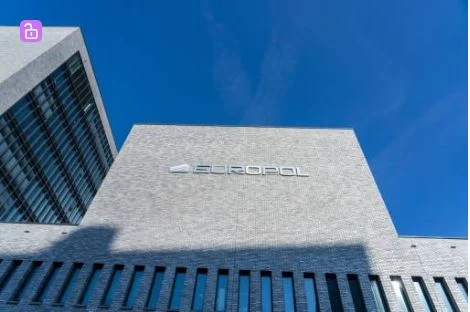
EUROPEAN POLICE BUST MAJOR SYNTHETIC DRUG RING IN LARGEST-EVER OPERATION
Read Time:1 Minute, 51 Second
Agency Report

European law enforcement agencies have dismantled a major cross-border synthetic drug network in what authorities described as the largest operation of its kind, dealing a significant blow to organised crime across the continent.
The year-long operation, coordinated by Europol, led to the shutdown of 24 industrial-scale drug laboratories, the seizure of about 1,000 tonnes of chemicals used to produce synthetic drugs, and the arrest of more than 85 suspects, including two alleged ringleaders from Poland.
Speaking to AFP, Andy Kraag, head of Europol’s European Serious Organised Crime Centre, said the crackdown marked an unprecedented achievement in the fight against synthetic drug production and distribution.
“I’ve been in this business for a while. This is by far the largest-ever operation we did against synthetic drug production and distribution,” Kraag said, describing it as “a massive blow to organised crime groups involved in drug trafficking.”
The coordinated action involved police forces from Belgium, the Czech Republic, Germany, the Netherlands, Poland and Spain. Investigations began in 2024 after Polish authorities detected a suspicious network importing large volumes of legal chemicals from China and India.
Further probes revealed that the chemicals were being repackaged, mislabelled and redistributed across the European Union to clandestine laboratories producing drugs such as MDMA, amphetamine and methamphetamine.
While most of those arrested were Polish nationals, investigators said suspects from Belgium and the Netherlands were also believed to be part of the criminal network.
Kraag explained that the operation focused on a “supply-chain strategy” aimed at cutting off access to the chemicals essential for synthetic drug production. “These criminal groups don’t have their supply anymore,” he said.
Beyond the health risks posed by synthetic drugs, Europol highlighted the broader consequences, including violence, corruption, money laundering, and severe environmental damage. Authorities seized more than 120,000 litres of toxic chemical waste, which criminal groups often dump illegally on land or into waterways.
“Today, it’s profit for criminals. Tomorrow, it’s pollution,” Kraag warned.
Europol said investigations are continuing, noting that while a major distributor has been dismantled, other networks remain under scrutiny. “This is one of the biggest distributors. But it’s not the only one,” Kraag added.


Happy
0 %

Sad
0 %

Excited
0 %

Sleepy
0 %

Angry
0 %

Surprise
0 %
 0
0
 0
0