
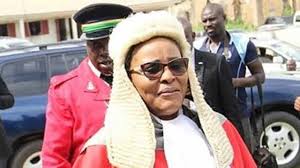
JUSTICE MOSUNMOLA STRESSES NEED FOR SYNERGY AND TECH INNOVATION TO CURB SEXUAL VIOLENCE IN OGUN STATE.
Read Time:2 Minute, 42 Second
By: Fasasi Hammad
The Chief Judge of Ogun State, Mosunmola Dipeolu, has urged closer collaboration among key stakeholders — including the police, legal practitioners, judges, government agencies and non-governmental organisations — to strengthen the response to sexual violence across the country.
She also recommended greater use of technology in handling such cases, particularly video link facilities that would allow vulnerable witnesses, such as children and traumatised survivors, to testify from separate rooms instead of facing defendants in open court, thereby minimising further trauma.
Dipeolu emphasised that the judiciary holds a central and indispensable role in combating sexual violence and must ensure that courts serve as safe havens for survivors while offenders face penalties strong enough to deter future crimes.
Represented by Justice Funke Odubanjo, the Chief Judge made these remarks on Saturday in Abeokuta at a stakeholders’ forum themed “Strengthening Laws, Policies, and Institutional Coordination to Improve Justice Delivery in Sexual Violence Cases,” organised by the Headfort Foundation for Justice.
Speaking on “The Weight of the Gavel, The Call for Justice: A Judicial Perspective on Dismantling Barriers and Forging a Survivor-Centred Response to Sexual Violence,” she stressed that the judiciary must prioritise the rights and dignity of survivors.
According to her, judges are not only interpreters of the law but also shape societal attitudes toward sexual offences through courtroom conduct, evidentiary rulings, sentencing decisions and trial management. She warned that judicial actions can either reinforce harmful stereotypes and re-traumatise survivors or affirm their rights and dignity.
Citing Section 34 of the 1999 Constitution, which guarantees the right to dignity of the human person, Dipeolu described the provision as the constitutional foundation for judicial efforts in sexual violence cases. Every survivor who approaches the court, she noted, seeks validation, protection and restoration of dignity.
She further highlighted the Ogun State Violence Against Persons (Prohibition) Law, 2017, as a strong legal instrument that broadens the definition of sexual offences, provides safeguards for survivors and prescribes stiff penalties for perpetrators.
However, she identified prolonged trials, evidentiary challenges, the adversarial nature of the legal system and weak institutional coordination as major obstacles to justice. To address these gaps, she advocated clearer sentencing guidelines, technological innovations for vulnerable witnesses and improved cooperation among justice sector actors.
Dipeolu maintained that tackling sexual violence requires collective action. She called on the executive to adequately fund justice institutions and social services, the legislature to continually strengthen laws, the police to conduct professional and empathetic investigations, civil society to support survivors and demand accountability, and the media to report responsibly without sensationalism.
She commended the Headfort Foundation for Justice for reaching more than 500,000 women with information on accessing justice and encouraged other organisations to help bridge the gap between the law and the public.
In her remarks, the foundation’s Executive Director, Oluyemi Orija, said the gathering was aimed at improving access to justice and promoting a survivor-centred approach in sexual violence cases. She noted that stakeholders were reviewing existing laws in Ogun State to identify areas requiring reform to ensure faster and more effective justice delivery.
Orija added that while justice sector actors in Ogun State and across Nigeria are willing and capable, sustained government funding and support remain critical to achieving meaningful progress.


Happy
0 %

Sad
0 %

Excited
0 %

Sleepy
0 %

Angry
0 %

Surprise
0 %
 0
0
 0
0