
SENATE EXPLAINS DELAY IN BAN ON DUAL PARTY MEMBERSHIP
Read Time:2 Minute, 55 Second
By: Balogun Ibrahim
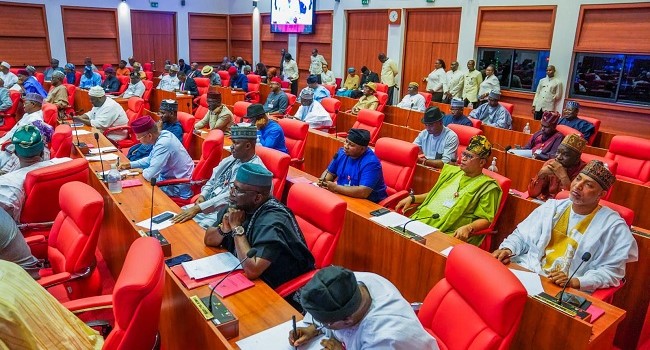
The Senate has explained why it declined to take a position on the proposed amendment to the Electoral Act seeking to criminalise dual party membership, stating that it cannot deliberate on the matter until it is formally transmitted from the House of Representatives.
Chairman of the Senate Committee on Media and Publicity, Yemi Adaramodu, made the clarification in an interview with The Media on Friday.
He said that under Nigeria’s bicameral legislative system, the Senate cannot comment on a bill until it is officially received from the House and has undergone the required legislative processes.
“In a nutshell, even after the President’s assent, there could still be an amendment, whether private, executive or coming from the public through a legislator. So, this law cannot be enacted wholly until it passes through the other chamber. As of now, it has not come to us. So we can’t comment further on it,” he said.
Adaramodu’s statement underscores the constitutional requirement that any amendment to an existing law must be approved by both chambers of the National Assembly before being sent to the President for assent.
The Senate’s cautious approach comes two weeks after the House of Representatives passed an amendment to the Electoral Act 2026, which seeks to prohibit individuals from holding membership in more than one political party at the same time.
READ MORE…
Under the proposed law, offenders could face a fine of N10 million, a maximum prison term of two years, or both, representing a significant departure from the current administrative approach to enforcement.
The amendment proposes the introduction of three new subsections to Section 77 of the Electoral Act, which regulates political party membership.
It stipulates that any individual found to be registered with more than one political party simultaneously will have all such memberships declared invalid.
The amendment provides that a person shall not be registered as a member of more than one political party at the same time.
It further states that where it is established that an individual belongs to multiple political parties, such dual membership shall be rendered void, and the person shall cease to be recognised as a valid member of any party until proper regularisation is carried out in line with the Act and the party’s constitution.
It also prescribes that any person who knowingly registers or maintains membership in more than one political party commits an offence and, on conviction, is liable to a fine of ₦10 million, a prison term of up to two years, or both.
If signed into law, the amendment is expected to strengthen the legal framework governing party affiliation and introduce stricter penalties for violations.
The proposal comes amid growing concerns over allegations that some politicians maintain ties with multiple political parties—a practice critics say undermines internal party discipline and weakens the integrity of Nigeria’s electoral system.
Although existing laws already stipulate that individuals should belong to only one political party at a time, enforcement has largely remained administrative, with limited legal consequences.
Supporters of the amendment argue that the absence of clear criminal penalties has created loopholes that are often exploited, particularly during party primaries and candidate nomination processes.
The issue has gained renewed attention in recent years amid frequent political defections and disputes over party membership registers, further strengthening calls for stricter legal provisions to protect the integrity of the electoral process.


Happy
0 %

Sad
0 %

Excited
0 %

Sleepy
0 %

Angry
0 %

Surprise
0 %
 0
0
 0
0