
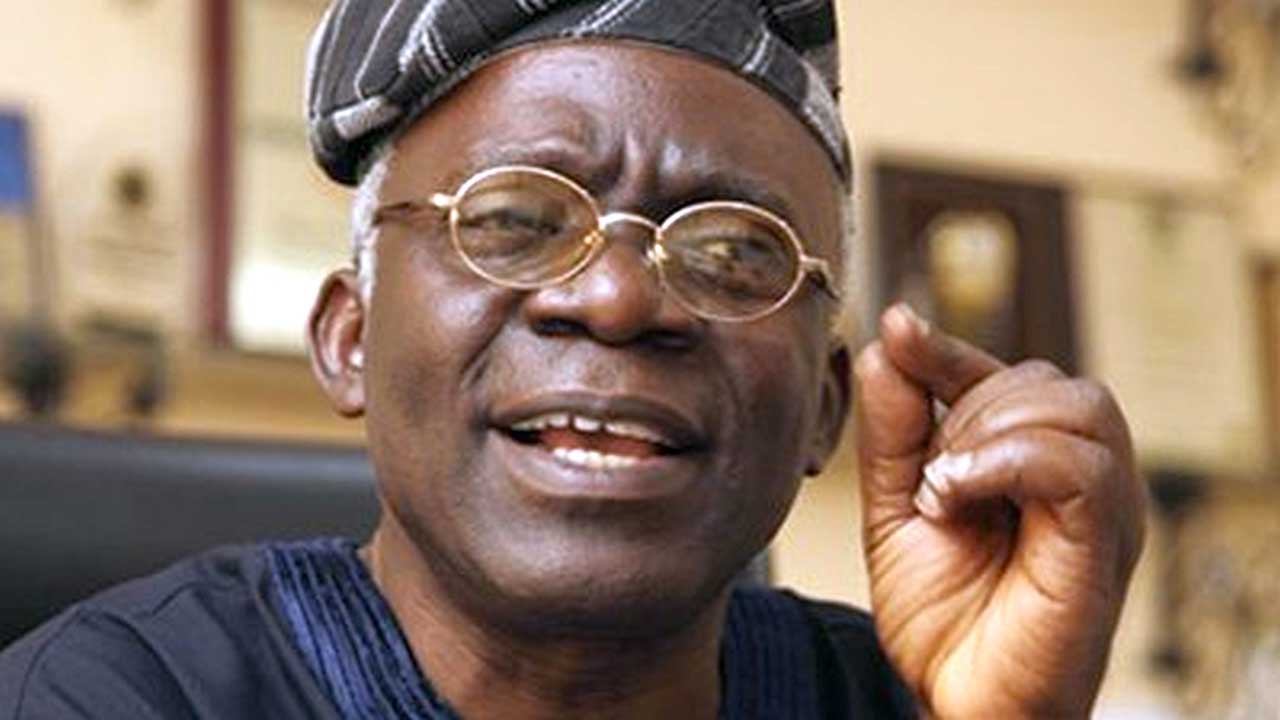
2027: NIGERIA MAY SEE ONLY ONE PRESIDENTIAL CANDIDATE — FALANA, GANI ADAMS
Read Time:5 Minute, 22 Second
By: Balogun Ibrahim
Human rights lawyer Femi Falana and the Aare Ona Kakanfo of Yorubaland, Gani Adams, on Thursday warned that Nigeria could face a scenario with only one presidential candidate in the 2027 election if the judiciary continues to interfere in political party affairs.
The warning came during the fifth Comrade Yinka Odumakin Memorial Lecture held at the Airport Hotel, Ikeja, Lagos. The event drew prominent figures, including Nigeria Labour Congress President Joe Ajaero, activist and Sahara Reporters publisher Omoyele Sowore, and Senior Advocate of Nigeria Olumide Fusika.
Hosted by the President of the Oluyinka Odumakin Foundation, Joe Odumakin, the lecture was also attended by International Press Centre Executive Director Lanre Arogundade and activists such as Agba Jalingo and Richard Akinola.
In his lecture, Falana highlighted that court orders and conflicting judicial rulings are increasingly being used to destabilize political parties, cautioning that such interference could result in only one party fielding a presidential candidate in 2027.
Falana’s remarks followed Wednesday’s announcement by the Independent National Electoral Commission (INEC) that it would no longer recognize factions of the African Democratic Congress (ADC) led by David Mark.
INEC’s decision was based on a Court of Appeal ruling directing the commission to maintain the status quo while a suit challenging the legality of Mark’s leadership of the party is being determined.
Falana condemned the judiciary for interfering in the internal affairs of political parties, noting that such intervention violates provisions of the Electoral Act.
“Through the manipulation of Nigerian courts and senior lawyers, the country could end up with only one candidate contesting the presidential election. If that happens, Nigeria might not even need to spend money on the election,” Femi Falana said.
He cautioned that actions undermining democracy could spark unrest if Nigerians feel deprived of a genuine electoral choice.
Falana called on civil society groups, labour unions, and political activists to mobilize and defend democratic principles, warning that uncoordinated protests could descend into anarchy. “We must stop agonising and start organising in the interest of our people and democracy,” he added.
Echoing similar concerns, Gani Adams warned that Nigeria is gradually moving toward a one-party system, accusing those in power of using the judiciary to suppress opposition parties and undermine the will of the people.
“We are drifting toward a one-party system, with those in power using the judiciary to suppress the will of the people. If caution is not exercised, Nigeria could end up with only one presidential candidate,” Gani Adams warned.
He urged Nigerians not to remain silent simply because their ethnic group currently holds power, noting that political leadership rotates and silence in the face of injustice could later be used against those who fail to speak out.
Adams emphasized that the best way to honour the late Comrade Yinka Odumakin is for activists and civil society groups to stay committed to justice, democracy, and good governance.
During a lecture titled “Can Nigeria’s Democracy Work without Restructuring?”, Femi Falana argued that restructuring has already been occurring in the country, but primarily benefiting the political class, particularly state governors and members of the ruling elite.
He noted that Nigeria functioned more like a true federal system during the First Republic, when regions controlled the police, courts, and local governments. However, the 1999 Constitution shifted the country back to a more centralised system, expanding items under the Exclusive Legislative List.
“In 1963, there were about 45 items on the Exclusive Legislative List, but today that number has grown to around 68. Practically everything is controlled by Abuja, making our system more unitary than federal,” Femi Falana said.
He explained that certain powers had been reclaimed from the Federal Government through court rulings by states, particularly in areas such as local government administration, Value Added Tax, and land control.
Falana noted, however, that despite calls for restructuring, many state governments have failed to utilise the powers already granted to them, especially in sectors like electricity generation, railways, and prisons.
“Some of those who shout about restructuring don’t truly believe in it. Electricity, railways, and prisons were removed from the Exclusive List, yet how many states have generated electricity, built rail lines, or established prisons? None,” he added.
Speaking on the debate over state police, Femi Falana cautioned that such a system could be exploited by governors to suppress political opponents, pointing to similar abuses during the First Republic.
He noted that the Police Council—which comprises the President, the Inspector-General of Police, the Chairman of the Police Service Commission, and state governors—was intended to oversee the Federal Police collectively but rarely meets, effectively placing policing under the control of the President.
Falana also accused the political elite of monopolizing the country’s resources, particularly oil blocks and solid minerals, claiming that a small group of individuals had amassed significant wealth through government allocations. He added that illegal mining and mineral smuggling were fueling insecurity, as unemployed youths were being drawn into such activities.
Senior Advocate of Nigeria Olumide Fusika warned that the nation was approaching a critical point due to widespread insecurity and called for unity to address the challenges.
Activist Richard Akinola criticised what he described as an “incestuous relationship” between the executive and judiciary. “Politicians have hijacked the judiciary, and it is dangerous,” he said.
Speaking at the event, Nigeria Labour Congress President Joe Ajaero argued that the country had been hijacked by a small group of individuals benefiting from the current centralised system.
He voiced support for restructuring, devolution of powers, and state police, but cautioned that any revolutionary change must be carefully organised to avoid descending into anarchy.
Activist and Sahara Reporters publisher Omoyele Sowore added that the administration of President Bola Tinubu was pushing Nigerians toward a revolution.
“These are revolutionary times if we seize the opportunity. I predicted that when President Bola Tinubu assumed office, he would lead Nigeria toward a revolution. It is now up to the Nigerian people to take charge of this moment and the opportunity his administration has created,” Sowore said.
He continued, “Tinubu is on a highway driving the country toward revolution, and many have yet to grasp the message. But it will happen, because Nigeria cannot avoid a revolution. His most important duty as President is to propel the country in a revolutionary direction, leaving him, his colleagues, ministers, and allies strangers to the system they believe they control.”


Happy
0 %

Sad
0 %

Excited
0 %

Sleepy
0 %

Angry
0 %

Surprise
0 %
 0
0
 0
0