

CENTRE URGES ENHANCED BORDER SECURITY, COLLABORATION TO CURB ARMS PROLIFERATION
Read Time:4 Minute, 32 Second
By: Muftau Fatimo
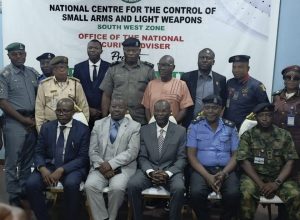
The Southwest Zonal Director of the National Centre for the Control of Small Arms and Light Weapons, CP Abiodun Alamutu, has identified Nigeria’s porous borders as a key obstacle in efforts to prevent small arms from falling into the wrong hands.
He noted, however, that the government is addressing the issue, with plans to deploy advanced technology across the country’s extensive borders to curb the illegal influx of contraband, especially small and light weapons.
The former Ogun State Commissioner of Police also revealed that an estimated five million firearms are currently in circulation nationwide.
Alamutu emphasised that tackling the illegal spread of firearms will require coordinated efforts among security agencies, community leaders, the judiciary, and other critical stakeholders.
The former police boss stated this in Abeokuta on Thursday at a one day seminar and interactive session themed “Effective Post-Judgement Management of Small Arms And Light Weapons” organised by the NCCSALW.
Alamutu stated that it has been discovered that the major enabler of insecurity, banditry, terrorism in the country is the proliferation of small arms and light weapons with a large chunk of these arms in the hands of non-state actors.
He explained that “Some claim the estimate is up to five million, but we cannot say categorically this is the number. But from records available, it falls within or quite above five million.
“And that explains why we want to now shift our focus to mopping up of those illicit arms that are already in circulation. The bulk of the successes we have recorded has been at the border points, those that are about to come into our society. And we have made tremendous successes in that.
“But now, we want to divert our attention into mopping up those that are already in circulation. That is why we require the active collaboration of stakeholders, of traditional rulers, NGOs, community leaders to talk into the minds of these criminals so that those that will voluntarily bring out these arms will do just that.
“And I think the possibility of granting amnesty to them is also there, but this is still a suggestion that we can push up to the headquarters for consideration”.
Alamutu, while speaking on essential collaboration to win the war against proliferation of arms in the country said that the NCCSALW is already talking with the police leadership to fashion out audit and return of small of seized and forfeited firearms to the centre and this could be an exercise that is done every quarter or every six months.
He added that the government has equally demonstrated strong political will to tackle the challenge of arms proliferation, however, the problem of border porosity must be confronted frontally to curb illegal importation of arms into the country
Alamutu said that “The government has demonstrated strong political will, but the challenge, which I must admit remains the porosity of our borders. And I’m sure the government at the center, is working towards finding a lasting solution by way of technology so that those porous borders will be effectively manned via the use of technology”.
Speaking at the event, the state Commissioner of Police, Bode Ojajuni lauded the centre for coming up with the seminar and interactive session to address the challenge of proliferation of arms in the country.
Ojajuni has however demanded for a more coordinated approach towards the mopping up of seized and forfeited firearms by the centre from the security agencies, particularly, the police.
He added that “aside recovery of illicit arms here and there, there also many of these arms that have been recovered and which after judgement are kept with security agencies, especially the police.
“I feel that the center should devise another avenue to mop up these weapons immediately after the judgement has been delivered from all of these units, consistently so that they don’t wait for the security agencies like the police to bring it forward to the center.
“So that there will be a kind of coordinated approach to handling of these weapons in terms of mopping up from the different units. We are all aware that anything at times can happen to these weapons when there is too much of delay”
Ojajuni said that the police has taken up the challenge to help the centre fulfill its mandate, while urging other security agencies to also consider the possibility of setting up a unit that can help mop up arms after a judgement had been given on such arms and hand over such firearms to the centre without any delay.
Delivering his key note address, Dr Kunle Olawunmi, Associate Professor of International Relations, Intelligence and Strategic Studies Chrisland University, Abeokuta called for a stronger procedure and mechanism to ensure that forfeited firearms after judgement are lawfully confiscated and not allow a re-entry of such into the society.
Dr Olawunmi said that once adjudicated weapons are securely tracked from court order to lawful final disposition, the state closes one important route through which insecurity reproduces itself.
He explained that “the responsibility of the criminal justice system does not end with the delivery of a court judgment.
“In Nigeria, the post-judgment stage is a crucial security phase, as weapons that are inadequately documented, poorly secured, insufficiently tracked, or improperly disposed of can find their way back into criminal circulation, undermine evidence integrity, and erode public confidence in the rule of law.”


Happy
0 %

Sad
0 %

Excited
0 %

Sleepy
0 %

Angry
0 %

Surprise
0 %
 0
0
 0
0