
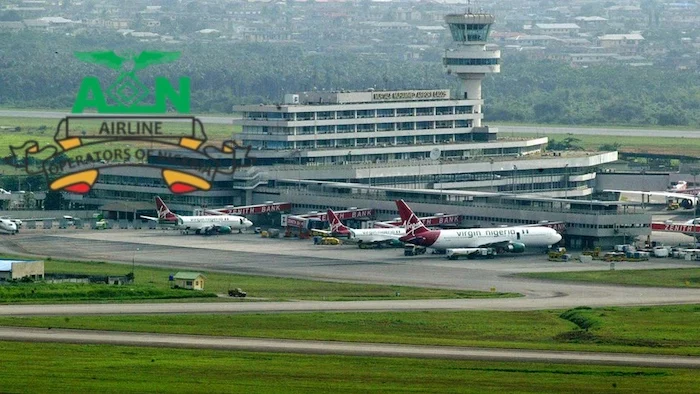
NIGERIAN AIRLINES BORROW OVER N60BN TO FUND AVIATION FUEL AS COSTS SOAR
Read Time:4 Minute, 24 Second
By: Muftau Fatimo
Nigerian airlines have borrowed more than N60bn from local banks to finance aviation fuel purchases amid the persistent rise in the cost of Jet A1, the Airline Operators of Nigeria (AON) has disclosed.
A member of the AON Board of Trustees, Roland Iyayi, disclosed this in an interview with the media, saying rising fuel prices had forced airlines to rely heavily on bank loans to sustain their operations.
Iyayi said some airlines now owe more than N60bn to local financial institutions solely to procure aviation fuel, describing the situation as a reflection of the severe financial pressure confronting operators.
He blamed the growing debt burden on the failure of the Federal Government to implement measures recommended by industry stakeholders to address the high cost of aviation fuel.
According to Iyayi, the AON had threatened to suspend flight operations in February following a sharp increase in Jet A1 prices, prompting the Minister of Aviation and Aerospace Development, Festus Keyamo, to intervene.
He said Keyamo, who was in Riyadh at the time, appealed to the operators to suspend the planned shutdown and allow him to return to Nigeria to address their concerns.
Iyayi said subsequent meetings involving the AON, the Nigerian Midstream and Downstream Petroleum Regulatory Authority (NMDPRA) and fuel marketers led to the establishment of a committee to examine immediate measures to reduce aviation fuel costs.
However, he said the committee’s recommendations had yet to result in any concrete government action.
According to him, Nigerian airlines continue to pay significantly higher prices for aviation fuel compared with operators in other parts of the world.
“There hasn’t been any intervention by the government to address the issue of why it is that fuel price in Nigeria is 270 per cent of the original value, whereas other parts of the world are recording 60 to 80 per cent. So Nigeria is a peculiar case,” he said.
Iyayi also disclosed that the fuel crisis had affected airlines’ ability to meet statutory obligations, including the remittance of the five per cent ticket sales charge to the Nigeria Civil Aviation Authority.
He explained that airlines were diverting a significant portion of their ticket revenue towards fuel purchases, leaving little room to meet other financial obligations.
He said operators were also unable to increase ticket fares sufficiently to absorb the surge in fuel prices, forcing many airlines to continue operating despite making losses.
“The airlines are there, having to fly even though the operations are not profitable. They’re more indebted now than they ever were,” Iyayi said.
He added that the AON had sought government intervention on historical debts owed by airlines, particularly liabilities attributed to carriers that were no longer operational.
According to him, the association’s request for a 100 per cent write-off of historical debts was intended to clean up the books of aviation agencies and provide active airlines with a fresh financial start.
Iyayi said the request had, however, been misunderstood as a demand for a 30 per cent reduction in the current debts of operating airlines.
He maintained that little progress had been made since the February fuel price increase.
Meanwhile, the Public Relations Officer of United Nigeria Airlines, Chibuike Uloka, said Jet A1 remained one of the biggest cost burdens for operators, accounting for about 50 per cent of airline revenue.
Uloka said the slight reductions in fuel prices recorded so far had made little difference, noting that Jet A1 prices remained close to their highest levels in recent years.
“If 50 per cent accounts for your fuel, you’re probably running at a loss. So you’re using the other 50 per cent for service, servicing your equipment, paying salaries and taxes,” he said.
He also raised concerns over the multiple taxes imposed on airlines, saying the combined burden of fuel costs and taxes was putting further pressure on operators.
Uloka stressed that airlines relied on financing facilities and partnerships to sustain operations because of the capital-intensive nature of the industry.
He said the combination of high Jet A1 prices, taxes and other operational expenses had pushed airlines’ operating costs to unsustainable levels.
The development comes amid a sharp increase in aviation fuel prices following the escalation of the Middle East crisis, which prompted Nigerian airlines to threaten a suspension of flight operations.
The AON had warned that the surge in Jet A1 prices was making domestic flight operations increasingly unsustainable.
The warning prompted Keyamo to meet with airline operators, fuel marketers and other stakeholders in April 2026 following the association’s decision to suspend its planned shutdown to allow for further dialogue.
The Federal Government subsequently announced a 30 per cent relief on airlines’ debts owed to aviation agencies and directed negotiations among fuel marketers, airlines and regulators on an appropriate Jet A1 price.
However, industry operators maintain that the intervention has not sufficiently eased the financial pressure confronting airlines.
The global fuel-price shock linked to the Iran conflict has further worsened the situation, with aviation fuel accounting for a substantial portion of airlines’ operating expenses.
In April 2026, the AON warned that domestic carriers could suspend operations after the price of Jet A1 reportedly surged from about N900 per litre on February 28 to N3,300 per litre.


Happy
0 %

Sad
0 %

Excited
0 %

Sleepy
0 %

Angry
0 %

Surprise
0 %
 0
0
 0
0