
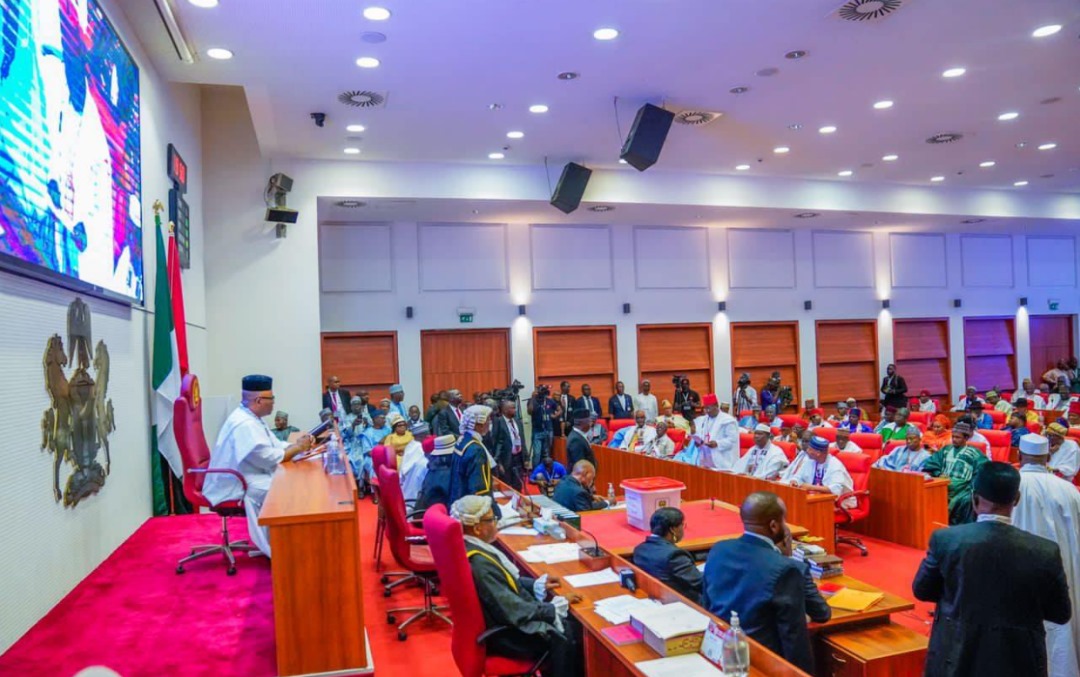
SENATE MOVES TO FAST-TRACK ESTABLISHMENT OF STATE POLICE IN CONSTITUTIONAL REVIEW
Read Time:1 Minute, 45 Second
By Aishat Momoh. O.

The Senate has scheduled the consideration of constitutional amendments to establish state police in Nigeria this week, in what lawmakers describe as a decisive step toward addressing the country’s worsening security challenges.
Senate Leader, Senator Opeyemi Bamidele, disclosed this in a statement issued on Monday by his Directorate of Media and Public Affairs, noting that the proposed legislation would be treated as a priority item during the legislative week.
According to him, the bill on state police has been separated from the broader constitutional amendment process due to its urgency and widespread national support.
“Our position is very clear on state police. We are standing with Nigerians on the issue of state police,” Bamidele said, adding that “all strata of the federation” had expressed support for its establishment.
He stated that once passed by the National Assembly, the bill would be transmitted to the 36 State Houses of Assembly for concurrence, as required under constitutional amendment procedures.
“We came to the conclusion that we are going to pass the constitutional amendment in this respect to make a provision for the state police,” he said, expressing confidence that the proposal would be concluded within the week.
Bamidele further revealed that consultations had been held with key stakeholders, including the Office of the Attorney-General of the Federation, the Chief of Staff to the President, Femi Gbajabiamila, the Inspector-General of Police, and other security actors.
He added that the bill had received backing from President Bola Tinubu and state governors, describing the coming week as “crucial” for the legislative process.
Under Nigeria’s constitutional framework, the creation of state police would require approval by at least two-thirds of state assemblies before presidential assent.
The move comes amid sustained national debate over security restructuring, with proponents arguing that decentralised policing would improve response to local threats such as banditry, kidnapping, and communal violence, while critics warn it could be misused by state authorities.
If passed, the amendment would mark one of the most significant overhauls of Nigeria’s security architecture since the 1999 Constitution came into force.


Happy
0 %

Sad
0 %

Excited
0 %

Sleepy
0 %

Angry
0 %

Surprise
0 %
 0
0
 0
0