
UNGA81: ELUMELU URGES GLOBAL INVESTORS TO PRIORITISE AFRICAN TRADE
Read Time:2 Minute, 25 Second
By ‘Balogun Ibrahim
Nigerian businessman and Chairman of Heirs Holdings, Tony Elumelu, has called for a fundamental shift in US-Africa relations, urging global investors and international policy partners to move away from traditional aid dependence towards private-sector-led commercial partnerships.
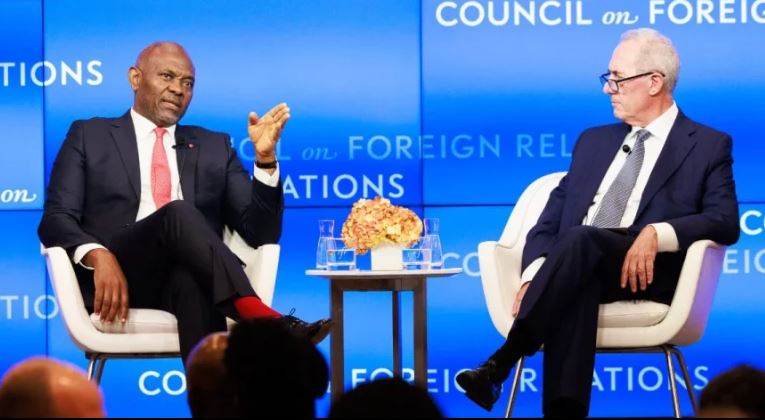
Elumelu made the call during a fireside chat on the sidelines of the 81st United Nations General Assembly in New York, where he argued that Africa’s long-term economic development should be driven largely by trade, entrepreneurship and domestic private investment.
READ MORE…
AIYEDATIWA FLAGS OFF N400M EDUCATION SUPPORT SCHEME FOR 13,360 ONDO STUDENTS
The discussion formed part of the Council on Foreign Relations’ Darryl G. Behrman Lecture on Africa Policy and was moderated by its President, Michael Froman.
Addressing international investors and policymakers, Elumelu challenged the perception of Africa as a single, aid-dependent market exposed to uniform financial risks.
He said treating the continent as one high-risk entity fails to recognise the economic differences and opportunities across its 54 countries.
According to Elumelu, international investors can access significant commercial opportunities by forming strategic co-investment partnerships with credible African business leaders who have a strong understanding of local markets.
Reaffirming his support for Africapitalism, the philosophy that places the private sector at the centre of Africa’s economic and social transformation, Elumelu said foreign aid could provide short-term assistance but could not replace sustained private investment or build the industrial infrastructure required for long-term growth.
He called on international venture capital funds, pension managers and development finance institutions to work directly with African financial institutions to finance major energy projects, trade corridors and critical infrastructure.
Elumelu also linked economic development with national security, describing Africa’s young entrepreneurs as an important pillar of global stability.
He warned that persistent youth unemployment could contribute to irregular migration and social unrest if left unaddressed.
He cited the Tony Elumelu Foundation’s commitment of $100 million to train and fund young African entrepreneurs as an example of how private-sector investment can support job creation across both urban and rural communities.
On climate policy and infrastructure, Elumelu called for a practical approach to Africa’s energy transition, noting that more than 600 million Africans lack access to electricity.
He argued that reliable energy supply was essential for industrial development and digital expansion and urged African countries to use their natural gas resources as a transition fuel while investing in renewable energy infrastructure.
Elumelu also advocated reforms to existing commercial frameworks, including the African Growth and Opportunity Act, to reduce production and transportation costs for African exports.
He said the implementation of the African Continental Free Trade Area should be accompanied by stronger supply-chain integration, increased local manufacturing and the removal of regulatory barriers to intra-African trade.
He concluded by stressing that greater prosperity in Africa would contribute to global economic stability and security.


Happy
0 %

Sad
0 %

Excited
0 %

Sleepy
0 %

Angry
0 %

Surprise
0 %
 0
0
 0
0